Numerian's blog

Ben Bernanke Runs Out of Options

Originally published on The Agonist

The US economy is on the road to recovery, right? That’s what all the economists and financial analysts say. Unemployment has dropped down to 8.3%, unemployment claims are now at a level last seen in 2008 before the economy fell off a cliff, almost all the TBTF banks have just passed the recent Fed stress tests and are now allowed to use their excess capital to pay dividends and buy back their stocks, inflation is tame if you go by official government statistics (especially core inflation that the Fed loves to look at because it removes the effects of food and oil price increases), and finally all major economic indicators are flashing green lights.

So why is Ben Bernanke saying that zero interest rates and his endless stream of quantitative easing programs are still essential? You would think the Fed would grab at any opportunity to pare back its balance sheet and restore interest rates to a more normal level. Several Fed officials have asked that same question. When Ben Bernanke was giving his speech yesterday in defense of his policies, Philadelphia Fed President Charles Plosser was giving an entirely different speech arguing that central banks should not have unlimited authority to expand their balance sheets, because all that does is enable their governments to rack up larger deficits. Another Fed President, Richard Fisher of Dallas, has said QE3 is unnecessary and is simply not going to happen, no matter what Wall Street wants.

Just One Last Bubble, Please!

bubblesThe time-honored advice brokers have always given their investment clients is to "diversify, diversify, diversify!” It’s the basic law of investment – Investment 101 you might say – never put all your eggs in one basket. Which is why it is so odd to see the CEO of one of the largest investment funds in the world –BlackRock – insist that his customers ignore this basic rule and invest everything they have in equities.
CEO Laurence D. Fink says that we are living in a “New World” where it is impossible to earn a decent return on traditional bonds or other conservative investments. He’s right about that; Fed Chairman Ben Bernanke has made it clear he intends to keep interest rates at zero percent through at least the end of 2014. Maybe this New World is a welcome relief for borrowers, many of whom are desperate to reduce their debts, or at least the interest cost on their debts if they can refinance at lower rates.

This is a dreadful world for savers, however. Many people who live off the interest on their savings, like retirees, have watched their income collapse to zero, and are being forced to liquidate their nest egg in order to afford food and medicine, the prices of which (along with energy) have been increasing at annual rates near 10%.

Delightful News Out of Greece This Morning (for bankers)

Traders in New York this morning were greeted with this happy headline from The Wall Street Journal:

US Stock Futures Higher; Buoyed by Greece

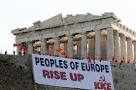
greece austerity protestYes indeed, the Dow Jones index is set to open at least 70 points higher because the Greek parliament approved the additional austerity measures demanded by the European Union, the European Central Bank, and the International Monetary Fund. In exchange for €130 million in a second bailout by the “Troika”, as the three lending institutions are called, Greece will have to cut its minimum wage by 22% and the government will have to lay off an additional 150,000 workers. This is in a country that is in its fifth year of recession, with an official unemployment rate of 21%. Business has virtually collapsed, with many private sector companies on the verge of bankruptcy. The health system is so starved for funds that a bacteria resistant to all medicines is raging through hospitals, forcing the chronically ill to decide whether to even risk seeking professional care. Poverty is reaching extreme levels and is well-entrenched among what used to be the middle class. Children are sent to school so hungry that they are fainting in the classrooms. As of last night, the crowds that were storming through Athens and other large cities no longer were content to throw rocks at the police; Molotov cocktails were used to set at least forty buildings in Athens on fire. The police in Athens, facing crowds estimated from 80,000 to 100,000 people, were forced off Syntagma Square, and appeared to have run out of tear gas. Journalists described the business center of Athens as a war zone. The country is slipping into social disorder, if not anarchy. But stock markets in Europe were up today on the happy news that the Greek parliament approved the additional austerity measures.

Wow! 243,000 New Jobs Created in January

The headline number from the Unemployment Report this morning showed 243,000 jobs were created, more than the highest estimated increase by any of the economists surveyed before the report was released (the average expected increase from the economist survey was 120,000 jobs). The unemployment rate fell to 8.3%, again lower than predicted, and certainly good news for President Obama. Job growth was nearly across the board – in retail, construction, manufacturing, business services, and the hotel and restaurant industry. You can believe all this if you want, or you can go into the details in the report for some interesting context.

First, ever since the credit crisis of 2008, there has been a trend in the unemployment report that shows a declining participation rate in the job market. While a whopping number of jobs were created in January, a far larger number of people left the labor force - 1,752,000 in fact. The percent of the total working population who did not have jobs rose to 36.7%, an all time high. It’s no wonder the unemployment rate fell, when the denominator shrinks so markedly. The total number of people employed fell by 737,000. So what do you want to celebrate – the 243,000 who got jobs, or the million or so people who dropped by the wayside and are no longer counted in the data?

The Invisible Handshake

I was telling someone earlier this week about my good friend Newt Gingrich. You didn’t know he was one of my friends? Neither did I, until I saw his television commercial attacking Mitt Romney for being a vulture capitalist. For at least five years, a lot of us in Leftist Blogoland have been decrying the equity extraction and asset stripping practices of people like Mitt Romney, the former CEO of Bain Capital. We’ve been joined in this crusade by writers with libertarian beliefs, and some of them, like Karl Denninger, are far more direct than we have ever been in calling a crime a crime, and demanding prison terms for the people who helped destroy America’s productive manufacturing base.

Now we have Newt Gingrich challenging Mitt Romney’s claim that he was a venture capitalist, creating jobs while he saved companies from certain bankruptcy. Newt sees it differently; he asks in his ad if it is acceptable for someone to come in to a community, manipulate people’s lives for the worse, and “walk off with the money.” Others have joined in on the Mitt Romney bashing. Ron Paul has said that the business practices of people like Mitt Romney have nothing to do with free market capitalism, and it was Rick Perry who has come up with the phrase “vulture capitalist”.

Peak Money Arrives

The world is running out of money. If money is credit, and credit relies on confidence, there is not enough confidence in the financial system to supply the world with the money it needs. Since the initial credit crisis struck in 2008, credit and money have been withdrawn from the system in such staggering amounts that international trade can no longer grow. The world’s central banks are playing a rear guard action by acting as lender of last resort to banks that no longer trust each other and have stopped lending in the interbank market. As liquidity flows out from the system, the rottenness that has corrupted the foundations of global finance is now exposed for all to see.

This was especially evident in the bankruptcy of MF Global, when the unthinkable happened – innocent bystanders on the Chicago Mercantile Exchange were stuck with over $1.0 billion in losses that should otherwise have been allocated to MF Global’s lenders. For over 100 years the futures exchanges have bragged that no customer on an exchange has lost money due to a broker-dealer’s default. No longer. This is how confidence is lost in the financial system – investors are surprised by large losses from institutions or products thought to be impregnable.

Kim Jong-il - From Despised Despot to Tolerated Visionary

I was nine years old at the time. We were in school one morning when our teacher was called away. This was a very unusual occurrence. We sat quietly waiting, and when teacher returned, she was crying and shaking uncontrollably. All of us were worried and confused – teacher had never acted this way before. In fact we had never seen any emotion from her at all. “What has happened, teacher?”, someone called out. Sobbing, she replied – “Children, Great Teacher has died!”

It was as if you pushed a button in the room. Instantaneously all of us burst into tears, with many of us wailing “What is going to happen to us? Who is going to take care of us? How will we live?” It never occurred to any of us that our parents or some responsible adult would take care of us. From the moment we were aware of the outer world, we understood that all that was good, beautiful and intelligent in the world came from Great Teacher.

When Even the Clearing Houses Start to Malfunction

Financial markets rise and fall based on the perceived value of the products being sold. But there are occasions when market value is affected by the condition of the marketplace itself, and whether the infrastructure that supports the market is structurally sound. This is the situation investors are now facing. There is rottenness apparent in even the largest and most trusted markets, like the US Treasury market, and investors are beginning to question how safe their funds are, or whether the protection being bought is worth anything. Private money is nervous, or it is fleeing the markets altogether. When so many different markets are afflicted by the same creeping structural weakness, it is no surprise that the average investor begins to ask whether Financial Armageddon may be upon us.

There are a number of recent cases where the “system” did not work the way investors expected, especially in the case of the collapse of MF Global, and the less-publicized ruling that banks would not have to pay out the protection they sold investors who bought credit default swaps covering a potential Greek government default. Before we turn to these specific and highly consequential events, we should look at the some of the precedents which reveal a history of rule-changing by banks and regulators that inevitably has worked against the interest of investors.

Rules Can be Changed for the Benefit of the Market Makers

"Take Care That the Laws be Faithfully Executed"

There is a story that appeared yesterday in The New York Times that would have been worth reading if it had been published five years ago. In the article, the reporter, Edward Wyatt, analyzes the propensity of the largest financial institutions to violate securities laws despite having previously violated these same laws and made promises to the Securities and Exchange Commission never to violate them again.

The New York Times has a portentous way of writing such stories, as if the information they have uncovered is revelatory if not earthshattering. Case after case is presented, experts are interviewed and asked to provide analysis, and some weighty conclusions are reached. Readers should be left with at least a slight feeling of outrage that such things have been going on in high finance.

As an ex-subscriber to The New York Times, I too have been outraged by such stories, but not because I read them in the paper of record, which is not simply very late to the game of reporting on this phenomenon - it is too late. I’ve been outraged by these stories because I have been reading about this for years on internet blogs. Some of the most persistent reporters and analysts who write about this problem include Glenn Greenwald at Salon.com, Yves Smith at the Naked Capitalist blog, and Karl Denninger at the Market Ticker blog. All three of these writers have no doubt lost some readers over the years because they write about these stories over and over, and manage to maintain a sustained fury over the debasement of the rule of law that is evidenced by the way the big banks operate, and the inability or refusal of the government to do much about it.

Give the People a Vote on Bank Bailouts? Markets and Politicians Horrified at the Thought

Stock markets around the world reacted with horror this week to the news that Greek Prime Minister George Papandreou has ordered that the terms of a proposed EU rescue package worth €130 billion should be voted on by the Greek people in a national referendum. The Nikkei, the German DAX index, the French CAC-40, and the Dow Jones Industrial index all ended the day down 2% or more. The euro took a pummeling on the foreign exchange markets.

Global leaders involved in the Greek rescue talks expressed shock and disappointment that the Greek government would throw into jeopardy the carefully-constructed rescue plans that required approval from all 17 EU governments. The White House press secretary, speaking on behalf of the President, urged Greece to accept the bailout terms as soon as possible. It was US Treasury Secretary Timothy Geithner who first recommended to the EU leadership that it significantly expand its bailout fund from €440 billion to as much as €2 trillion in order to calm global financial markets.

Now let’s step back a minute and consider how ludicrous this all is. The Greek Prime Minister proposes that the Greek people, who have borne the burden of one austerity package after another each time Greece has approached the EU for help, at long last get to have a say in these discussions. Politicians everywhere express dismay and surprise that any politician, especially one on the receiving end of the bailout talks, would even consider allowing the people to at long last have a vote in these decisions. Financial markets plummet on the news. Since when did democracy become the enemy of good governance in democratic countries?

Pages