Home

The Economic Populist

Speak Your Mind 2 Cents at a Time

Discussion

  • Forums
    • Labor Economics
      • Labor
      • Outsourcing/Insourcing
        • Immigration
        • Professional Labor Issues
    • Macro Economics
      • Fiscal, Monetary Policy
      • Global
      • Tax Policy
      • Trade Policy
      • Wall Street
    • Politics
      • Congress
      • Executive Branch
    • Admin
  • Home
  • Reads
  • Discuss
  • RSS Feed
  • Twitter
  • About
  • Contact
Home Blogs midtowng's blog

New blog posts

  • A Brief History of Securitization
  • Cuomo Takes on The Money Party
  • PIGS and the ouzo effect
  • Sunday Morning Comics - Yeah Yes Men Edition
  • Must Read Posts - Sometimes you just can't say it better for 02.06.10
  • Friday Movie Night - 25 Million Pounds
  • Is Residential Real Estate a Ticking Time Bomb?
  • It's time to live within our means once again
  • U.S. Manufacturing, Hire America & Buy American
  • Sunday Morning Comics - Hayek vs. Keynes Edition
more

User login

  • Create new account
  • Request new password

Navigation

  • User Guide
  • News aggregator

Recent Comments

  • Hi I am from Slovakia - a
    8 hours 15 min ago
  • Oh yes
    11 hours 8 min ago
  • Dylan Ratigan show today
    11 hours 45 min ago
  • SIGTARP is "the tell"
    13 hours 42 min ago
  • Actually,
    13 hours 51 min ago
  • What surprised me about that interview
    13 hours 57 min ago
  • True, but they are only making matters....
    15 hours 30 min ago
  • Part of the problem is the dire straits of states and cities
    16 hours 17 min ago
  • automatic graph scaling
    18 hours 38 min ago
  • Thanks
    19 hours 22 min ago
  • Euro being heavily shorted now
    19 hours 41 min ago
  • blog post idea
    19 hours 53 min ago
  • Great Post
    20 hours 7 sec ago
  • there goes what's left of savings and retirement funds
    21 hours 4 min ago
  • FYI
    21 hours 10 min ago
  • Let's sure hope so
    23 hours 3 min ago
  • Greece default doesn't matter yet then it does ...
    1 day 38 min ago
  • Actually the biggest waste of government money
    1 day 54 min ago
  • We're In Holding Pattern Until 2012..
    1 day 3 hours ago
  • When is the MSM going to point out we are LOSING the best jobs?
    1 day 4 hours ago

Poll

Populist Du Jour

  • Holy Cow Batman! SIGTARP Barofsky says U.S. on the hook for $23.7 Trillion in bail out!

Vox Populi

  • Holy Cow Batman! SIGTARP Barofsky says U.S. on the hook for $23.7 Trillion in bail out!
  • Subprime meltdown over; now comes the bad news
  • The Deflationary Recession of 2009?
  • The Panic of 2008: a turning point
  • Text of Bail Out Act Before Congress - TAKE ACTION NOW!
  • Scientist Who Laid Ground Work for Nobel Prize Drives a Bus, Can't get a Job
  • 2009: Recession vs. Recovery (Update 4)

Active forum topics

  • How important is Greece?
  • Economic Stress hits new record
more

Atlanta Fed's Macroblog

  • Is good news hidden in bad employment numbers?
  • Southeast businesses offer insights on capital spending plans
more

iMFdirect

  • Getting Ready to Join the Eurozone Club
  • More to Do on Financial Sector Tax, Says IMF’s Lipsky
more

CBO

  • Visit to Morehouse College
  • CBO Estimates a Federal Budget Deficit of $434 Billion in the First Four Months of Fiscal Year 2010
more

powells

GAO

  • GAO-10-248, Highway Research: The Second Strategic Highway Research Program Addresses the Four Required Areas, but Some Anticipated Research Was Not Funded, February 5, 2010
  • GAO-10-25, Troubled Asset Relief Program: Treasury Needs to Strengthen Its Decision-Making Process on the Term Asset-Backed Securities Loan Facility, February 5, 2010
more

Instapopulist

  • Economic Stress hits new record
  • The Federal Reserve's Exit Plan is Another Bank Bail Out Pig Fest
  • How important is Greece?
  • China Eastern Jiangsu Provence raises minimum wage, wow $140 a month!
  • Bank Failure Friday - one this week, 200 failures expected this year
  • Dr. Robert Reich on financial reform
  • Banksters ready to side-step new credit card rules
more

Calculated Risk

  • BLS: Few Job Openings in December
  • NFIB: Small Business Owners Report "shortage of customers"
more

Naked Capitalism

  • Links 2/9/10
  • Head of BIS Calls for Bigger Liquidity Buffers
more

Paul Krugman

  • Euro perspective
  • Know Your Deficits
more

dorgan

The Baseline Scenario

  • Elizabeth Warren Calls Out Wall Street
  • Whose Fault?
more

EPI

  • Unemployment drops to 9.7% despite more job losses
  • Unemployment rate drops to 9.7% despite more job losses
more

Eyes on Trade

  • Exciteable Young Men
  • Exciteable Young Men
more

Econbrowser

  • Letting the EGTRRA and JGTRRA Provisions Expire
  • Reactions to last week's economic data
more

TradeReform.org

  • CO-Gov: Dem leading
  • CO-03: Salazar not a sure bet
more

EconomPic

  • The Death of the Workforce
  • Market Recap (2/08/10)
more

Economist's View

  • "Fine Print, Deceptive Pricing, and Buried Tricks"
  • "The Inexact Science of Economics"
more

Economy in Crisis

  • Why Layoffs are Not Beneficial to Companies
  • A Growing Concern
more

The Big Picture

  • 5 Most Expensive Pieces of Art
  • Food Stamps – The Great Recession’s Soup Lines
more

Credit Slips

  • Bankruptcies Maintain Similar Month-to-Month Rate in January
  • Monetary Policy and the Housing Bubble
more

Manufacture This

  • The Early Shift
  • The Future of Manufacturing…Part Five
more

Alan Tonelson

  • More on Obama's Export Delusions
  • Domestic Manufacturers Urge Obama to Back Up Tougher China Talk With Immediate Currency-Manipulation Bill Push
more

black swan

Beat The Press

  • Jingoism and the Budget Deficit: Using Any Tactic to Advance the Budget Cutting Agenda
  • Social Security Benefits Will Be Paid, It is the Law
more

Nouriel Roubini's Global EconoMonitor

  • Roubini Bloomberg Interview on Sovereign Debt and U.S. Outlook
  • RGE's Weekly Roundup
more

Zero Hedge

  • S&P Revises Outlooks on Citigroup, Bank Of America To Negative From Stable
  • First Greece, Now Spain: Moore Capital, Brevan Howard, Paulson As Well As JPM And Goldman Implicated In Spanish CDS Rout
more

The Mess That Greenspan Made

  • On the Fed's exit strategy
  • Tuesday morning links
more

Tax Justice Network

  • OECD: involve civil society and developing countries in peer review process
  • Football premier league seeks elite opt-out
more

Brad Delong

  • links for 2010-02-09
  • Pretending that Nothing Is Wrong When Your Hair on Fire Does Not Send a Good Signal...
more

Steve Keen's Debtwatch

  • Interview on Switzer TV
  • Vote for Ignoble/Dynamite Economics Prize
more

New Deal 2.0

  • Bill Black to BofA Chairman: Racist bank adviser in Germany must go
  • Straws in the Wind: The 5 Supremes
more

Pension Pulse

  • Greece Implements Pension Reforms
  • Drop in Dividends Leaves Pensions Exposed?
more

Angry Bear

  • Limit Banks' Proprietary Trading? Links Worth Noting on Possible Reprise of Glass Steagall Maybe
  • AN IMMODEST PROPOSAL
more

Robert Reich

  • Obomanomics One Year Out
  • 2010 Rancho Mirage Speakers Series
more

Noslaves.com

  • Economy in Crisis Calls Out Bill Gates and Lobbyist H-1B Propaganda
  • Jobs Bill
more

Financial Armageddon

  • The Next Phase of My Evaluation
  • The Next Phase of My Evaluation
more

The Coming Foreclosure Wave

Submitted by midtowng on Sun, 08/16/2009 - 21:20.
  • foreclosures
  • real estate housing bust

Has housing hit a bottom? Fox News declared that the bottom is in, as had many other talking heads.

In fact, the reality of the situation is a "good news, bad news" scenario.

(Bloomberg) -- The wave of “option” adjustable-rate mortgages recasting to higher payments, projected by some economists to represent a looming source of foreclosures that will hurt housing markets over the next few years, will be smaller than “feared” because many borrowers will default before their bills change, Barclays Capital analysts said.

So you see, the coming tsunami of foreclosures will be much small than expected because people are going to go broke beforehand. That's the good news.
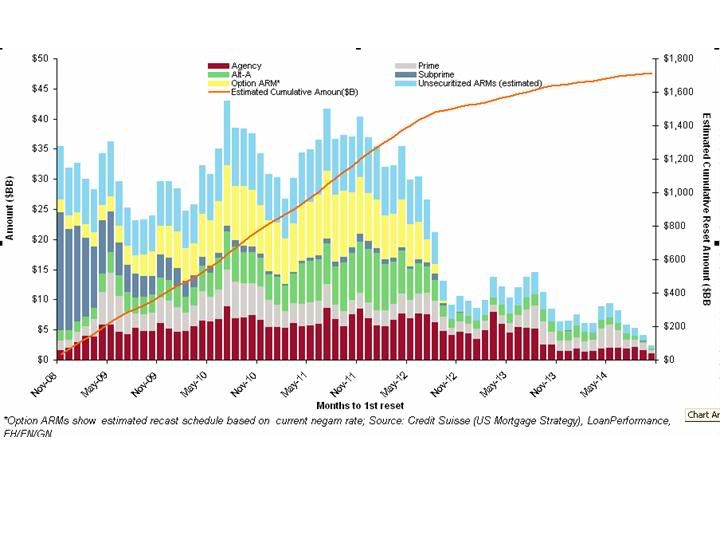
mortgage resets
Click Graph to Enlarge

The subprime crash is largely over, but the Option-ARM bubble was supposed to be spread out over many years.
Instead the Option-ARM mortgages are blowing up ahead of time. Why are they blowing up early? Because they are already underwater, and "negative equity is a necessary condition for foreclosure" according to the Boston Federal Reserve.
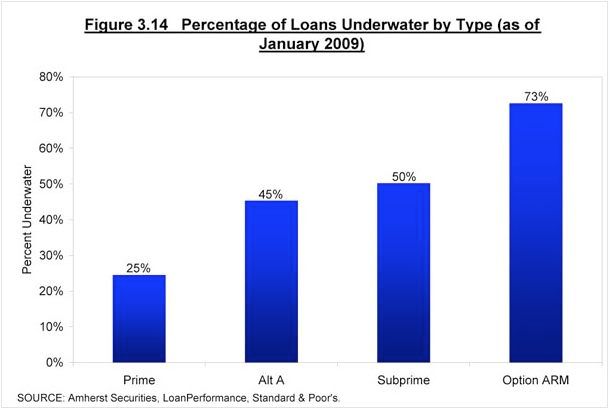
underwater mortgages
Click graph to enlarge

Option-ARM holders are the worst of the worst. While 32% of all mortgage holders are currently underwater, and that number expected to rise to 48%, Option-ARM borrowers are expected to peak at a number closer to 90%.
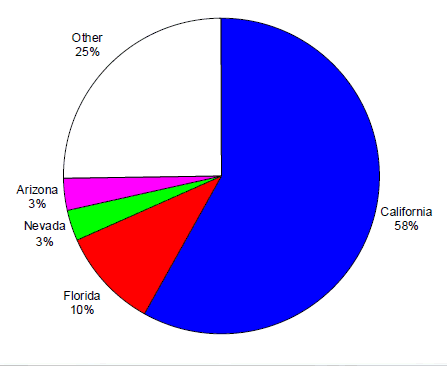
40% of Option-ARM borrowers are already delinquent. This is especially bad news for California, where an overwhelming percentage of Option-ARMs originated.

“The additional risk really will only be for borrowers who manage to stay current over the next couple of years and might default due to a payment shock,” the New York-based analysts including Sandeep Bordia and Jasraj Vaidya wrote.
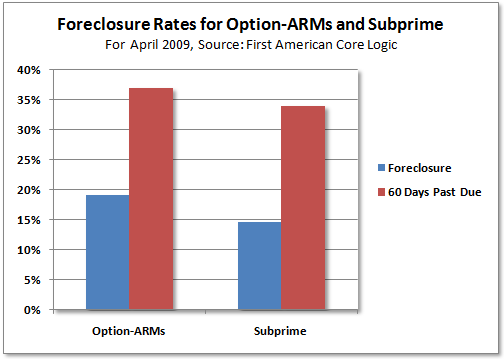
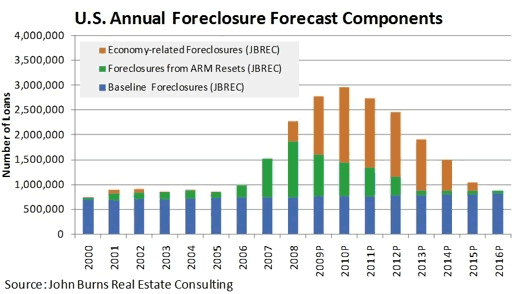
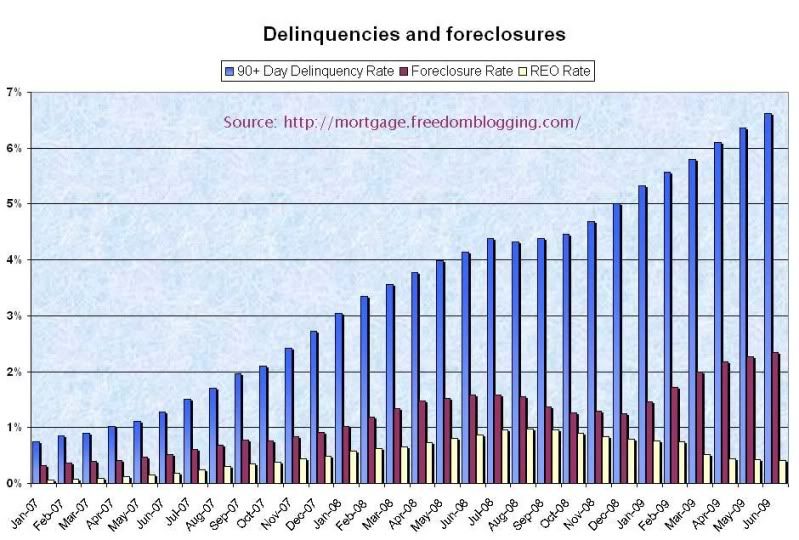
So what does the coming foreclosure wave look like and when will it hit? After all, foreclosures and foreclosure inventory is already at all-time highs.
Click on this graph to get a more visual idea.
foreclosures 2009
Click on graph to enlarge

“To say there is a second wave implies the (current) wave has receded. I don’t see that the wave has receded.”
- Sam Khater, senior economist, First American CoreLogic

Another factor you must take into the coming wave of foreclosures is the high unemployment rate.
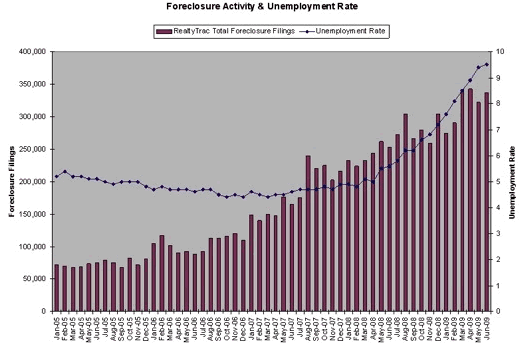
fed foreclosures
Click on graph to enlarge

Another factor weighing on the housing sector is the near record level of inventory.
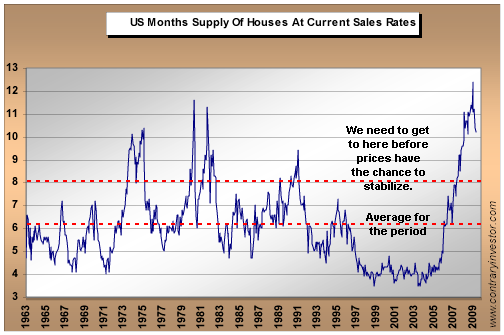
And that's only the official housing supply. The Shadow Inventory is far, far larger.

"The number of homes listed officially on the market, while still at historically high levels, might be only the tip of the iceberg," said Stan Humphries, chief economist at real estate website Zillow.com in Seattle, Washington.

According to Zillow's latest Homeowner Confidence Survey, 12 percent of homeowners said they would be "very likely" to put their home on the market in the next 12 months if they saw signs of a real estate market turnaround, 8 percent said "likely," while 12 percent said "somewhat likely."

Survey results could translate into around 20 million homeowners trying to sell their homes, a startling number given that the Census bureau indicates there are 93 million U.S. houses, condos and co-ops, Humphries said.

According to the National Association of Realtors, the market is currently on track to sell 4.89 million homes annually.

"At this pace, it would take about four years to run through this amount of backlogged inventory," he said.

And if that wasn't enough, the banking sector has its own "shadow inventory" that it refuses to sell at this time because it can't afford to book the losses. Estimates are somewhere north of 600,000 homes.

Speaking of the banks, what effect will all these foreclosures have on them?

The Barclays analysts, who wrote that about 88 percent of option ARMs packaged into securities in 2007 will eventually default, said that after a rally in prices they no longer suggest owning related bonds, “a trade we have been recommending for months.”
...
More than $750 billion of option ARMs were originated between 2004 and 2008 as borrowers used their low initial payments to afford higher-priced homes, according to newsletter Inside Mortgage Finance.

All those losses that banks will eventually have to book one way or another, will take their toll on balance sheets. The Congressional Oversight Panel created to oversee the U.S. banking bailout, had this to say about the state of the banking system.

In its latest assessment of the $700 billion financial system bailout, the Congressional Oversight Panel warns that banks still hold many risky loans of uncertain value. If unemployment rises sharply or the commercial real estate market collapses -- as many economists fear -- the banking system could again lose its footing, the panel says in a report to be released Tuesday.

No mention of Option-ARMs, but then maybe no one wants to talk about it.

  • midtowng's blog
  • addthis
  • Email this Blog entry
  • 2 points

FHA

Submitted by Robert Oak on Sun, 08/16/2009 - 22:21.

I saw they were continuing to do subprime, 3.5% down and were hitting a 7.5% default rate. I didn't verify those stats but the "let's re-inflate the housing bubble" seems to be active.

Supposedly the taxpayer will never see any of the money back given to Freddie/Fannie and their recent profit was due to some sort of accounting technical issue.

Not yet rated.
  • reply

a couple of remarks: - that

Submitted by Anonymous Drive-by (not verified) on Mon, 08/17/2009 - 03:18.

a couple of remarks:
- that 20m homes that could end up on the market is a highly exaggerated number. all those families do not intend to become renters or move abroad, but to trade up or down, more likely down.
- the loss rate on the option-arm morgages is not even touched upon. most reset at 125% ltv, which combined with a depreciation of 30-40% in ca/nv/fl means about 50% recovery rate for banks before any additional foreclosure and resale expenses. it is realistic to say that banks would barely recover 30% of the loan value, so they better become rentiers.

Not yet rated.
  • reply

Proposal:

Submitted by RebelCapitalist on Mon, 08/17/2009 - 05:47.

Change current mortgage model to one similar to Danish mortgage model. Fannie/Freddie can be consolidated and used as the entity to start lending under the new model or as a guarantor.

Here is a little info. on Danish Mortgage model: Link

RebelCapitalist.com - Financial Information for the Rest of Us.

Not yet rated.
  • reply

Report: China's Sovereign Wealth Fund buying Mortgages

Submitted by RebelCapitalist on Mon, 08/17/2009 - 05:52.

China's CIC to buy U.S. mortgages: sources

China's $200 billion sovereign wealth fund, which made big paper losses on stakes in Morgan Stanley and Blackstone, is set to invest up to $2 billion in U.S. mortgages as it eyes a property market recovery, two people with direct knowledge of the matter said on Monday.

China Investment Corp (CIC) plans to invest soon in U.S. taxpayer subsidized investment funds of toxic mortgage-backed securities, which it sees as a safer bet than buying into the Federal Reserve's Term Asset-Backed Securities Loan Facility (TALF).

It is investing in the smaller PPIP. It is investing in the "safer" toxic mortgages - the ones guaranteed by FDIC.

RebelCapitalist.com - Financial Information for the Rest of Us.

Rated 5 by one user. see individual ratings
  • reply

Extent of the problems

Submitted by jturner (not verified) on Mon, 08/17/2009 - 08:18.

I think one can look at the extent of the problems in the housing market to get a further sense of just how much taxpayer money is going to be wasted propping up failed institutions like Fannie and Freddie and trying to help the banks "earn" their way out of this mess. This unfortunately though is going to take a large toll on our currency and cause interest rates to rise in the long term, which will make the chance of a sustainable recovery based on sound economic principles very unlikely. So I would again state that one of the few ways for investors to profit from this trend will be to invest in gold and gold mining companies, which will benefit from the weaker dollar. in particular, is levered to the gold price and trades at one of the cheapest cash flow per share valuations in the industry. If the company can continue to bring down its cost structure, then this current valuation gap should shrink considerably.

And with regard to the amount of Option Arms that are or will soon be delinquent, I think it is very important that this was discussed in the post. A very large sum of money is most likely going to be printed by the government to further offset the damaging effects of this in 2010 and 2011.

Rated 5 by one user. see individual ratings
  • reply

Article updated

Submitted by midtowng on Mon, 08/17/2009 - 09:11.

I just spotted new information about the underwater situation.

It turns out that it's not 24% of all U.S. mortgages are underwater.
It's 32%.

If you count another 2.5 million properties that are nearly underwater, it comes out to 38%.
Suddenly that 48% projection doesn't look unrealistic.

Not yet rated.
  • reply

And another comment

Submitted by midtowng on Mon, 08/17/2009 - 09:17.

This has some interesting observations on the coming foreclosure wave.

Not yet rated.
  • reply

negative equity

Submitted by Robert Oak on Mon, 08/17/2009 - 09:37.

What are they going to do in Nevada and California? This is where the negative equity is the worse?

The actual prices were so unaffordable in comparison to wages they cannot return, yet both areas look like a nuclear bomb is going on and who can pay for 2x for something what it is really worth?

Not yet rated.
  • reply

What is this disconnect, homebuilders confident!

Submitted by Robert Oak on Mon, 08/17/2009 - 11:22.

Homebuilder Confidence in U.S. Rises to One-Year High:

Lower prices and government tax credits for first-time buyers have stabilized home sales, setting the stage for builders to gradually step up construction from record lows. Job losses, rising foreclosures and tight credit are a reminder that any recovery in housing will be slow to develop, limiting sales at builders such as D.R. Horton Inc. and Pulte Homes Inc.

“Inventory is being cleared and that is starting to benefit the new-home market,” said Julia Coronado, a senior U.S. economist at BNP Paribas in New York. “With a few months lag, that will lead to a turnaround in construction activity.”

Tell me they are not trying to rebuild the housing bubble. Someone tell me that with projected 3.2M foreclosures this year.

Not yet rated.
  • reply

Delinquency rates surge

Submitted by midtowng on Mon, 08/17/2009 - 12:22.

Calculated Risk notes a new Fed report.

Commercial real estate delinquencies (7.91%) are rising rapidly, and are at the highest rate since the early '90s (as delinquency rates declined following the S&L crisis).

Residential real estate (8.84%) and consumer credit card (6.7%) delinquencies are at the highest levels since the Fed started tracking the data (since Q1 '91).

Meanwhile, banks continue to tighten credit standards.

In the July survey, domestic banks indicated that they continued to tighten standards and terms over the past three months on all major types of loans to businesses and households, although the net percentages of banks that tightened declined compared with the April survey. Demand for loans continued to weaken across all major categories except for prime residential mortgages.

Tighter credit and less demand for it. Does this really sound like Green Shoots to you?

Rated 5 by 2 users. see individual ratings
  • reply

not on the neutron bomb called financial crisis it doesn't!

Submitted by Robert Oak on Mon, 08/17/2009 - 12:40.

Looks like grass killer is being sprayed all over the green shoots lawn!

Good God, this needs it's own blog post. That's an incredible rate of delinquencies.

I should note that in 1986, Tax Reform Act of 1986, removed a lot of CRE tax shelters.

This hit, hard...many upper middle class, but not super rich, investors and is one of the contributing factors to the S&L crisis.....

So, considering the above numbers vs. a major tax shelter change that caught hundreds of thousands of CRE investors with their pants down in the 1980's....

I think this news deserves it's own historical analysis blog post.

Not yet rated.
  • reply

No Skin in the Game

Submitted by Frank T. on Tue, 08/18/2009 - 13:38.

A lot of the credit that never should have been created is being extinguished. Not sure how big the number is, but this is demand that is not coming back. Credit limits lowered -- and wage garnishment for some unsecured debtors. Not a good outlook.
Frank T.

Not yet rated.
  • reply

Welcome Naked Capitalism Readers!

Submitted by Robert Oak on Mon, 08/17/2009 - 12:20.

Thank you Naked Capitalism for the link.

We love NC, esp. the bail out, Fed, derivatives coverage.

Yes, isn't this post a huge disconnect from what we are hearing on the housing market in the MSM?

Charts don't lie!

Not yet rated.
  • reply

Seeking Alpha picked up your post, Welcome Seeking Alpha readers

Submitted by Robert Oak on Tue, 08/18/2009 - 09:45.

Ah, what a series of references put together in a coherent post will do. Thank you again midtowng...

Seeking Alpha article recommending this post, markets taking a breather or change in direction?

They should read your market is for suckers post, Ultimate Stock Market Sucker's Rally.

Not yet rated.
  • reply

Post new comment

The content of this field is kept private and will not be shown publicly.
Input format
  • Web page addresses and e-mail addresses turn into links automatically.
  • Allowed HTML tags: <a> <b> <address> <blockquote> <br> <caption> <center> <code> <dd> <del> <div> <dl> <dt> <em> <font> <h2> <h3> <h4> <h5> <h6> <hr> <i> <img> <li> <ol> <p> <pre> <span> <strong> <sub> <sup> <table> <tbody> <td> <tfoot> <th> <thead> <tr> <u> <ul> <tr>
  • Lines and paragraphs break automatically.
  • Web page addresses and e-mail addresses turn into links automatically.
  • Lines and paragraphs break automatically.
  • Image links with 'rel="lightbox"' in the <a> tag will appear in a Lightbox when clicked on.
CAPTCHA
This question is for testing whether you are a human visitor and to prevent automated spam submissions.
Image CAPTCHA
Copy the characters (respecting upper/lower case) from the image.

Syndicate

Syndicate content

Add to Technorati Favorites

Privacy Policy

Google Delicious Yahoo! Bloglines Newsgator MSN AOL Rojo Newsburst RSSFwd
© Economic Populist 2008-2009