Calculated Risk

Thursday: New Home Sales, Weekly Unemployment Claims

Most of the coverage of the FOMC minutes today focused on this sentence:
"A number of participants expressed willingness to adjust the flow of purchases downward as early as the June meeting if the economic information received by that time showed evidence of sufficiently strong and sustained growth; however, views differed about what evidence would be necessary and the likelihood of that outcome."
emphasis added
Three words: Will Not Happen. Not in June. Probably not this year (although tapering could start late this year).

The real Fed story today was that Fed Chairman Ben Bernanke scolded Congress. In his speech he said:
"Notably, over the past four years, state and local governments have cut civilian government employment by roughly 700,000 jobs, and total government employment has fallen by more than 800,000 jobs over the same period. For comparison, over the four years following the trough of the 2001 recession, total government employment rose by more than 500,000 jobs.

Most recently, the strengthening economy has improved the budgetary outlooks of most state and local governments, leading them to reduce their pace of fiscal tightening. At the same time, though, fiscal policy at the federal level has become significantly more restrictive. In particular, the expiration of the payroll tax cut, the enactment of tax increases, the effects of the budget caps on discretionary spending, the onset of the sequestration, and the declines in defense spending for overseas military operations are expected, collectively, to exert a substantial drag on the economy this year."
And in the Q&A, Bernanke added:
“I fully realize the importance of budgetary responsibility, but I would argue that it’s not responsible to focus all of the restraint on the very near term and do nothing about the long term, which is where most of the problem exists. I do think that we would all be better off, with no loss to fiscal sustainability or market confidence, if we had somewhat less restraint in the very near term – this year and next year, say – and more aggressive action to address these very real long-term issues, which threaten within a decade or so to begin to put our fiscal budget on an unsustainable path.”
Current policy is "not responsible".  Unfortunately most members of Congress weren't even aware that Bernanke was giving them a failing grade!  Most of the media reports ignored the reprimand too.  Even the FOMC statement mentioned fiscal restraint several times.  Oh well ...

Thursday economic releases:
• At 8:30 AM ET, the initial weekly unemployment claims report will be released. The consensus is for claims to decrease to 345 thousand from 360 thousand last week.

• At 9:00 AM, FHFA House Price Index for March 2013. This was original a GSE only repeat sales, however there is also an expanded index that deserves more attention. The consensus is for a 0.9% increase.

• Also at 9:00 AM, The Markit US PMI Manufacturing Index Flash for May. The consensus is for a decrease to 50.8 from 52.0 in April.

• At 10:00 AM, New Home Sales for April from the Census Bureau. The consensus is for an increase in sales to 425 thousand Seasonally Adjusted Annual Rate (SAAR) in April from 417 thousand in March.

• At 11:00 AM, Kansas City Fed regional Manufacturing Survey for May. The consensus is for a reading of minus 2, up from minus 5 in April (below zero is contraction).

Existing Home Sales: A few comments

The most important number in the existing home sales report was inventory, and the NAR reported that inventory increased 11.9% in April from March, and is only down 13.6% from April 2012.  This fits with the weekly data I've been posting.

This is the lowest level of inventory for the month of April since 2001, but this is also the smallest year-over-year decline since July 2011. The key points are: 1) inventory is very low, but 2) the inventory decline will probably end soon. With the low level of inventory, there is still upward pressure on prices - but as inventory starts to increase, buyer urgency will wane, and price increases will slow.

Important: The NAR reports active listings, and although there is some variability across the country in what is considered active, most "contingent short sales" are not included. "Contingent short sales" are strange listings since the listings were frequently NEVER on the market (they were listed as contingent), and they hang around for a long time - they are probably more closely related to shadow inventory than active inventory. However when we compare inventory to 2005, we need to remember there were no "short sale contingent" listings in 2005. In the areas I track, the number of "short sale contingent" listings is also down sharply year-over-year.

Another key point: The NAR reported total sales were up 9.7% from April 2012, but conventional sales are probably up close to 25% from April 2012, and distressed sales down.  The NAR reported (from a survey):
Distressed homes – foreclosures and short sales – accounted for 18 percent of April sales, down from 21 percent in March and 28 percent in April 2012.
Although this survey isn't perfect, if total sales were up 9.7% from April 2012, and distressed sales declined from 28% of total sales to 18%, this suggests conventional sales were up sharply year-over-year - a good sign. However some of this increase is investor buying; the NAR is reporting:
All-cash sales were at 32 percent of transactions in April, up from 30 percent in March; they were 29 percent in April 2012. Individual investors, who account for most cash sales, purchased 19 percent of homes in April, unchanged from March; they were 20 percent in April 2012.
The following graph shows existing home sales Not Seasonally Adjusted (NSA).

Existing Home Sales NSAClick on graph for larger image.

Sales NSA in April (red column) are  above the sales for for 2008 through 2012, and close to the level in 2007.  Sales are well below the bubble years of 2005 and 2006. 

The bottom line is this was a solid report. Conventional sales have increased sharply, although some of this is investor buying. And inventory is low, but the year-over-year decline in inventory is decreasing.

Earlier:
Existing Home Sales in April: 4.97 million SAAR, 5.2 months of supply

FOMC Minutes: Exit Strategy Discussion

Note: I'll have more on existing home sales and Bernanke's testimony later today.

From the Fed: Minutes of the Federal Open Market Committee, April 30-May 1, 2013. A few excerpts on the exit strategy:
After the policy vote, participants began a review of the exit strategy principles that were published in the minutes of the Committee's June 2011 meeting. Those principles, which the Committee issued to clarify how it intended to normalize the stance and conduct of monetary policy when doing so eventually became appropriate, included broad principles along with some details about the timing and sequence of specific steps the Committee expected to take. The participants' discussion touched on various aspects of the exit strategy principles and policy normalization more generally, including the size and composition of the SOMA portfolio in the longer run, the use of a range of reserve-draining tools, the approach to sales of securities, the eventual framework for policy implementation, and the relationship between the principles and the economic thresholds in the Committee's forward guidance on the federal funds rate. The broad principles adopted almost two years ago appeared generally still valid, but developments since then--including the change in the size and composition of SOMA asset holdings--suggested a need for greater flexibility regarding the details of implementing policy normalization, particularly because those details would appropriately depend at least in part upon future economic and financial developments. Also, because normalization still appeared to be well in the future, the Committee might wish to wait and acquire additional experience to inform its plans. In particular, the process of normalizing policy could yield information about the most effective framework for implementing monetary policy in the longer run, and thus about the appropriate size of the SOMA portfolio and level of reserve balances. In addition, several participants raised the possibility that the federal funds rate might not, in the future, be the best indicator of the general level of short-term interest rates, and supported further staff study of potential alternative approaches to implementing monetary policy in the longer term and of possible new tools to improve control over short-term interest rates.

Views differed regarding whether the best course at this point would be to simply acknowledge that certain components of the June 2011 principles had been overtaken by events or rather to formally revise the principles. Acknowledging that the principles need to be updated would help avoid possible confusion regarding the Committee's intentions; waiting to update the principles would allow the Committee to obtain additional information before revising them. It was also mentioned that the public's understanding of the likely exit process might not be improved if the Committee issued only a set of broad principles without providing detailed information on the steps anticipated for normalization. However, issuing revised principles relatively soon could give the public additional confidence that the Committee had the tools and a plan for eventually normalizing the conduct of policy. Moreover, one participant stressed that the Committee's ability to provide forward guidance about the normalization process was a key monetary policy tool, and revised principles would permit use of that tool to help adjust the stance of policy. Participants emphasized that their review of the June 2011 exit strategy principles did not suggest any change in their views about the economic conditions that would eventually warrant beginning the process of normalizing the stance of monetary policy. At the conclusion of the discussion, the Chairman directed the staff to undertake additional preparatory work on this issue for Committee consideration in the future.
emphasis added
Based on comments by Bernanke today, and NY Fed President Dudley yesterday, it sounds likely the Fed will allow the MBS to run off (a change from their previous thinking).

AIA: Architecture Billings Index indicates decreased demand for design services in April

Note: This index is a leading indicator primarily for new Commercial Real Estate (CRE) investment.

From AIA: Architecture Billings Index Reverts into Negative Territory for First Time in Nine Months
After indicating increasing demand for design services for the better part of a year, the Architecture Billings Index has reversed course in April. As a leading economic indicator of construction activity, the ABI reflects the approximate nine to twelve month lag time between architecture billings and construction spending. The American Institute of Architects (AIA) reported the April ABI score was 48.6, down from a mark of 51.9 in March. This score reflects a decrease in demand for design services (any score above 50 indicates an increase in billings) and is the lowest mark since July 2012. The new projects inquiry index was 58.5, down from the reading of 60.1 the previous month.

“Project approval delays are having an adverse effect on the design and construction industry, but again and again we are hearing that it is extremely difficult to obtain financing to move forward on real estate projects,” said AIA Chief Economist, Kermit Baker, PhD, Hon. AIA. “There are other challenges that have prevented a broader recovery that we will examine in the coming months if this negative trajectory continues. However, given that inquiries for new projects continue to be strong, we’re hopeful that this is just a short-term dip.”
emphasis added
AIA Architecture Billing Index Click on graph for larger image.

This graph shows the Architecture Billings Index since 1996. The index was at 48.6 in April, down from 51.9 in March. Anything below 50 indicates contraction in demand for architects' services.  This decline followed eight consecutive months of expansion.

Note: This includes commercial and industrial facilities like hotels and office buildings, multi-family residential, as well as schools, hospitals and other institutions.

According to the AIA, there is an "approximate nine to twelve month lag time between architecture billings and construction spending" on non-residential construction.  The previous increases in this index suggest some increase in CRE investment in the second half of 2013.

Existing Home Sales in April: 4.97 million SAAR, 5.2 months of supply

NOTE: Federal Reserve Chairman Ben Bernanke testimony Testimony by Chairman Bernanke on the economic outlook

The NAR reports: April Existing-Home Sales Up but Constrained
Total existing-home sales, which are completed transactions that include single-family homes, townhomes, condominiums and co-ops, increased 0.6 percent to a seasonally adjusted annual rate of 4.97 million in April from an upwardly revised 4.94 million in March. Resale activity is 9.7 percent above the 4.53 million-unit level in April 2012.

Total housing inventory at the end of April rose 11.9 percent, a seasonal increase to 2.16 million existing homes available for sale, which represents a 5.2-month supply at the current sales pace, compared with 4.7 months in March. Listed inventory is 13.6 percent below a year ago, when there was a 6.6-month supply, with current availability tighter in the lower price ranges.
Existing Home SalesClick on graph for larger image.

This graph shows existing home sales, on a Seasonally Adjusted Annual Rate (SAAR) basis since 1993.

Sales in April 2013 (4.97 million SAAR) were 0.6% higher than last month, and were 9.7% above the April 2012 rate.

The second graph shows nationwide inventory for existing homes.

Existing Home InventoryAccording to the NAR, inventory increased to 2.16 million in April up from 1.93 million in March.   Inventory is not seasonally adjusted, and inventory usually increases from the seasonal lows in December and January, and peaks in mid-to-late summer (so some of this increase was seasonal).

The last graph shows the year-over-year (YoY) change in reported existing home inventory and months-of-supply. Since inventory is not seasonally adjusted, it really helps to look at the YoY change. Note: Months-of-supply is based on the seasonally adjusted sales and not seasonally adjusted inventory.

Year-over-year Inventory Inventory decreased 13.6% year-over-year in April compared to April 2012. This is the 26th consecutive month with a YoY decrease in inventory, but the smallest YoY decrease since 2011 (I expect the YoY decrease to get smaller all year).

Months of supply increased to 5.2 months in April.

This was  just below expectations of sales of 5.0 million.  For existing home sales, the key number is inventory - and inventory is still down sharply year-over-year, although the declines are slowing.   This was a solid report.  I'll have more later ...

LPS: Mortgage Delinquency Rate falls below 6.5% in April, Lowest since July 2008

According to the First Look report for April to be released today by Lender Processing Services (LPS), the percent of loans delinquent decreased in April compared to March, and declined about 10% year-over-year. Also the percent of loans in the foreclosure process declined further in April and were down almost 25% over the last year.

LPS reported the U.S. mortgage delinquency rate (loans 30 or more days past due, but not in foreclosure) decreased to 6.21% from 6.59% in March. Note: the normal rate for delinquencies is around 4.5% to 5%.

The percent of loans in the foreclosure process declined to 3.17% in April from 3.37% in March. 

The number of delinquent properties, but not in foreclosure, is down about 11% year-over-year (375,000 fewer properties delinquent), and the number of properties in the foreclosure process is down 25% or 543,000 properties year-over-year.

The percent (and number) of loans 90+ days delinquent and in the foreclosure process is still very high, but declining fairly quickly.

LPS will release the complete mortgage monitor for April in early June.

LPS: Percent Loans Delinquent and in Foreclosure Process Apr 2013Mar 2013Apr 2012 Delinquent6.21%6.59%6.87% In Foreclosure3.17%3.37%4.20% Number of properties: Number of properties that are 30 or more, and less than 90 days past due, but not in foreclosure:1,717,0001,842,0001,890,000 Number of properties that are 90 or more days delinquent, but not in foreclosure:1,394,0001,466,0001,596,000 Number of properties in foreclosure pre-sale inventory:1,588,0001,689,0002,131,000 Total Properties4,699,0004,997,0005,617,000

MBA: Mortgage Applications Decrease in Weekly Survey

From the MBA: Mortgage Applications Decrease in Latest MBA Weekly Survey
The Refinance Index decreased 12 percent from the previous week. The seasonally adjusted Purchase Index decreased 3 percent from one week earlier.
...
“Mortgage rates increased to their highest level since March last week, leading to the largest single week drop in refinance applications this year,” said Mike Fratantoni, MBA’s Vice President of Research and Economics. “The refinance index has fallen almost 19 percent over the past two weeks and is back to its lowest level since late March. Purchase activity declined over the week but is still running about 10 percent above last year’s pace at this time.”

The average contract interest rate for 30-year fixed-rate mortgages with conforming loan balances ($417,500 or less) increased to 3.78 percent from 3.67 percent, with points decreasing to 0.39 from 0.41 (including the origination fee) for 80 percent loan-to-value ratio (LTV) loans.
emphasis added
Purchase IndexClick on graph for larger image.

The first graph shows the refinance index.

There has been a sustained refinance boom for over a year.

However the index is down almost 20% over the last two weeks, and this is the lowest level since March.

Refinance Index The second graph shows the MBA mortgage purchase index.  The 4-week average of the purchase index has generally been trending up over the last year, and the 4-week average of the purchase index is up about 10% from a year ago.

Wednesday: Existing Home Sales, Bernanke Testimony and more

From Tim Duy at Economist'sView: Fed Watch: And Then There is Bernanke. Duy discusses the various Fed speeches this week and concludes:
So many voices, so many views. Looking through the noise, I think there is strong interest in tapering QE now that we have a string of job reports pointing to substantial and sustainable improvement in labor markets, but, given the fiscal contraction, little willingness to pull the trigger on tapering until we see another two or three similar reports. On net, I think disinflation concerns will move to the back-burner as long as inflation expectations are stable.

Still, at the same time, the Fed wants to keep its options open, as they are very much cognizant that past efforts to pull back on easing have been premature. Hence the talk that future moves could be up or down, which is really just plain confusing because why would the Fed even begin tapering if they thought there was a reasonable chance of having to reverse course the next month? It is even more confusing given that some officials seem to care about inflation, but others labor markets. The former says more purchases, arguably the latter says less. And I am not sure they have a consensus view of what would be the pace of tapering even if they all could agree on the forecast and relevant indicators. No wonder communications is a problem. Back to Dudley:
An important challenge for us will be to think carefully about what combination of actions and communications will best ensure that when we do eventually judge that it is appropriate to begin normalizing policy, the initial tightening of financial market conditions is commensurate to what we desire. There is a risk is that market participants could overreact to any move in the process of normalization.
It seems that lacking a more clear, consistent framework for the exit from quantitative easing, the risk of miscommunication is high. Hence, we are all looking toward tomorrow's speech by Federal Reserve Chairman Ben Bernanke to provide the clarity that appears very much needed.
Wednesday economic releases:
• At 9:55 AM ET, the Mortgage Bankers Association (MBA) will release the results for the mortgage purchase applications index.

• At 10:00 AM, Existing Home Sales for April from the National Association of Realtors (NAR). The consensus is for sales of 5.00 million on seasonally adjusted annual rate (SAAR) basis. Sales in March were at a 4.92 million SAAR. Economist Tom Lawler is estimating the NAR will report a April sales rate of 5.03 million.

• Also at 10:00 AM, Testimony by Fed Chairman Ben Bernanke, Economic Outlook, Before the Joint Economic Committee, U.S. Congress

• At 2:00 PM, the FOMC Minutes for Meeting of April 30-May 1, 2013 will be released.

• During the day, the AIA's Architecture Billings Index for April (a leading indicator for commercial real estate).

Fed's Dudley: "Lessons at the Zero Bound: The Japanese and U.S. Experience"

As president of the NY Fed, William Dudley is a key member of the FOMC. He clearly supports QE ...

From NY Fed President William Dudley: Lessons at the Zero Bound: The Japanese and U.S. Experience. A few excerpts:
In terms of our asset purchase program, I believe we should be prepared to adjust the total amount of purchases to that needed to deliver a substantial improvement in the labor market outlook in the context of price stability. In doing this, we might adjust the pace of purchases up or down as the labor market and inflation outlook changes in a material way. For me, the base case forecast is not the sole consideration—how confident we are about that outcome is also important.

Because the outlook is uncertain, I cannot be sure which way—up or down—the next change will be. But at some point, I expect to see sufficient evidence to make me more confident about the prospect for substantial improvement in the labor market outlook. At that time, in my view, it will be appropriate to reduce the pace at which we are adding accommodation through asset purchases. Over the coming months, how well the economy fights its way through the significant fiscal drag currently in force will be an important aspect of this judgment.
This is a reminder that the next change in asset purchases could be either to buy more or less per month depending on the economy.  Note: Earlier in this speech Dudley noted that "complementary fiscal" policy is important, but of course fiscal policy is currently not "complementary" - and is a significant drag.

And on the eventual exit strategy:
We are also learning about how best to prepare for the eventual normalization of monetary policy. For example, we may need to update our thinking with respect to the so-called exit principles that we published in June 2011 in order to bring them up to date with developments since then, and ensure they do not unnecessarily constrain our ability to conduct policy in the most effective way today.

Those exit principles stated that we would first stop reinvesting, then raise short-term interest rates, and finally sell agency mortgage backed securities over a three-to-five year period. This seems stale in several respects. In particular, how does one time the end of reinvestment given that we now have economic thresholds that govern the timing of liftoff? Also, the thresholds are thresholds, not triggers. Thus it is hard to link the timing of the end of reinvestment to the unknown liftoff date for short-term rates.

More broadly, it may be desirable to update our thinking around the path and composition of the balance sheet over time, in light of our capacity to shape this path in a way that mitigates potential costs and risks. For example, the agency MBS portfolio is substantially larger today than it was when the original exit principles were devised. To the extent that the Committee wants to reduce the risk of disrupting market functioning during normalization, it could decide to indicate that it will avoid selling the MBS portfolio during the early stages of the normalization process. Moreover, to the extent that the Committee wants to mitigate the risk of a sharp increase in long-term rates, it could judge that it would prefer not to commit to agency MBS sales. Expectations about future MBS sales or actual sales have the potential to generate or amplify such an upward spike in long-term rates. If the Committee believes that it could be costly in terms of credibility to incur a period of no remittances to Treasury—a notion I am personally somewhat skeptical about—avoiding MBS sales would also reduce this risk. Indeed, the Committee might conclude that it was better on all three counts to allow the agency MBS securities to run off passively over time.
Allowing the MBS to run off would be a significant change to the exit strategy.

ATA Trucking Index decreases slightly in April

This is a minor indicator that I follow.

From ATA: ATA Truck Tonnage Index Fell 0.2% in April
The American Trucking Associations’ advanced seasonally adjusted (SA) For-Hire Truck Tonnage Index fell 0.2% in April after rising 0.9% in March. (The 0.9% gain in March was unchanged from what ATA reported on April 23, 2013.) In April, the SA index equaled 123.2 (2000=100) versus 123.5 in March. The highest level on record was December 2011 at 124.3. Compared with April 2012, the SA index was up 4.3%, which is the largest year-over-year gain since January of this year (4.7%). Year-to-date, compared with the same period in 2012, the tonnage index is up 4%.

“The slight drop in tonnage during April fit with trends from other industries that drive a significant amount of truck freight, such as manufacturing and housing,” ATA Chief Economist Bob Costello said, noting that in April, compared with the previous month, factory output slipped 0.4% while housing starts plunged 16.5%.

“After rising significantly late last year and in January of this year, truck tonnage has been bouncing around a narrow, but elevated band over the last three months.” he said. “It is also worth noting that the year-over-year comparisons are much better than expected just a few months ago and I’m hearing good comments about freight so far in May.”
emphasis added
Note from ATA:
Trucking serves as a barometer of the U.S. economy, representing 67% of tonnage carried by all modes of domestic freight transportation, including manufactured and retail goods. Trucks hauled 9.2 billion tons of freight in 2011. Motor carriers collected $603.9 billion, or 80.9% of total revenue earned by all transport modes.
ATA Trucking Click on graph for larger image.

Here is a long term graph that shows ATA's For-Hire Truck Tonnage index.

The dashed line is the current level of the index.

The index is fairly noisy, but is up solidly year-over-year.

Philly Fed: State Coincident Indexes increased in 45 States in April

From the Philly Fed:
The Federal Reserve Bank of Philadelphia has released the coincident indexes for the 50 states for April 2013. In the past month, the indexes increased in 45 states, decreased in four states, and remained stable in one (Minnesota), for a one-month diffusion index of 82. Over the past three months, the indexes increased in 47 states, decreased in two (Wisconsin and Wyoming), and remained stable in one (Alaska), for a three-month diffusion index of 90.
Note: These are coincident indexes constructed from state employment data. From the Philly Fed:
The coincident indexes combine four state-level indicators to summarize current economic conditions in a single statistic. The four state-level variables in each coincident index are nonfarm payroll employment, average hours worked in manufacturing, the unemployment rate, and wage and salary disbursements deflated by the consumer price index (U.S. city average). The trend for each state’s index is set to the trend of its gross domestic product (GDP), so long-term growth in the state’s index matches long-term growth in its GDP.
Philly Fed Number of States with Increasing ActivityClick on graph for larger image.

This is a graph is of the number of states with one month increasing activity according to the Philly Fed. This graph includes states with minor increases (the Philly Fed lists as unchanged).

In April, 46 states had increasing activity, the ninth consecutive month with 45 or more states showing increases.


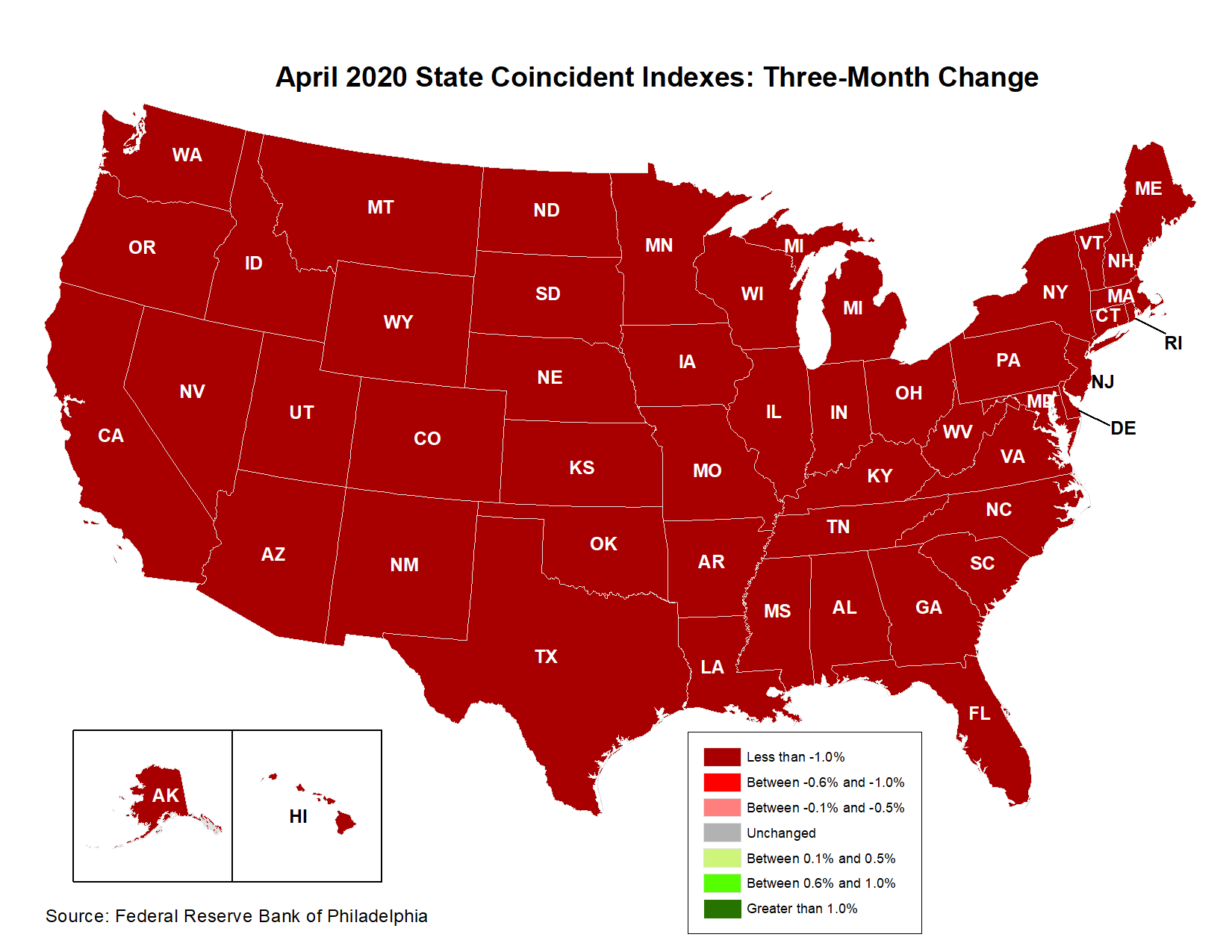
Philly Fed State Conincident Map Here is a map of the three month change in the Philly Fed state coincident indicators. This map was all red during the worst of the recession.

The map is mostly green again and suggests that the recovery is geographically widespread.

Zillow: House Prices up over 5% year-over-year in March, Case-Shiller expected to show 9.8% YoY increase

From Zillow: Annual U.S. Home Value Appreciation Exceeds 5 Percent for Sixth Straight Month in April
U.S. home values continued to climb in April, increasing 0.5 percent from March to $158,300, according to the April Zillow Real Estate Market Reports. Home values were up 5.2 percent year-over-year, marking the sixth consecutive month of annual home value appreciation at or above 5 percent. The last time national home values were at this level was in June 2004.

A majority (55 percent) of the 365 metros covered saw home values climb in April from March. Of the 30 largest metro areas covered, Sacramento experienced the largest monthly increase, with home values rising 3.4 percent. Other large metro areas with notable monthly increases include Las Vegas (3 percent) and San Francisco (2.8 percent).

“April marks the sixth straight month of annual home value appreciation of 5 percent or above, the longest such streak since the height of the bubble in 2006. In the short term, this has been welcome news for homeowners. But in the long term, this cannot be sustained, and consumers entering the market today should not expect this kind of appreciation to last,” said Zillow Chief Economist Dr. Stan Humphries. “Overall, we expect home value appreciation to moderate as more supply comes on line over the next year, but in some areas, runaway home value appreciation, combined with expected interest rate hikes in coming years, runs a real risk of pricing out many potential buyers. Home values in these areas will have to flatten or even fall to come back in line.”

The Zillow Home Value Forecast calls for 4 percent appreciation nationally from April 2013 to April 2014.
The Case-Shiller house price indexes for March will be released Tuesday, May 28th. Zillow has started forecasting the Case-Shiller a month early - and I like to check the Zillow forecasts since they have been pretty close.

Zillow: March Case-Shiller Composites To Show Annual Appreciation Above 9%
[W]e predict that ... Case-Shiller data (March 2013) will show that the 20-City Composite Home Price Index (non-seasonally adjusted [NSA]) increased 9.8 percent on a year-over-year basis, while the 10-City Composite Home Price Index (NSA) increased 9.3 percent on a year-over-year basis. The seasonally adjusted (SA) month-over-month change from February to March will be 0.9 percent for both the 20-City Composite and the 10-City Composite Home Price Indices (SA). All forecasts are shown in the table below. Officially, the Case-Shiller Composite Home Price Indices for March will not be released until Tuesday, May 28.
...
To forecast the Case-Shiller indices we use past data from Case-Shiller, as well as the Zillow Home Value Index (ZHVI), which is available more than a month in advance of Case-Shiller numbers, paired with foreclosure resale numbers, which we also have available more than a month prior to Case-Shiller numbers. ...

The ZHVI does not include foreclosure resales and shows home values for March 2013 up 5.1 percent from year-ago levels. ... Further details on our forecast can be found here ...
The following table shows the Zillow forecast for March.

Zillow March Forecast for Case-Shiller Index  Case Shiller Composite 10Case Shiller Composite 20 NSASANSASA Case Shiller
(year ago)Mar 2012146.46150.36134.07140.12 Case-Shiller
(last month)Feb 2013159.24162.37146.57149.80 Zillow ForecastYoY9.3%9.3%9.8%9.8% MoM0.5%0.9%0.5%0.9% Zillow Forecasts1 160.1164.1147.3151.0 Current Post Bubble Low 146.46149.45134.07136.86 Date of Post Bubble Low Mar-12Feb-12Mar-12Jan-12 Above Post Bubble Low 9.3%9.8%9.8%10.3% 1Estimate based on Year-over-year and Month-over-month Zillow forecasts

Discussion on Inequality and Economic Growth

From 6:30 to 8:00 PM ET, the will be a live stream of professors Tony Atkinson and Paul Krugman discussing inequality and growth at CUNY. The dialogue will be moderated by Chrystia Freeland.
As we endure the slow, uneven recovery from the “Great Recession,” there is no more critical or timely question than that of the relationship between economic growth and inequality. Join two preeminent economists as they assess the connection between prosperity for some and poverty for others. Paul Krugman is professor of economics at Princeton University, a Nobel laureate, and a New York Times columnist. He is the author of numerous books, including the recently published End This Depression Now! Sir Tony Atkinson, professor of economics at Oxford's Nuffield College, is one of the world’s foremost scholars of inequality and author or editor of more than thirty books on inequality and related topics. He recently coedited Top Incomes: A Global Perspective, a volume that analyses high-end income inequality around the world.
Chrystia Freeland will be taking questions at #GCinequality

This is a very interesting topic. Intuitively it seems higher inequality should lead to slower growth (I think it would at the extreme!), but I'm not sure the relationship between inequality and growth is clear.

Existing Home Inventory is up 17.7% year-to-date on May 20th

Weekly Update: One of key questions for 2013 is Will Housing inventory bottom this year?. Since this is a very important question, I'm tracking inventory weekly in 2013. 

There is a clear seasonal pattern for inventory, with the low point for inventory in late December or early January, and then peaking in mid-to-late summer.

The Realtor (NAR) data is monthly and released with a lag (the most recent data was for March).  However Ben at Housing Tracker (Department of Numbers) has provided me some weekly inventory data for the last several years. This is displayed on the graph below as a percentage change from the first week of the year (to normalize the data).

In 2010 (blue), inventory increased more than the normal seasonal pattern, and finished the year up 7%. However in 2011 and 2012, there was only a small increase in inventory early in the year, followed by a sharp decline for the rest of the year.

Exsiting Home Sales Weekly dataClick on graph for larger image.

Note: the data is a little weird for early 2011 (spikes down briefly).

So far in 2013, inventory is up 17.7%. This is well above the peak percentage increases for 2011 and 2012 and suggests to me that inventory is near the bottom. It now seems likely - at least by this measure - that inventory bottomed early this year (it could still happen early next year). 

It is important to remember that inventory is still very low, and is down 15.1% from the same week last year according to Housing Tracker.  Once inventory starts to increase (more than seasonal), buyer urgency will wane, and I expect price increases to slow. 

Lumber Prices decline Sharply over last month

Just over a month ago I mentioned that lumber prices were nearing the housing bubble highs. Since then prices have declined sharply, with prices off about 20% from the recent highs.

Some of the decline could be related to additional supply coming on the market, and some due to less buying from China (several sources are reporting that China has pulled back significantly on buying North American lumber).

On additional supply, two months ago the WSJ had an article about some producers increasing supply:
Georgia-Pacific, the largest U.S. producer of plywood ... plans to invest about $400 million over the next three years to boost softwood plywood and lumber capacity by 20%.
Lumcber PricesClick on graph for larger image in graph gallery.

This graph shows two measures of lumber prices (not plywood): 1) Framing Lumber from Random Lengths through last week (via NAHB), and 2) CME framing futures.

Lumber prices are now 20% off the recent highs.

DOT: Vehicle Miles Driven decreased 1.5% in March

The Department of Transportation (DOT) reported:
Travel on all roads and streets changed by -1.5% (-3.7 billion vehicle miles) for March 2013 as compared with March 2012. Travel for the month is estimated to be 248.8 billion vehicle miles.

The following graph shows the rolling 12 month total vehicle miles driven.

The rolling 12 month total is still mostly moving sideways.


Vehicle Miles Click on graph for larger image.

In the early '80s, miles driven (rolling 12 months) stayed below the previous peak for 39 months.

Currently miles driven has been below the previous peak for 64 months - over 5 years - and still counting.

The second graph shows the year-over-year change from the same month in the previous year.

Vehicle Miles Driven YoYGasoline prices were down in March compared to March 2012. In March 2013, gasoline averaged of $3.78 per gallon according to the EIA. In 2012, prices in March averaged $3.91 per gallon. But even with the year-over-year decline in gasoline prices, miles driven decreased.

This is because gasoline prices are just part of the story.  The lack of growth in miles driven over the last 5 years is probably also due to the lingering effects of the great recession (high unemployment rate and lack of wage growth), the aging of the overall population (over 55 drivers drive fewer miles) and changing driving habits of young drivers.

With all these factors, it might take several more years before we see a new peak in miles driven. 

Chicago Fed: "Economic Activity Slower in April"

The Chicago Fed released the national activity index (a composite index of other indicators): Economic Activity Slower in April
Led by declines in production-related indicators, the Chicago Fed National Activity Index (CFNAI) decreased to –0.53 in April from –0.23 in March. Three of the four broad categories of indicators that make up the index decreased from March, and none of the categories made a positive contribution to the index in April.

The index’s three-month moving average, CFNAI-MA3, ticked up to –0.04 in April from –0.05 in March. April’s CFNAI-MA3 suggests that growth in national economic activity was very near its historical trend. The economic growth reflected in this level of the CFNAI-MA3 suggests subdued inflationary pressure from economic activity over the coming year.
emphasis added
This graph shows the Chicago Fed National Activity Index (three month moving average) since 1967.

Chicago Fed National Activity Index Click on graph for larger image.

This suggests economic activity slowed in April, and growth was near the historical trend (using the three-month average).

According to the Chicago Fed:
What is the National Activity Index? The index is a weighted average of 85 indicators of national economic activity drawn from four broad categories of data: 1) production and income; 2) employment, unemployment, and hours; 3) personal consumption and housing; and 4) sales, orders, and inventories.

A zero value for the index indicates that the national economy is expanding at its historical trend rate of growth; negative values indicate below-average growth; and positive values indicate above-average growth.

Sunday Night Futures

Monday:
• At 8:30 AM ET, the Chicago Fed National Activity Index for April will be released. This is a composite index of other data.

Weekend:
Schedule for Week of May 19th

The Asian markets are green tonight with the Nikkei up 1.0%, and Shanghai Composite up 0.2%.

From CNBC: Pre-Market Data and Bloomberg futures: the S&P futures are down slightly and DOW futures are down 6 (fair value).

Oil prices have moved sideways recently with WTI futures at $95.99 per barrel and Brent at $104.62 per barrel.

Below is a graph from Gasbuddy.com for nationwide gasoline prices. Nationally prices are up 17 cents per gallon over the last two weeks to $3.67 per gallon. Based on Brent prices and the calculator at Econbrowser, I expect gasoline prices to fall soon.

If you click on "show crude oil prices", the graph displays oil prices for WTI, not Brent; gasoline prices in most of the U.S. are impacted more by Brent prices.


Orange County Historical Gas Price Charts Provided by GasBuddy.com

Report: Wells Fargo, JPMorgan Chase and Citigroup "nearly halt foreclosure sales"

From Scott Reckard at the LA Times: 3 big banks nearly halt foreclosure sales after U.S. tweaks orders
Sales of homes in foreclosure by Wells Fargo & Co., JPMorgan Chase & Co. and Citigroup Inc. ground nearly to a halt after regulators revised their orders on treatment of troubled borrowers during the 60 days before they lose their homes.

The banks said they paused the sales on May 6 to make sure that their late-stage foreclosure procedures were in accordance with the guidelines.
...
"We are in the process of complying and following the directive set forth in the OCC guidance," Citigroup said.

Wells, saying the latest OCC bulletin had "slight changes from the previous," declared that it "wanted to be absolutely sure that our interpretation of the language was the same as our regulators."
This will probably be a temporary delay. Here is the new Operating standards for scheduled foreclosure sales, but I'm not sure what was changed.

Research Notes: Fiscal Drag and Upward Revisions to Q2 GDP

Some brief excerpts from two research notes released this week. The fiscal drag is hitting hard right now and is expected to fade towards the end of the year. Right now it looks like Q2 is tracking close to 2% GDP growth.

From economist Alec Phillips at Goldman Sachs:
Earlier this year, we expected fiscal policy to weigh on growth most heavily in Q2 and Q3, when sequestration, other federal spending reductions, and the recent tax increases looked likely to have their greatest combined effect. It now looks like the fiscal drag will be somewhat more spread out than we anticipated.

The main reason is the 15% (annualized) drop in federal spending in Q4, followed by the 8% drop in Q1. This reduces the amount of fiscal drag from federal spending cuts we think is still in the pipeline, though it doesn't eliminate it. The chart below shows the drag on growth ...

Fiscal DragClick on graph for larger image.

The upshot is that the amount of fiscal drag we expect is fairly similar in Q1, Q2, and Q3. This is consistent with our current growth forecast: we expect Q1 GDP to come in slightly lower than the 2.5% advance reading, at 2.3%, while we see Q2 tracking at 2.1% and we forecast growth in Q3 of 2.0%. In Q4, when we expect the drag from fiscal policy to fade somewhat, we expect real GDP growth to pick up to 2.5% at an annual rate.
From Ethan Harris at Merrill Lynch:
Despite significant fiscal tightening, the US economy continues to grow at a trendlike pace. Last fall we had expected growth to be weak in both 1Q and 2Q. As the better data came in, we assumed the shock was hitting with longer lags and we moved the “soft patch” to 2Q and 3Q. We argued that investors should look at two indicators for signs of weakness: soft retail sales and rising jobless claims. Instead, the “control” measure of retail sales continues to grow at about a 4% annualized pace and claims have fallen.

This week we are “marking to market” our 2Q forecast: we now see growth of 1.8%, up from 1.3% and roughly in line with the consensus. We have not changed our forecast for coming quarters. The economy has shown a lot more resilience than we had thought, but the full impact of the fiscal shock has not arrived yet and some kind of soft patch still appears likely.

Pages