 How will they get rid of Rupert Murdoch and his toxic enterprises?
July 4, 2011 may turn into the people's Independence Day. On that day, stellar journalist Nick Davies of the Guardian released his story; Missing Milly Dowler's voicemail was hacked by News of the World. Twelve year old Milly Dowler had been kidnapped with foul play feared. The Murdoch tabloid couldn't resist. News of the World (the News) hired a private detective to hack Milly's voicemail. Finding the mail box full, the News or its hired dick deleted existing messages to make room for new ones, all to fuel their ongoing coverage. The deleted messages raised hopes by Milly's parents that she was still alive and using her voicemail. (Image)
The Davies story elicited a reaction of near universal shock, outrage, and revulsion. Milly had already been murdered by the time the Murdoch paper began its illegal tapping.
The public revulsion resulted in immediate and fervent popular demands for justice. Those demands were compounded by follow-up stories on other Murdoch media hacking. As it turned out, the News also broke into the voicemails of war widows to capture their most intimate exchanges on the loss of fallen soldiers in Afghanistan and Iraq. All in all, at least 4,000 citizens had their voicemails hacked to boost the Murdoch publication's circulation and profits.
Driven by broad public ire, Murdoch's empire began unraveling immediately. He became a target for those he'd tormented, particularly in politics. In just a few days, he became anathema for those he'd placed in power, indicating the focused intensity and force of public outrage. Conservative Prime Minister David Cameron fell in line with Labour Party Leader Ed Milliband's call to stop Murdoch's critical acquisition of pay TV network BSkyB. The Independent spoke of Murdoch having to abandon his United Kingdom media properties.
The crisis spread across the Atlantic when Senator John D. (Jay) Rockefeller demanded that law enforcement look into possible voicemail and other electronic surveillance of 9/11 survivors in the United States by Murdoch's News Corporation.


 Standard and Poor's finally did it. They downgraded the credit rating of the United States from AAA to AA+. There are serious questions about the reliability of S&P. The White House pointed out that there is a $2 trillion error in the calculations used for the downgrade. Ths is of interest since the two other agencies failed to change the AAA status of the US. (
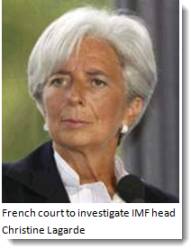 I reviewed the candidates for IMF head on May 23,
 Let the word go forth from Washington! The corporate rulers occupying our nation's capital have declared war on just about every citizen.
 The crazies in the United States House of Representatives would have you believe it were so. They say fix that budget before we'll raise the debt ceiling. If we don't get our fix, they announce, there's no deal. We'll just default until things get straightened out. (
Recent comments