Credit reports control way too much of an individual's life. A bad credit score can deny someone a job, never mind a credit card and a mortgage. The four billion dollar a year consumer credit rating industry has way too much power and almost no accountability.
The newly formed Consumer Financial Protection Bureau will start to oversee the companies who generate credit reports on you. That's Experian, Equifax and TransUnion plus about 30 more.
This action can come none too soon. Unscrupulous debt collectors inaccurately report actions to credit reporting bureaus all the time, especially for Medical bills. Getting these illegal collections or inaccuracies and errors off of one's credit report is next to impossible. Credit reporting agencies simply do not respond it seems to challenges. Experian, as an example, doesn't even have a phone number! Of course you can sue them, but even small claims court is not for the faint of heart and it's not guaranteed one will win, even when being in the right.
One of the biggest problems turning up on credit reports are medical bills. Who does not know billing from Medical facilities is loaded with errors, duplicates and mistakes? Yet more and more Medical companies are turning into the sellers of debt and even bring debt collectors into the Medical practices themselves. That's sloppy, inaccurate medical debt, often for services subpar or not rendered. Literally the health care sector is in the business of selling debt, demanding loan shark interest rates, almost the minute you walk out the door from their facility.
Could a recession occur in 2011? Under the current state of the US economy and its heavy reliance on federal spending, we could answer this question quite simply if we knew when the US government credit card will reach its limit. At some point it must; the compelling reality of mathematical compounding alone makes it impossible for any country to continue to rack up new principal and interest obligations.
The consensus is in and there is strong agreement: the US economy is on the path to a sustained recovery. 2011 will be a year of surprises on the upside, and 2012 will be even better. Among a list of the top 25 economists surveyed, not one of them predicts a recession in 2011. There is hardly any investment strategist or economist to be found who sees any risks serious enough to derail the US economy. Here is just a sample of the consensus thinking that is to be found in end-of-the year forecasts:
*Economists in universities and on Wall Street have raised their growth projections for next year. Retail sales, industrial production and factory orders are on the upswing, and new claims for unemployment benefits are trending downward. Despite persistently high unemployment, consumer confidence is improving. Large corporations are reporting healthy profits, and the Dow Jones industrial average reached a two-year high this week. – New York Times
This is the battlefield on which corporations and their customers are struggling for survival. If companies can make price increases stick, the consumer is going to bear the burden of inflation, and for a lot of consumers this can be the last gasp to bankruptcy.
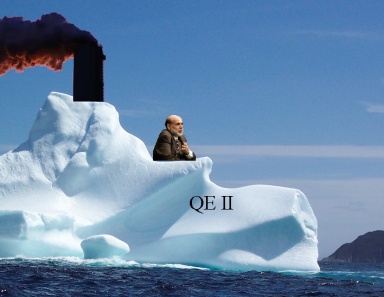
The Federal Reserve is on the defensive over its next round of Quantitative Easing, known as QE2. Over 20 distinguished economists and market analysts placed an ad yesterday in The Wall Street Journal urging the Fed to drop its plan to purchase $600 billion in Treasury securities over the next six months. Finance ministers around the world have deplored this policy for its tendency to generate global inflation and scupper the dollar on the foreign exchange markets. Even that noted financial expert Sarah Palin has published a Facebook criticism of the Fed’s “running the printing presses.”
Some Federal Reserve governors have warned about the potential inflationary implications of QE2, even though they voted for it. Fed Chairman Ben Bernanke and NY Fed President William Dudley have been in the media during the past week, justifying their QE2 decision. If you analyze their comments carefully, you realize they haven’t been helping their cause.
by Zach Carter, Media Consortium MediaWire Blogger
The U.S. economy lost nearly 600,000 jobs in January, bringing total losses in the past three months over 1.5 million—more than the entire population of Philadelphia. If there ever was a good time to mend the tattered U.S. social safety net, it's now. While unemployment benefits and food stamps remain relatively uncontroversial, basic welfare continues to be neglected by the general media and vilified by the right. And as of this moment, a responsible welfare program is needed more than at any point since the 1930s.
Look at the Base Money chart and the Reserve Bank Credit chart. Base money is soaring but all of it is sitting in bank reserves. In other words, banks are not lending. Clearly we have a huge monetary distortion, but banks seem to understand that lending money in this environment would do nothing but increase losses
Of course, Mish's article is simply received wisdom at this point. There can be no recovery until banks start lending, and they are refusing to lend.
There's just one problem with this argument: it isn't true.
I was invited by Manfrommiddletown to stray from my usual Blog home at European Tribune and post on the subject of Credit Default Swaps.
I find it hard to post on CDS without reference to the wider context, and in fact the reference here yesterday to the proposed Gas OPEC gives me the perfect excuse, since I have in recent days had a direct and intimate exposure to that initiative.
I have just returned to Scotland from ten days in Teheran, and was asked - by the head of the Iranian Majlis (Parliament) Energy Commission among others, to propose my ideas as to a possible structure for such a global gas market initiative.
For those who don't know, I was once upon a time a Director of the International Petroleum Exchange (now ICE Futures Europe), and since then have been busy in the area where markets and the Internet converge.
This is actually a continuation or sequel to yesterday's updates on the proposed plan to clean the bad debt. As news comes forward, I will update ASAP. I've been up most of the night, considering that Washington has been as well, attempting to nail something out.
Can't sleep, been thinking about the price of oil, worrying about it to be honest. Now you may be thinking "Venom, what are you crazy? A putz? A drop in the price of oil is a good thing!" And I would reply, yes, under normal circumstances it is. But these days, things ain't so normal. Actually, right now, oil is up since yesterday, but it's been in a slide for the past week or so. A prophetic lunch
A couple years ago, I had lunch with a trading friend/mentor of mine at Hackney's on Harms Road. He was an older gentleman, made his money in options, in fact was one of the first to trade at the CBOE back in the 1970s. We had just gotten back from one of those sales seminars from Equis, a company that makes a product called Metastock. While gobbling down on Hackney's infamous onion loaf and later cheeseburgers, topics ranging from the software to commodities came up. This was around 2002, and Enron was still in the headlines.
A while ago, in a diary entitled Are Hard Times near? The Great Decline in interest rates is ending I pointed out that the great decline in interest rates that began in 1981 looked like it was coming to an end, and with it American consumers' ability to refinance debt at lower rates. I noted that if consumers could no longer refinance at better terms, and if their wages weren't growing, the engine of the American economy would stall, not just for a short time, but for a very long period -- What I have called "The Slow Motion Bust."
With oil prices at $126 a barrel, and $4 a gallon gasoline, the boa constrictor of higher prices has tightened around the average American's budgetary breathing space some more. A look at how much and how consumers are coping, below.
Recent comments