Once again our daily barrage of economic injustice news is overwhelming. From lobbyist lies to interest rate swap rigging to killing workers by the hundreds to our best and brightest working jobs flipping burgers, here are some quick economic news shorts that you don't want to miss.
We have lobbyists controlling the fiscal cliff debate and the messaging:
By posing as populists hostile to “government social engineering,” the Right succeeded in duping large numbers of middle-class Americans into seeing their own interests – and their “freedom” – as in line with corporate titans.
Corporations are literally posing as grassroots activists with media appearances, twitter accounts, social media, major articles and dedicated websites, all in an effort to hoodwink the American people into signing onto having their social security cut along with their health benefits.
Pundits and Lobbyists all make huge riches ranting and prattling on how someone is stealing food stamps or how Grandma should have her social security benefits cut and denied health care. Corporate controlled financial press puts biased choices for their 1% audience. Those still ethical and objective cannot type fast enough to confront all of the lies on the fiscal cliff. We are being barraged with corporate money funded digital bitstream lies on an minute by minute basis.
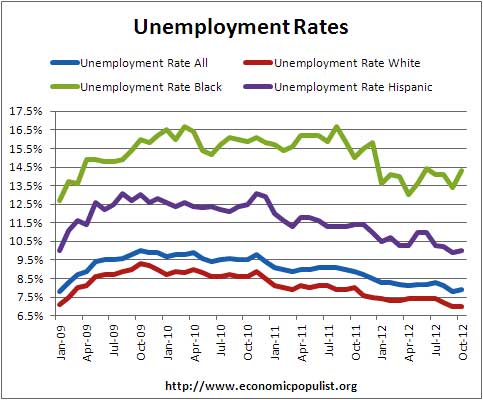
The election was won by identity politics. Black people voted for President Obama by over 93%, Hispanics 71% and Asians 73%. The exit polls show 55% of women voted for Obama, whereas 59% of white people voted for Romney. Ninety percent who thought the economy is good voted for Obama. Those who thought it is not so good voted for Romney by 60% margins.
Why Romney lost so big is a topic really outside our purview, yet we'll put in our 2¢ that it might be due to campaign rhetoric on policies promised. Unfortunately, there are words and there are deeds. What has the Obama administration done economically for the demographic groups who gave President Obama a second term?
The Federal Reserve will extend their Operation Twist past the June 2012 deadline and downgraded the economic outlook. Originally Operation Twist was $400 billion in Treasuries that were maturity dates of 3 years of less turned into T-bills with maturity dates of 6 to 30 years.
With Spain now getting a bail out all to pump up their insolvent banks, one might wonder how did we get here in the first place?
We actually are on the precipice, with a key critical Geek vote on whether or not they will default on their international bail out. Sitting on the edge of a cliff, a review of the European sovereign debt crisis and how we got here is at hand.
What the hell happened is complicated. Greece is not the same as Ireland, nor is Spain the same as Greece. Ireland's sovereign debt crisis was the direct result of their financial crisis. Greece, on the other hand, had long standing structural problems with their economy. Nor are their economies the same although treating them as such originally was part of the problem.
The St. Louis Federal Reserve Research Director Christopher Waller gave a presentation on the the European Debt Crisis. The entire May 8th, 2012 lecture is below. The focus is on debt to GDP ratios, the European Union and interest rates for sovereign bonds. We learn about the European Union's major financial structural problems versus how exactly the debt happened. There are plenty of specifics and this lecture is concise, accurate in it's scope. If you don't understand European Sovereign Debt fundamentals, watch this lecture in full and you will.
For untold millions, Walmart is not simply a place to shop, but the place. Considering that the quintessential big-box retailer claims to, and often does, offer just about every conventional item necessary for the family at an affordable price, this should be none too surprising.
However, at what cost does this convenience come, and in the grander scheme of things, is what Walmart has to offer really convenience at all? The company’s ownership would most definitely say so, as would throngs of eager consumers. Many economists, social scientists, and former employees, though, have a strikingly different opinion. While one can choose to believe whichever side of the argument he or she likes best, where do the facts lie?
First and foremost, it should be known that every single American taxpayer is essentially footing the bill for Walmart’s mere existence.
According to Reuters, this is because, as a study published last year by the City University of New York’s Hunter College Center for Community Planning showed, company employees receive inadequate health insurance coverage and in turn are left with few other options than to apply for public assistance. Beyond providing a lack of medical benefits, Walmart’s presence in most regions, says the study, "Depresses area wages....pushes out more retail jobs than it creates, and results in more retail vacancies."
You've got to be kidding me. We have a strong case of what people say, what dogs hear. Federal Reserve Chairman Ben Bernanke gave a speech today on the labor market. Surprise, surprise, the jobs market still sucks. Yet Wall Street didn't hear about the plight of working America. Nope, they only heard what they want to hear, the possibility of QE3, otherwise known as quantitative easing.
Ben Bernanke's speech acknowledged the pain and suffering endured by the United States worker. One would think the below quote would bring tears to Wall Street's eyes:
Those who have experienced unemployment know the burdens that it creates, and a growing academic literature documents some dimensions of those burdens. For example, research has shown that workers who lose previously stable jobs experience sharp declines in earnings that may last for many years, even after they find new work. Surveys indicate that more than one-half of the households experiencing long unemployment spells since the onset of the recent recession withdrew money from savings and retirement accounts to cover expenses, one-half borrowed money from family and friends, and one-third struggled to meet housing expenses. Unemployment also takes a toll on people's health and may have long-term consequences for the families of the unemployed as well. For example, studies suggest that unemployed people suffer from a higher incidence of stress-related health problems such as depression, stroke, and heart disease, and they may have a lower life expectancy. The children of the unemployed achieve less in school and appear to have reduced long-term earnings prospects
If you watch most media you'd never guess what's the real America. From television shows where minimum wage jobs pay rent on $2000 a month flats, to families who never seem to run out of money or get foreclosed on, to messages of if only you follow some green line you'll have enough money for retirement, a never ending weave of fiction is spun. Like prey in the spider's web of tall tales, we're stunned and hypnotized into no longer seeing the poverty and despair all around us.
The Money Party is a very small group of enterprises and individuals who control almost all of the money and power in the United States. They use their money and power to make more money and gain more power. It's not about Republicans versus Democrats. The Money Party is an equal opportunity employer. It has no permanent friends or enemies, just permanent interests. Democrats are as welcome as Republicans to this party. It’s all good when you’re on the take and the take is legal. Economic Populist
Negative job growth for eleven years is the best evidence concerning our economic troubles. There were 135 million jobs in 2000 for a workforce of 144 million. Today, there are 139 million jobs for a workforce of 154 million. That represents negative job growth when you factor in population growth.
The headquarters of JPMorgan Chase in New York. A JPMorgan research report concludes that the current corporate profit recovery is more dependent on falling unit-labor costs than during any previous expansion. (Photo: Jessica Ebelhar / The New York Times)
Christina Romer, former member of President Obama's Council of Economic Advisors, accuses the administration of "shamefully ignoring" the unemployed. Paul Krugman echoes her concerns, observing that Washington has lost interest in "the forgotten millions." America's unemployed have been ignored and forgotten, but they are far from superfluous. Over the last two years, out-of-work Americans have played a critical role in helping the richest one percent recover trillions in financial wealth.
Obama's advisers often congratulate themselves for avoiding another Great Depression - an assertion not amenable to serious analysis or debate. A better way to evaluate their claims is to compare the US economy to other rich countries over the last few years.
On the basis of sustaining economic growth, the United States is doing better than nearly all advanced economies. From the first quarter of 2008 to the end of 2010, US gross domestic product (GDP) growth outperformed every G-7 country except Canada.
But when it comes to jobs, US policymakers fall short of their rosy self-evaluations. Despite the second-highest economic growth, Paul Wiseman of the Associated Press (AP) reports:
The U.S. job market remains the group's weakest. U.S. employment bottomed and started growing again a year ago, but there are still 5.4 percent fewer American jobs than in December 2007. That's a much sharper drop than in any other G-7 country.
Recent comments