Feed aggregator

Taiwan Test Fires US Mobile Launchers Into Waters Directly Facing China For First Time

Zero Hedge -

Taiwan Test Fires US Mobile Launchers Into Waters Directly Facing China For First Time

China's PLA military has long been known to intimidate and threaten the self-ruled island of Taiwan, mainly with large military exercises which sometime encircle it partially or completely, or else with a heavy naval boat presence in the Strait of Hormuz.

Taiwan's military often reacts by scrambling its own fighter jets to closely monitor the PLA maneuvers - seen as a natural defensive and reactive move. But this week, in a rare moment, Taiwan is finally doing some proactive flexing of its own.

EPA-EFE

"Taiwan fired U.S. mobile missile launchers into the strategic waters directly facing China for the first time, sending a message of resolve to Beijing and Washington," The Wall Street Journal reports.

This involved over 30 test rocket launches via truck-mounted High Mobility Artillery Rocket Systems, or HIMARS. Importantly, the launch site was an area near a river mouth on Taiwan's western coast.

"This is sending a message to the Chinese that they are going to get hit hard if they try to come across the strait—and will end up with far fewer ships than they started with," Grant Newsham, a retired US Marine colonel who served in several Indo-Pacific roles, told WSJ.

The WSJ continues with further context:

The drill was the highlight of two days of military exercises showcasing Taiwan’s preparations to combat an amphibious invasion. China considers democratically self-ruled Taiwan as part of its territory and hasn’t ruled out potentially using force to absorb the island.

...Such exercises also serve as a signal to Washington that Taiwan is committed to defending itself and deserves U.S. support, with a $14 billion U.S. arms package currently on hold.

Back in April, Chinese President Xi Jinping addressed cross-strait relations: "All sons and daughters of China share the same Chinese roots and the same Chinese spirit. This originates from blood ties and is deeply embedded in our history – it cannot be forgotten and cannot be erased," he said at the time.

Officially, Biejing seeks a 'peaceful reunification' of the independent island to the mainland, while many Washington officials fear it could at any point launch an outright invasion and political takeover.

But the reality remains that any PLA direct military intervention would likely be in response to a provocation, and wouldn't just materialize out of thin air. Beijing has at times warned that the growing billions of dollars in arms that Washington has been providing Taiwan could be just such a provocation. 

Xi's China has also been very alarmed at the growing (direct) US military footprint in its own backyard, given the presence of American military advisers, said to be present in some of Taiwan's small islands which lie close to the Chinese mainland.

Tyler Durden Wed, 06/10/2026 - 11:05

Veterans Health Care: Scheduling Systems and Related Challenges

GAO -

What GAO Found The Department of Veterans Affairs (VA) uses dozens of systems to schedule appointments, manage referrals, and monitor wait times for veterans. The department is also in the process of replacing its primary health information system—the Veterans Health Information Systems and Technology Architecture (VistA)—by deploying a new electronic health record system with Oracle Health. However, the rollout of the new system has been delayed due to technical and performance issues. Some of those scheduling systems and tools are commonly used across the department by many VistA facilities. Schedulers at the handful of facilities that have the new Oracle Health system also have an additional set of scheduling systems and tools available. For example: VistA facilities. Almost allVA medical facilities use the VistA health information system, which is over 30 years old. These facilities use multiple VistA applications, in addition to other systems, for scheduling health care appointments and managing referrals for specialty care. Both schedulers and veterans must navigate a complex environment when using VA’s systems to schedule appointments. VA facility staff are required to open multiple applications to schedule a single appointment. They must also run reports in different systems to identify veteran self-scheduled and self-canceled appointments and appointment requests. Oracle Health facilities. Due to difficulties in rollout, very few facilities have begun to use the new Oracle Health system. These facilities have another set of scheduling systems, as well as some of the same systems VistA facilities use for scheduling appointments and managing referrals. In addition, veterans have experienced issues requesting an appointment online, getting confirmation once an appointment is scheduled, and receiving duplicative appointment reminders. This complex systems environment presents challenges for VA and for veterans scheduling appointments. VA officials acknowledge that some challenges are the result of operating multiple platforms (VistA and Oracle Health) as well as having multiple versions of VistA. VA is taking steps to address these challenges. VA initiated efforts to modernize its scheduling systems, which included several concurrent efforts to improve scheduling-related systems across VA’s medical facilities. For example, one of these efforts is intended to allow provider-based scheduling, which is the ability for VA schedulers to see a provider’s schedule across multiple modalities (in-person, telephone, telehealth) in a single scheduling application. According to VA officials, the department is also working to standardize veteran appointment self-scheduling at VistA and Oracle Health sites. GAO has reported for many years on VA’s challenges concerning its scheduling systems and their impact on delivering care to veterans. Although VA has generally agreed with GAO’s recommendations, it has not yet fully implemented them. Doing so would aid VA’s progress toward providing timely, quality care to veterans. Why GAO Did This Study The VA schedules tens of millions of health care appointments for veterans each year. To do so, it uses a patchwork of systems that have been developed in ways that make scheduling—with both Veterans Health Administration (VHA) and non-VHA providers—difficult for veterans and staff. In addition, VA has experienced information technology (IT) challenges related to the outdated, inefficient nature of systems and its efforts to modernize its health information system. VA health care was added to GAO’s High Risk List in 2015, where it remains today. GAO was asked to testify on its key prior work on VA scheduling and the systems involved, as well as the related challenges for VA providers, staff, and veterans, and how VA plans to address those challenges. GAO summarized the results of five prior reports.

Categories -

Americans' Real Wages Are Shrinking As CPI Tops 4% For First Time In 3 Years

Zero Hedge -

Americans' Real Wages Are Shrinking As CPI Tops 4% For First Time In 3 Years

With expectations of a 4%-plus print, all eyes are on this morning's CPI report as we move past April's shutdown-related distortions.

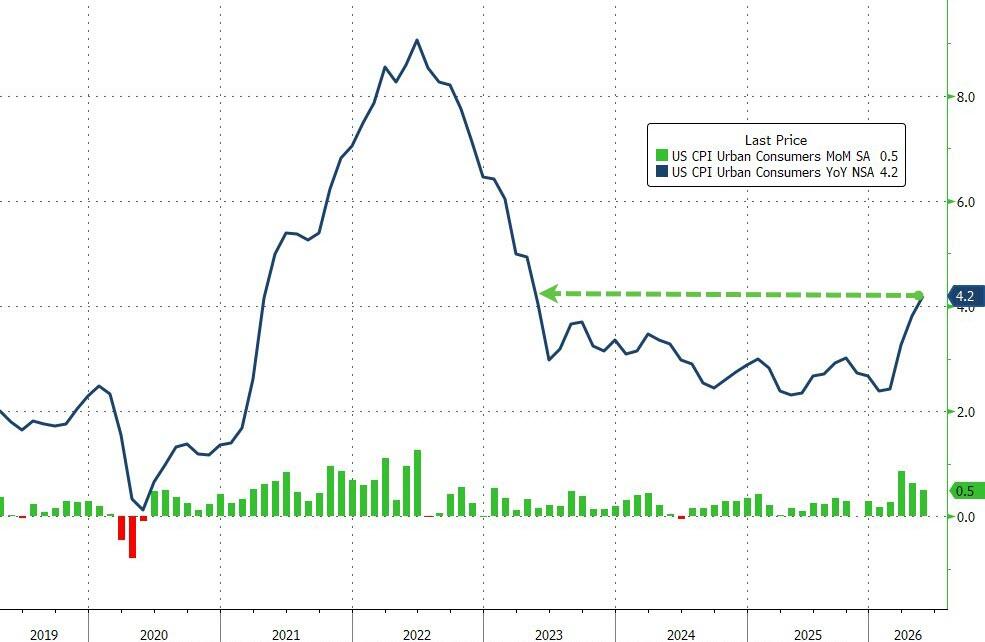
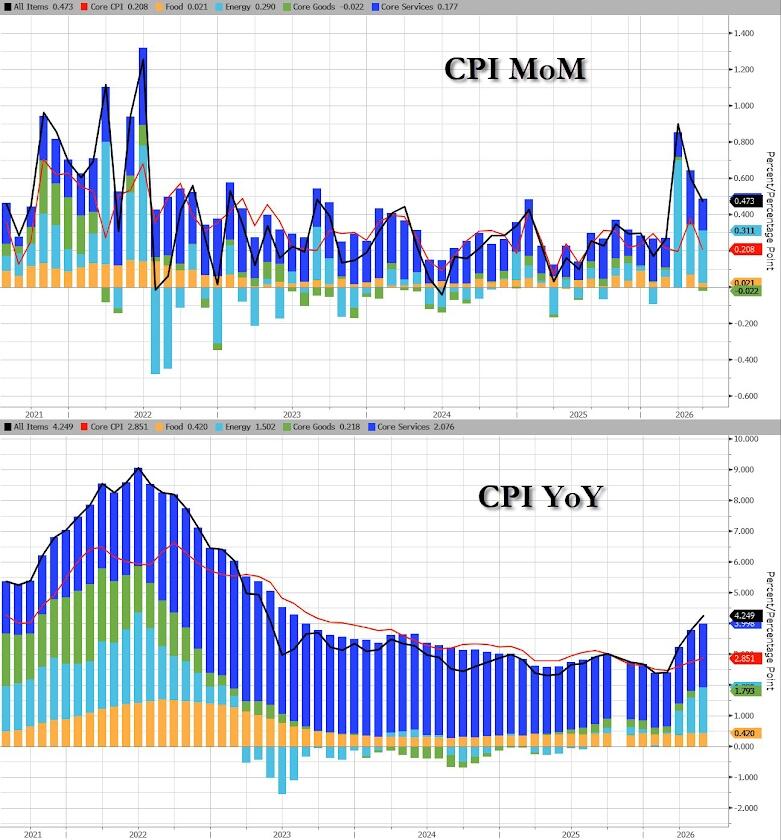
Headline CPI rose 0.5% MoM (as expected) in May, lifting prices 4.2% YoY (also as expected). The first 4%-plus print since April 2023...

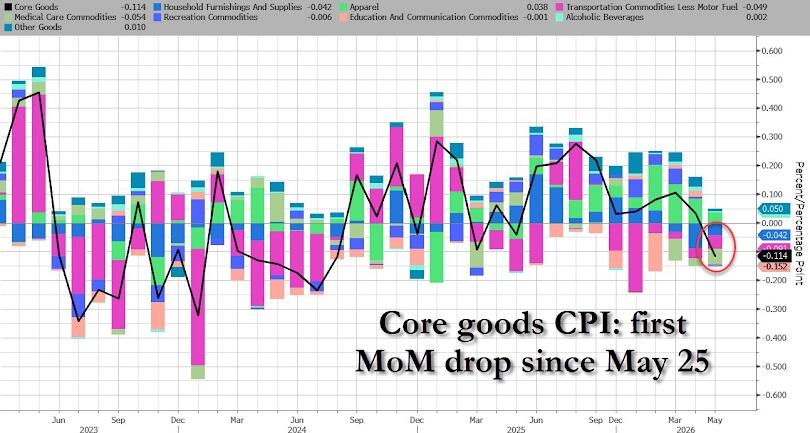
Core Goods prices deflated in May while Energy remains a notable contributor...

CPI details:

Headline: The all items index rose 4.2 percent for the 12 months ending May, after rising 3.8 percent for the 12 months ending April. The all items less food and energy index rose 2.9 percent over the year, following a 2.8-percent increase over the 12 months ending April. The energy index increased 23.5 percent for the 12 months ending May. The food index increased 3.1 percent over the last year

  • The index for energy rose 3.9% in May, after rising 3.8% in April and 10.9% in March. The energy index accounted for over 60% of the monthly all items increase. The index for shelter also increased in May, rising 0.3 percent.
  • The food index increased 0.2% over the month as the food at home index rose 0.1% and the food away from home index increased 0.3%.

This is the first deflationary print for goods prices in a year...

  • Household furnishings and Supplies -0.042%

  • Transportation Commodities less motor oil: -0.49%

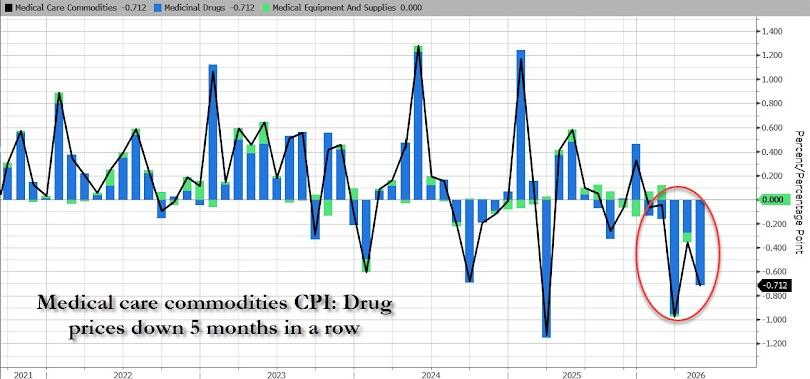
  • Medical Care Commodities -0.54%

Drug prices are down for the fifth month in a row...

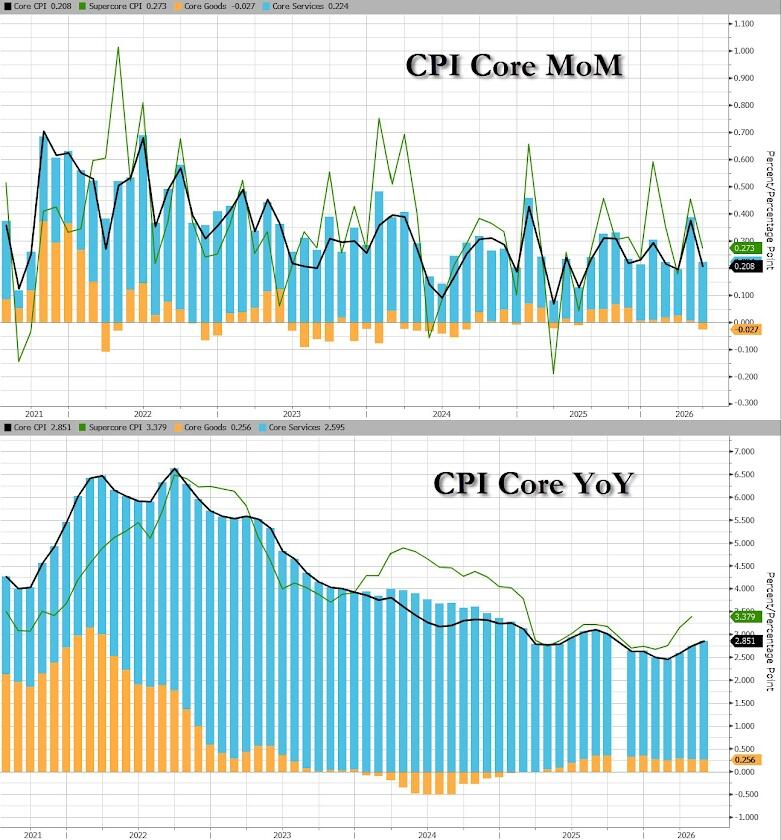
Core CPI rose less than expected (+0.2% MoM vs +0.3% MoM exp), lifting prices by 2.9% YoY (as expected), up from April's 2.8% YoY and the highest since Sept 2025...

Core Services costs are accelerating...

Core: The index for all items less food and energy rose 0.2% in May.

Indexes that increased over the month include communication, airline fares, medical care, personal care, and recreation.

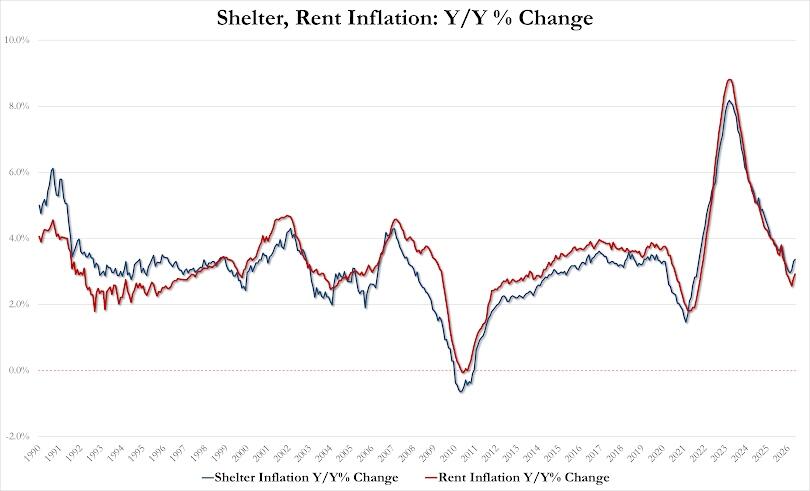
  • The shelter index increased 0.3% over the month.
    • The index for owners’ equivalent rent rose 0.3 percent in May and the index for rent increased 0.4 percent.
    • The lodging away from home index also rose 0.4 percent over the month.

  • The index for communication increased 1.3 percent over the month, after falling 0.2 percent in April.
  • The airline fares index rose 2.7 percent in May and the personal care index rose 1.0 percent.
  • The index for recreation rose 0.3 percent over the month as did the index for apparel.
  • The used cars and trucks index increased 0.1 percent in May
  • The medical care index increased 0.3 percent in May, after falling 0.1 percent in April.
  • The index for hospital services increased 0.7 percent over the month.

On the other hand, the indexes for motor vehicle insurance, household furnishings and operations, and new vehicles were among the major indexes that decreased in May.

  • Conversely, the prescription drugs index decreased 0.9 percent over the month while the physicians’ services index was unchanged in May.
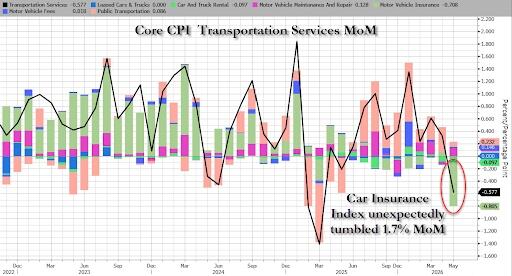
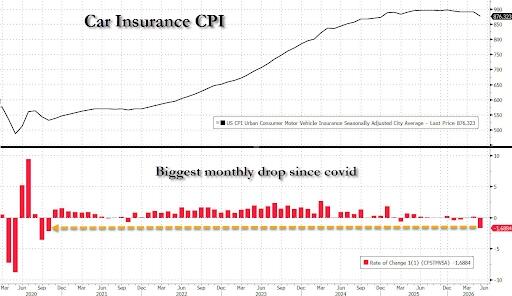
  • The motor vehicle insurance index declined 1.7 percent in May after rising 0.1 percent in April.
  • The index for household furnishings and operations fell 0.6 percent over the month and the index for new vehicles declined 0.3 percent.

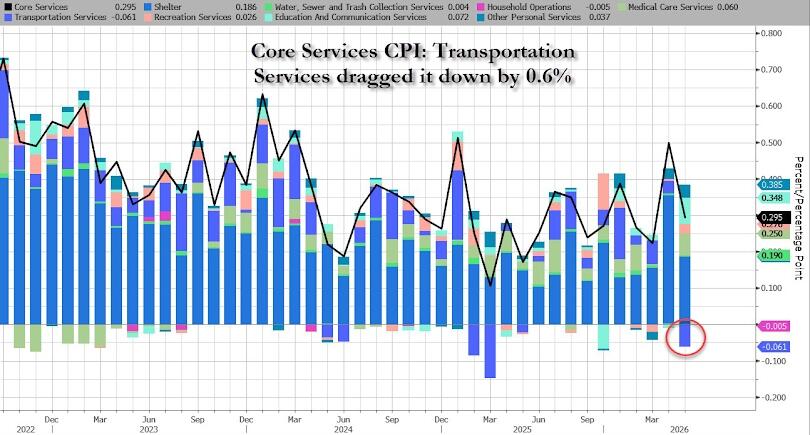
Transportation Services deflated MoM...

...led by the unexpected drop in Insurance costs...

That is the biggest drop in vehicle insurance costs since COVID...

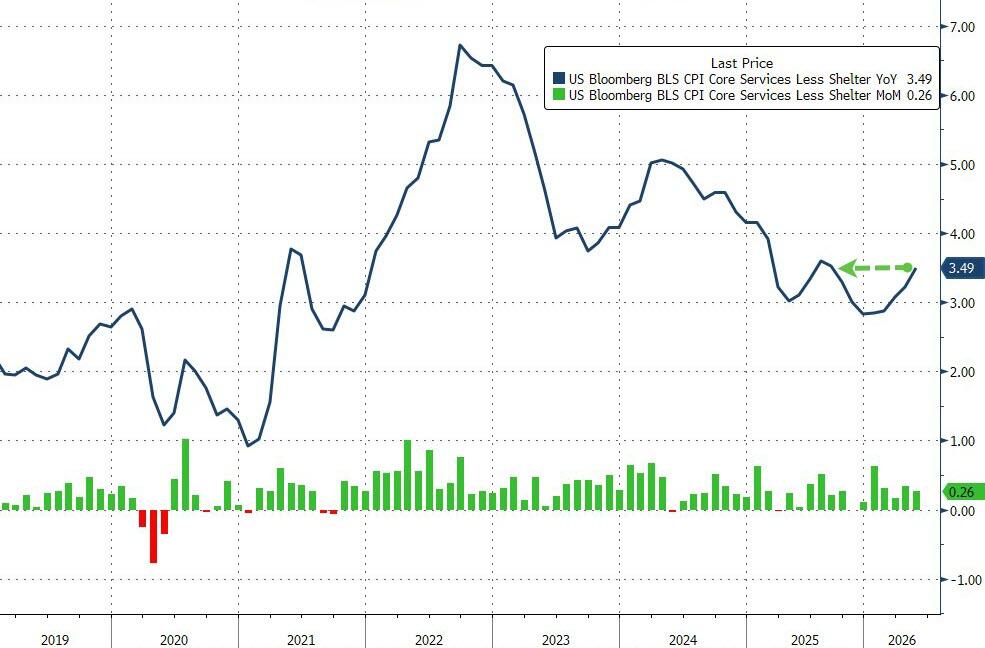
Goods inflation overall is trending lower while Services costs are accelerating...

The much-watched SuperCore CPI (Core Services Ex-Shelter) saw prices rise 0.26% MoM and 3.49% YoY (highest sine Aug 2025)..

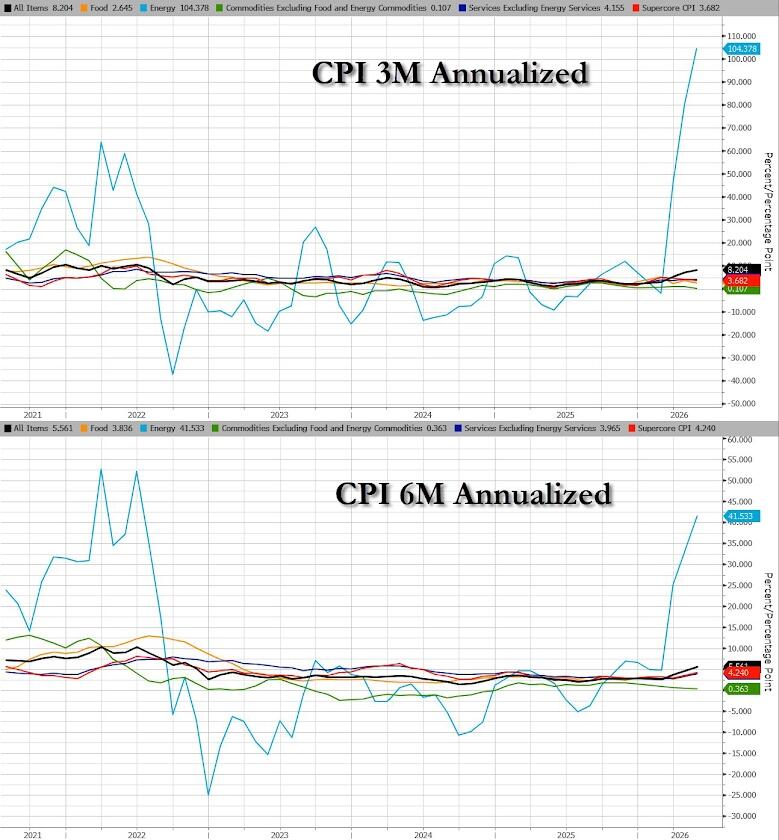
On a shorter-term basis, its all about energy...

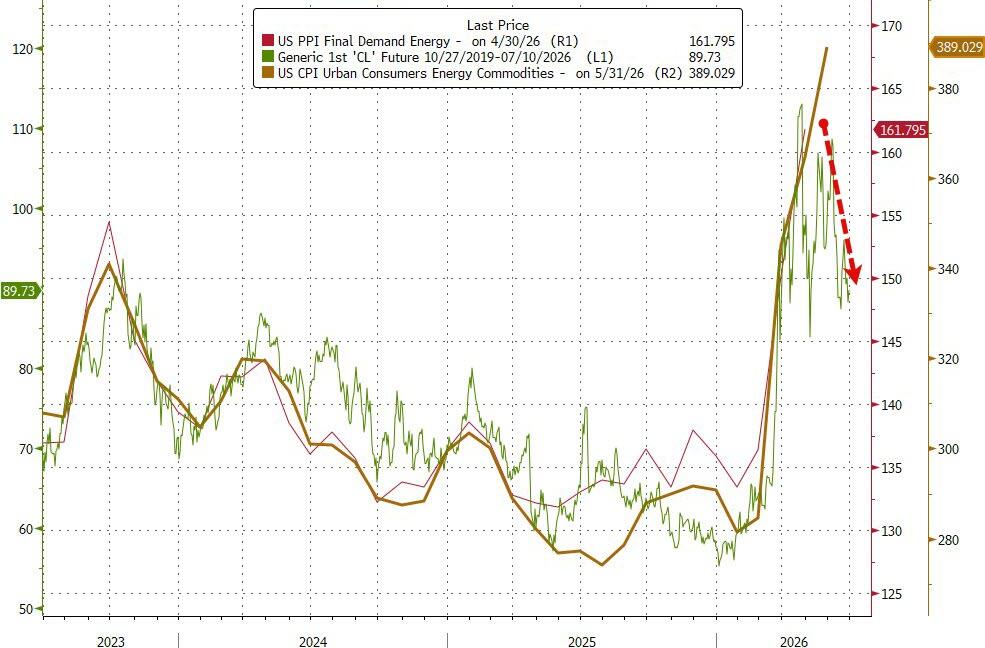
But, is this the peak of Energy-cost-driven inflation?

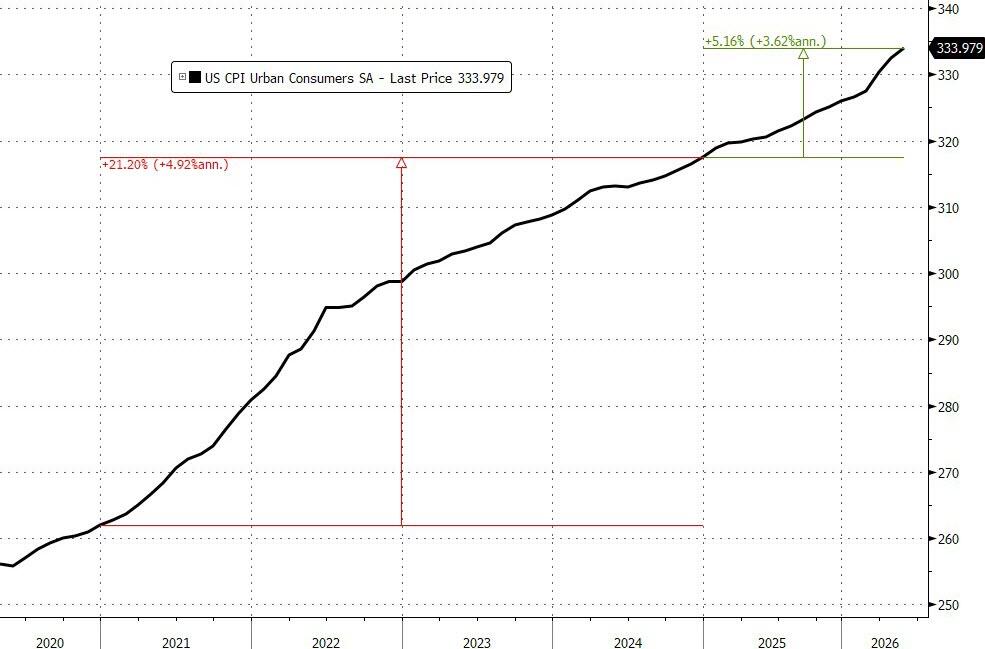
This leaves headline consumer prices up 5.16% since President Trump came to office...

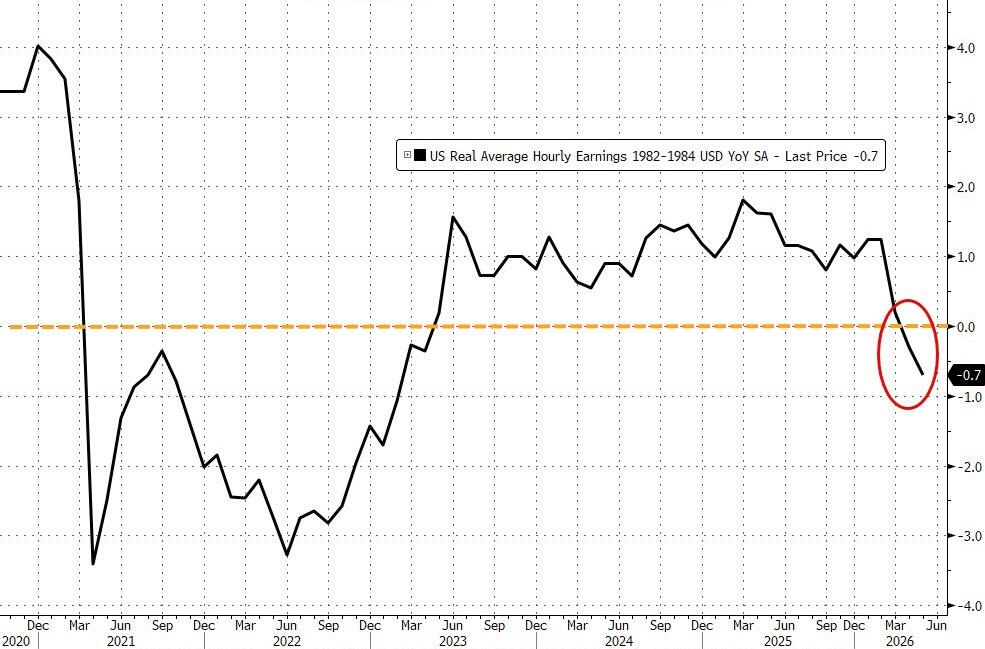
And perhaps most notably, Americans' real wages are shrinking on a YoY basis (for the first time since April 2023)...

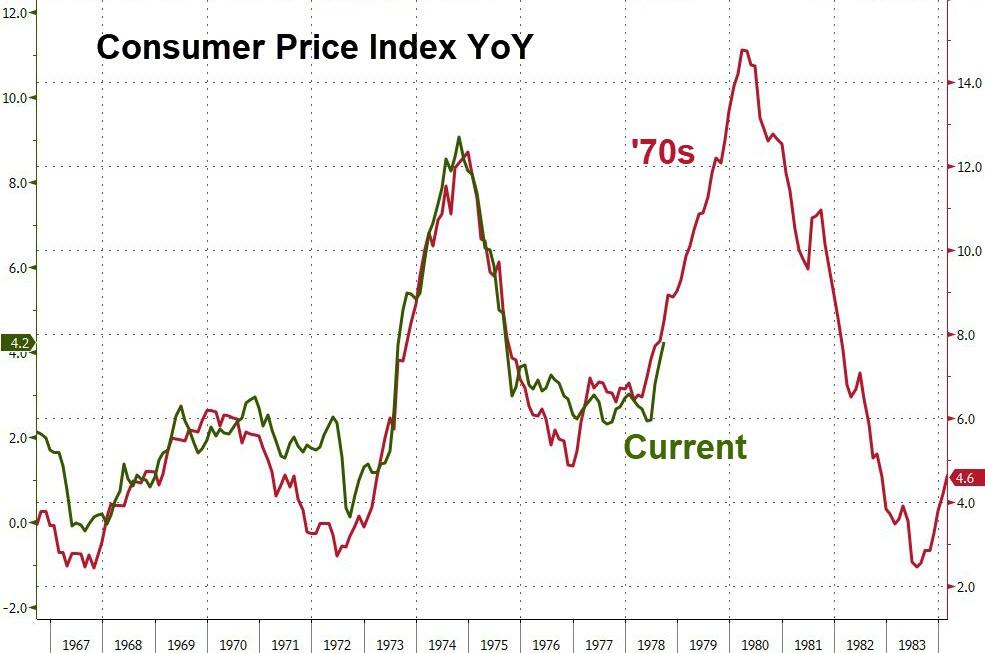
Let's just hope this analog fails here...

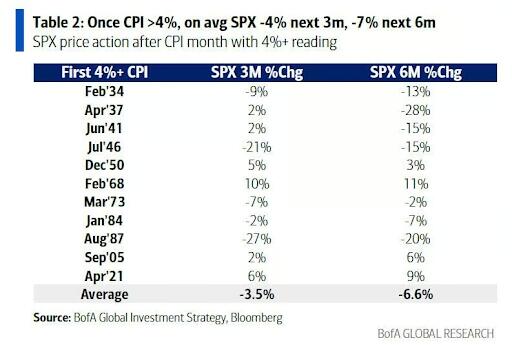
BofA's Michael Hartnett previously warned that a May print above 0.4% (estimates currently have it a 0.6%) means US CPI >4% YoY and on course for 5% by US midterms, and risk assets get twitchy: in the past 100 years once CPI crosses 4% on average, the S&P is down 4% in the next 3 months, and down 7% next 6 month...

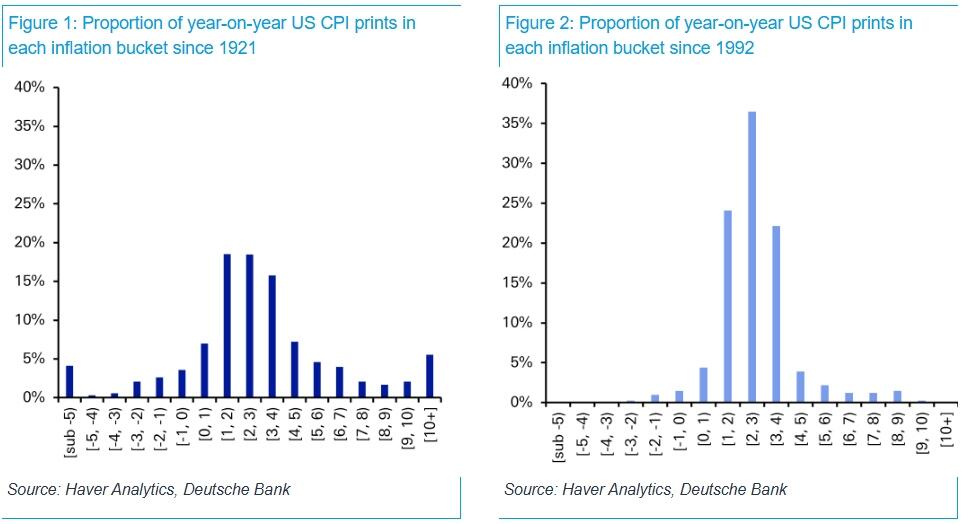
Finally, while nattering nabobs of mainstream media will be decrying Trump's terrible record on prices, Deutsche Bank's Jim Reid notes that when looked at over the full century, inflation above 4% is not especially rare: over a quarter of monthly observations have exceeded this level.

However, these episodes have tended to arrive in distinct waves - most notably around WWII, during the 1970s, and more briefly in the post-Covid period.

Smaller but still meaningful pockets also appeared during the late-1980s boom and ahead of the GFC.

The more recent experience looks very different.

Since 1992, 83% of observations have sat comfortably in the 1–4% range, with just 10% printing above 4%. For most market participants, then, inflation above 4% has been an exception rather than the rule.

The key question is whether the future looks more like the last 35 years or the full 105-year monthly history.

While there are no immediate signs of inflation running away, the disinflationary environment of the past few decades benefited from a set of unusually supportive, and largely non-repeatable, global forces.

So going forward the template from the last century rather than the last few decades will probably be the better guide.

Tyler Durden Wed, 06/10/2026 - 09:44

Amazon Freight Expansion Sparks Selloff Across Trucking Stocks

Zero Hedge -

Amazon Freight Expansion Sparks Selloff Across Trucking Stocks

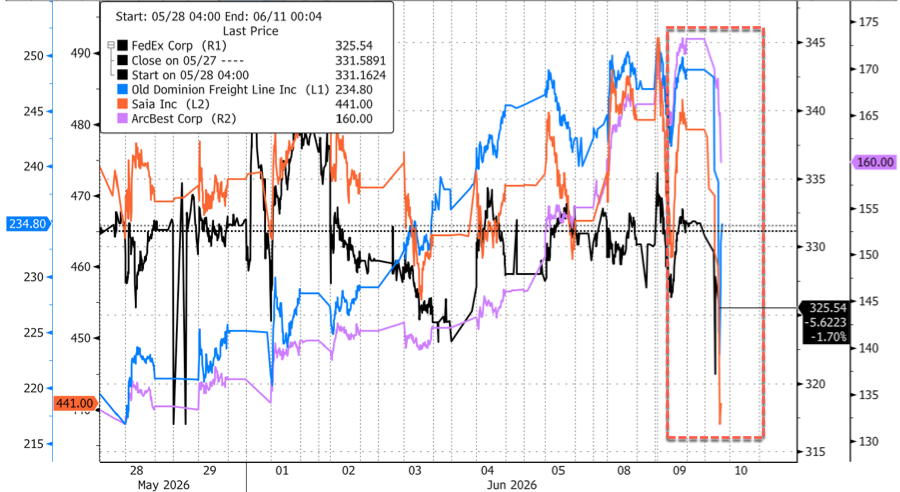
Less-than-truckload freight stocks fell in premarket trading in New York after Amazon roiled the industry yet again - this time by announcing expanded LTL services to cover all U.S. destinations, including third-party warehouses, distribution centers, and retail partners.

"Businesses now have the flexibility to ship by pallet, choosing LTL to share trailer space for partial loads instead of reserving and paying for a full truckload," Amazon wrote in a press release, adding, "Since 2019, Amazon LTL has served tens of thousands of Amazon selling partners and vendors, moving millions of pallets across its U.S. network last year. The company is now expanding the service based on strong positive feedback and growing customer demand." 

Among the movers in premarket trading, FedEx Freight fell 2%, Old Dominion declined 6%, Saia sank 7%, and ArcBest dropped nearly 8%.

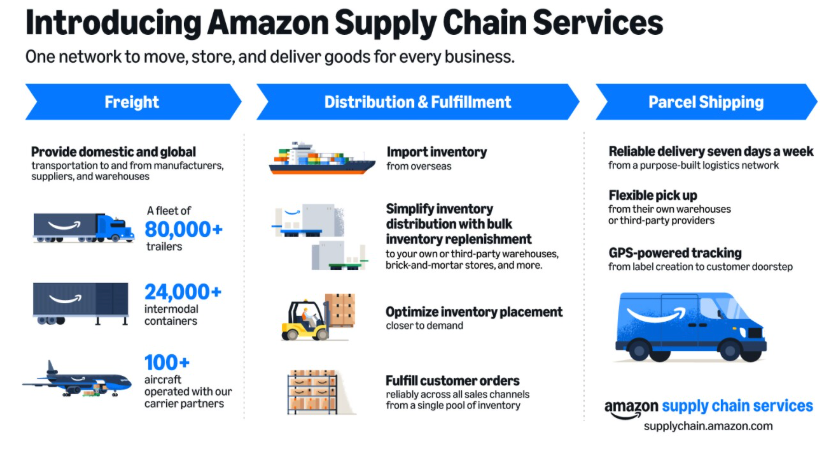
LTL services are part of Amazon Supply Chain Services, whose launch last month roiled trucking stocks at the time.

Amazon noted, "Businesses of all sizes can now use LTL to move freight, typically ranging from one to six pallets, or between 150 and 15,000 pounds."

UBS senior analyst Tom Wadewitz, who covers freight transportation, told clients last month that the selloff in transport names, including UPS, FedEx, and C.H. Robinson, sparked by Amazon’s push into the supply chain network, was "overdone."

Tyler Durden Wed, 06/10/2026 - 09:40

Priority Open Recommendations: Department of the Interior

GAO -

What GAO Found In May 2025, GAO identified 14 priority recommendations for the Department of the Interior. Since then, Interior has implemented one of those recommendations. In May 2026, GAO identified an additional 2 priority recommendations and removed the priority status from one recommendation, bringing the total to 14. GAO is highlighting the following two areas that warrant timely and focused attention: Improving oversight of oil and gas activities, and Conducting strategic workforce planning and oversight. Addressing GAO's recommendations in these areas would enhance Interior's ability to oversee oil and gas development—which provides billions of dollars of revenue—and help Interior develop strategies to close skill gaps and better understand the resources it needs to improve its overall capacity and fulfill its trust responsibility. Taking action to implement all of GAO's open priority recommendations would help enhance the efficiency and effectiveness of operations across Interior. Why GAO Did This Study Priority open recommendations are the GAO recommendations that warrant priority attention from heads of key departments or agencies because their implementation could save large amounts of money; improve congressional and/or executive branch decision-making on major issues; eliminate mismanagement, fraud, and abuse; or make progress toward addressing a high risk or duplication issue, among other benefits. Since 2015, GAO has sent letters to selected agencies to highlight the importance of implementing such recommendations. For more information, please contact Allison Bawden at BawdenA@gao.gov.

Categories -

Priority Open Recommendations: Department of Health and Human Services

GAO -

What GAO Found In May 2025, GAO identified 35 priority recommendations for the Department of Health and Human Services (HHS). Since then, HHS has implemented four of those recommendations. In May 2026, GAO identified an additional seven priority recommendations, bringing the total to 38. GAO is highlighting the following two areas that warrant timely and focused attention: Strengthen Medicare and Medicaid program integrity and oversight; and Improve public health program oversight and coordination. Taking action to implement GAO's open recommendations in these areas would help increase the efficiency and effectiveness of key federal health care programs and funding. It would also help officials understand how prepared jurisdictions are to respond to public health emergencies. Addressing all of GAO's open priority recommendations could significantly improve HHS's operations. Why GAO Did This Study Priority open recommendations are the GAO recommendations that warrant priority attention from heads of key departments or agencies because their implementation could save large amounts of money; improve congressional and/or executive branch decision-making on major issues; eliminate mismanagement, fraud, and abuse; or make progress toward addressing a high risk or duplication issue, among other benefits. Since 2015, GAO has sent letters to selected agencies to highlight the importance of implementing such recommendations. For more information, please contact Jessica Farb at farbj@gao.gov.

Categories -

Ukraine Hits Over Half A Dozen Energy & Industrial Sites Deep Inside Russia Overnight

Zero Hedge -

Ukraine Hits Over Half A Dozen Energy & Industrial Sites Deep Inside Russia Overnight

Ukraine has hit Russia in another sweeping wave of overnight aerial attacks, especially targeting industrial facilities and energy infrastructure across multiple regions, and the extent of damage is yet to be disclosed.

One of the key targets was reportedly the VNIIR-Progress plant, located in the republic of Chuvashia, which is alleged by Ukraine and the West to manufactures components for Russian drones and bombs. Other nearby infrastructure was also attacked.

via Telegram

Ukraine has for months been making clear that it is going gloves off when it comes to attacking Russia's energy and military sites, as well as dual use military-industrial factories. Ukraine used its domestic-made Flamingo cruise missile:

Ukrainian forces have carried out a missile attack deep inside Russia, hitting a major military plant overnight, President Volodymyr Zelensky has said.

He said FP-5 Flamingo cruise missiles struck the drone and missile plant in the city of Cheboksary, in the Chuvash Republic, more than 900km (560 miles) from the front line. Local officials say said three people were injured in a missile attack on the city.

Ukraine also said it had hit the Moscow-occupied port of Mariupol on the Sea of Azov, a Russian oil refinery in Samara and a "shadow fleet" oil tanker in the Black Sea.

According to a review of sensitive sites struck in the fresh overnight attack wave:

  • In Novokuibyshevsk in Russia’s Samara oil hub region, hosting Rosneft refineries, regional governors said authorities repelled drone attacks while urging one million residents to seek shelter. Russian OSINT channel Astra confirmed the Kuibyshevsk oil refinery was burning after at least 29 drones attacked.
  • In Russia’s Rostov region bordering Ukraine, falling debris from a drone triggered a fire in a fuel tank at a civilian site. In the central Vladimir region, two industrial facilities were ablaze.
  • Rare air raid alerts were issued in remote oil-producing regions Khanty-Mansiysk, Perm and Tyumen, plus industrial Ural mountain regions Chelyabinsk and Sverdlovsk.

Chuvashia regional governor Oleg Nikolayev blasted the strike on the aforementioned manufacturing plant as indicative of the "impotent rage of terrorists who, having no success at the front line, try to intimidate peaceful people in the rear."

All of these strike waves in disparate places is likely invite even greater airstrikes on Kiev, after the capital has already been hit hard over the past several weeks.

President Putin and top military brass had last month said strikes would be initiated against "decision-making centers" in response to the dorm attack in the Russia’s Lugansk People’s Republic on May 22, which killed 21 people - mostly teenage girls - and injured 70 others.

Kremlin officials now say that Russian forces have "a right to dismantle any infrastructure that supports terrorism."

But it's also these constant attacks on oil and industrial sites that little by little will put immense strain on Russia's economy and the populace. The salvos out of Ukraine will keep coming, especially as Moscow continues to maintain the 'special military operation' at a slow, grinding pace.

Tyler Durden Wed, 06/10/2026 - 09:05

Graham Platner Wins Maine Senate Democratic Nomination, Locking In Face-Off With Collins

Zero Hedge -

Graham Platner Wins Maine Senate Democratic Nomination, Locking In Face-Off With Collins

Authored by Joseph Lord via The Epoch Times,

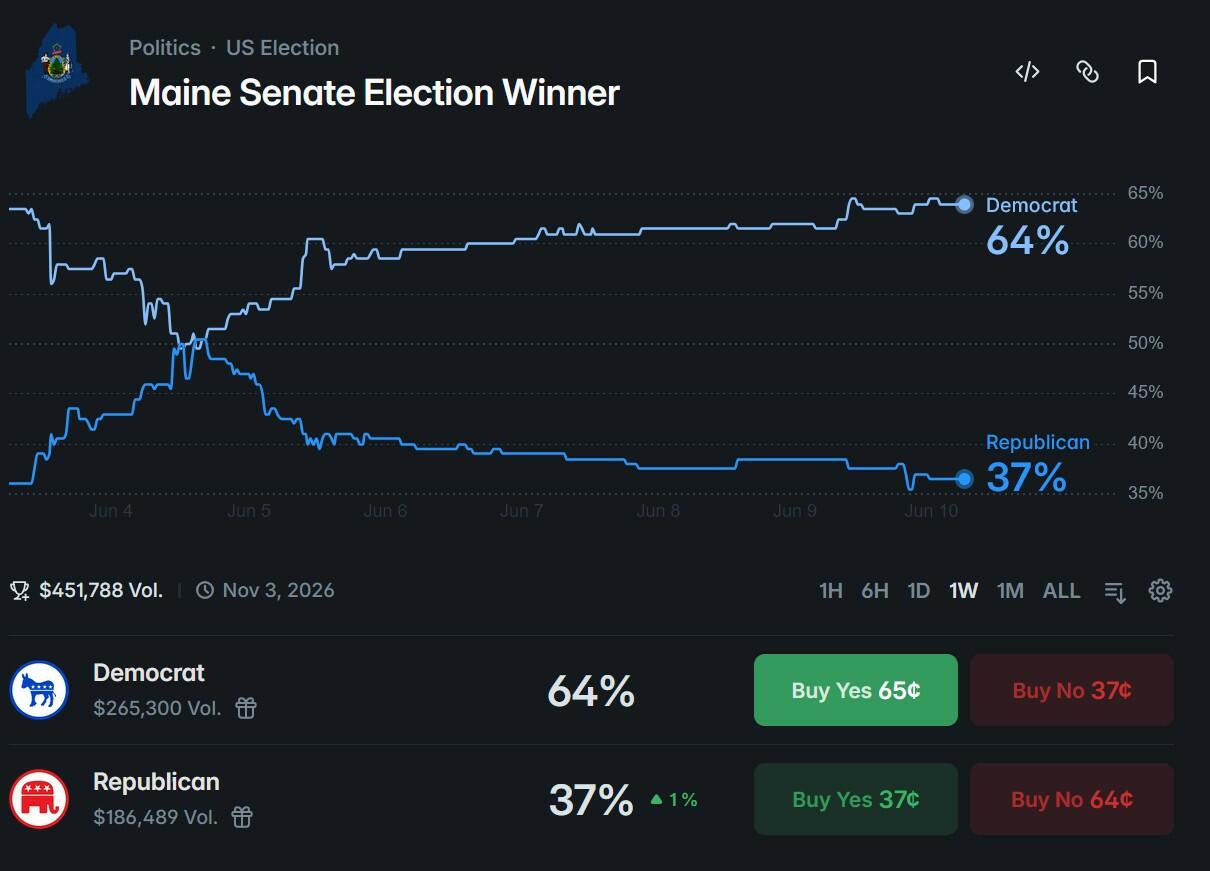
Democratic voters in Maine on Tuesday nominated oysterman and military veteran Graham Platner as their candidate to take on incumbent Sen. Susan Collins (R-Maine), locking in the nominees for one of the most critical Senate elections of the 2026 cycle.

Graham Platner, Democratic candidate for U.S. Senate, greets supporters after speaking at an event hosted by Sen. Bernie Sanders (I-Vt.) in Orono, Maine, on May 24, 2026. Robert F. Bukaty/AP Photo

At 9:23 p.m, The Associated Press formally declared that Platner would be the Democratic nominee. When the race was called, Platner led Gov. Janet Mills - who withdrew her candidacy after polls showed her trailing the dark horse Platner - by tens of percent, though only around 8 percent of the votes were in when the race was called.

Platner's campaign recently come under scrutiny after several media reports about his past treatment of women and other controversies.

Platner's victory formalizes the 2026 Senate lineup, locking in the final picks for a race that has been characterized as the political fight of Collins's life by many observers.

The five-term Collins was first elected in 1996 and has held on long beyond any other New England Republican at the federal level.

This year, she faced no Republican challenger for the nomination.

Though she regularly breaks with President Donald Trump and her party in the upper chamber, the political odds for a Republican in statewide matches have grown increasingly grim in recent years.

Aside from Collins, the last Republican to win a statewide federal race in New England was Kelly Ayotte, a New Hampshire Republican who won a single term to the Senate in 2010 before being unseated by Sen. Maggie Hassan (D-N.H.) in 2016.

Maine has never voted for Trump on a statewide level, with Vice President Kamala Harris winning by around 7 percent in 2024.

But Collins's brand of moderate, old-school Republicanism has kept her well ahead of most other Republicans in the state.

In 2020, Collins outran Trump by around 17 percent in Maine, defeating her Democratic rival by around eight points in an election former President Joe Biden won by around nine points.

Still, polls have painted a tough picture for Collins, who has fallen behind Platner in most polls conducted since March.

Platner has campaigned as a progressive candidate, winning the endorsement of key figures such as Sen. Bernie Sanders (I-Vt.) and Rep. Alexandria Ocasio-Cortez (D-N.Y.).

However, his campaign has faced some controversies.

The New York Times has run various stories against Platner, which include claims made by Lyndsey Fifield, a Republican political strategist who previously dated him.

Fifield claimed that on one occasion, while they were dating between 2013 and 2015, Platner twisted her arm. The New York Times stated in the article that it was unable to independently corroborate the allegation, which Platner has denied.

A report by The Wall Street Journal also relayed a story involving Platner exchanging sexually explicit text messages with other women during his marriage.

His wife, who knew about the infidelity, had shared the information with a campaign staffer, who later brought the story to The Wall Street Journal. Platner's wife has described the public reporting on the topic as "shameful" gossip.

Polymarket Tyler Durden Wed, 06/10/2026 - 08:50

Claude: What Are You Good At?

The Big Picture -


Last week, I was up in Montreal for a keynote presentation to 750 Bank RIAs. Morgan Housel was the keynote the day before (tough act to follow!).

Today, I am speaking with an old friend, Paul Kedrosky, about all things technology on the pod. Paul is a fascinating guy with an interesting background and an unusual set of interests — Science nerd, VC, academic, writer, skier, and among the last of the landed gentry in America. Artificial Intelligence is certain to come up.

During the Q&A in Montreal, I was taken aback by how many questions there were about AI — not the usual “Is it a bubble” line of inquiry, but rather, what are the best use cases? Should AI be used to create content (No!), research (Yes!). There were so many legitimate questions about AI that I decided to dig a little further.

I will definitely be asking Paul about his views, but until then, I had a little chat about how to best use AI with Claude, see what AI itself had to say on the topic of using AI.

Most agentic generated content is pretty bad — it’s great for research, but using AI for any kind of writing, prose, or content creation is a terrible idea. The reason I am sharing Claude’s responses is that A) I found the answers very useful, and, 2) I edited it down to size to make it mostly readable. (I also moved the more pedantic answers to footnotes).

Here is my conversation with Claude about AI, edited for length; (underlining is my emphasis added).

Let’s go:

Barry: Let’s discuss YOU, Claude — What are your best strengths, what are your weaknesses? What do you do really well? What do you do really poorly?  How can I best use your strengths to make my work product better?  What else should I be doing with you to be better?

Claude: Good question to actually sit with rather than give you the brochure version. Let me be specific to the kind of work you do.

Where I’m genuinely strong

Transformation and synthesis. Hand me raw material — a Fidelity CSV, a 90-minute transcript, a stack of Instapaper saves, a messy first draft — and I’m fast and reliable at reshaping it into something structured and usable. Your morning reads digest, the transcript cleanups, the thank-you emails: that’s my sweet spot because the facts already exist and I’m just organizing and formatting them. Low risk, high leverage.

Sparring. I’m useful as an adversary against your own arguments. When you’re assembling something like the divestiture-vs-overtrading piece or a “Liberation Day” scorecard, I can argue the other side hard, find the weak joint in the thesis, surface the objection a sharp reader will raise. Most people underuse me here and use me as a stenographer instead.

First drafts at volume. Interview questions, outreach emails, outlines, and alternate framings. I’m a good 70%-draft machine when you’re the editor.1

Where I’m weak — and these matter for you specifically

I confabulate. This is the big one, given that you publish precisely-sourced work. I will produce a plausible-looking statistic, a clean quote, a specific citation — and it can be wrong while sounding completely authoritative. A DALBAR number, a date, a “Buffett said X.” Treat every figure, quote, and citation I generate as unverified until you’ve checked it or I’ve shown you a real source. When it matters, make me search and cite rather than recall, and have me run actual math in code rather than predicting the answer.

I’m sycophantic by default. I lean toward agreeing with you and telling you your idea is good. For someone who wants honest pushback, that’s a bug. You have to explicitly tell me to be blunt, or I’ll soften. If you ever feel like I’m flattering a draft, I probably am — call it out.

I drift toward generic when you don’t push. Left alone I’ll “average” toward the median answer. The dark editorial aesthetic, your voice, your register — I hold those when you give me the spec, but I don’t reach for them on my own. I over-hedge and over-format unless told otherwise, and on very long documents, I can quietly miss things.

 How to get more out of me

A few concrete shifts. Use me earlier — at the thinking stage, not just execution. Bring me a half-formed thesis and let me poke at it before you’ve committed. Set up reusable instructions for the recurring stuff (morning reads format, transcript speaker conventions, your house style) so you’re not re-specifying every time.

“Red-team” published arguments before they go out: paste the draft and say “find what’s wrong, where will a smart critic attack this.” And separate the two modes explicitly — “draft this” versus “verify this” — because I’m great at the first and need supervision on the second.

The one-line version: use me to transform, structure, and stress-test, and never to be the system of record for a fact. Want me to set up a couple of reusable prompts for your standing workflows?

Barry: Hold off on the reusable prompts layer for now, and stay with this line of discussion. What kind of new capabilities do you have coming online in the near future, and when? What should be thinking about in terms of best using your strengths?

Claude: Straight answer first: I can’t see Anthropic’s internal roadmap, so I won’t hand you a dated list of unreleased features — that’s precisely the confabulation trap I warned you about, and it’d be worse coming from me right after that warning. What I can do is tell you what’s actually shipped in the gap between my training cutoff and today, because a lot of it is directly relevant to you and you may not be using it yet. Some of it reads less like “near future” and more like “already here, you just haven’t turned it on.” 2

Now the honest caveat that should shape how you use all of this. Even the finance-tuned setup scored about 64% on a finance agent benchmark — a failure rate that, as one writer put it, would get a human analyst tossed, and Anthropic’s own framing is that users should stay firmly in the loop, reviewing and approving Claude’s work before it goes to a client or gets filed. So the trajectory isn’t “Claude replaces the verification step.” It’s “Claude does more of the assembly, and your judgment becomes the scarce, valuable input.” 3

The work that gets more valuable is the editorial judgment, the thesis, the voice, and the fact-checking — the parts that are distinctly Barry Ritholtz and can’t be benchmarked.

So rather than chasing each feature, I’d position for the trend: get the recurring workflows specified tightly enough that they survive being handed to a more autonomous agent, and keep your hand firmly on the verification gate. The tooling will keep getting better at the first half on its own.

Barry: OK, final question – this one is about Co-Work and Code:

I had you [Perplexity] create an interactive Drake Equation dashboard – it was very cool, but it did not rely on changing data.  I tried some other dashboard ideas, ran test runs; it was not quite ready for prime time.

What can you create that auto-updates based on (weekly, monthly, quarterly) economic and (daily, weekly, monthly) market data?

I want to create economic & market dashboards that show various data series at a glance; that get updated automatically; I want to embed it onto WordPress so anyone [with that link] can see it; and I want to set specific indicators that create alerts based on specific (non-public) parameters that I set…

Claude: This is the right question, and the answer explains why your Drake dashboard and the other test runs felt stuck. It wasn’t a polish problem — it was structural. An artifact (the thing I generate in chat) is a self-contained front-end: no backend, no scheduler, no safe place to store an API key, and only a flaky ability to call outside data sources from the browser. So it can look great but it has nothing feeding it and nothing waking it up to refresh.

What you’re describing isn’t a fancier artifact; it’s a small data pipeline plus a hosted page. The good news is that Claude Code and Cowork are built to create exactly that — the artifact was just the wrong container.

Here’s the architecture that does everything on your list, and the one design decision that matters most for you.

Split it into two halves: a public dashboard and a private alert engine — fed by the same pipeline.

The pipeline is a scheduled job that runs on a cron (say, every weekday after market close, plus a monthly run for the slow economic series). Each run it pulls fresh data, computes your indicators, writes out a small JSON (JavaScript Object Notation) snapshot, and checks your alert thresholds.

The key move: your non-public parameters live inside this job, server-side, where no one can see them. The public dashboard never contains your thresholds — it just reads the pre-computed JSON snapshot and draws charts. So anyone embedding or viewing the WordPress page sees the data at a glance, while your alert logic and secret levels stay completely private and fire only to you. That separation is the thing most people get wrong: if the thresholds were in the front-end, “view source” would expose them instantly.

Mapping that to your four requirements:

Auto-updating comes from the cron, not the page. Economic series (CPI, unemployment, yield curve, etc.) refresh on their own monthly/quarterly cadence; market series refresh daily. The dashboard is fast because the heavy lifting already happened — it just loads a baked JSON.

Data sources. FRED (the St. Louis Fed’s API) is the gold standard for economic series — free, deep, and importantly, redistributable, which matters since you’re publishing publicly. Market data is the part to be careful with: free daily-close sources exist, but real-time exchange data carries licensing restrictions on public redistribution. For a public embed I’d stick to daily closes and clearly-licensed series; that sidesteps a headache you don’t want as a registered firm. (Worth having Code verify the current terms of whatever market provider you pick, rather than trusting my recall on free-tier limits.)

WordPress embed is the easy part: the dashboard gets hosted as a static page somewhere, and you drop an iframe (or Custom HTML block) on your WordPress page pointing at it. It renders for everyone, and it updates whenever the cron republishes the JSON — you never touch WordPress again.

Alerts fire from the scheduled job to wherever you want them — email, SMS, a Slack/Discord webhook. Your parameters stay in the job’s secret config.

The honest part about what I can and can’t do. Code can write all of this: the fetch scripts, your indicator math, the alert engine, the cron configuration, and the front-end charts — and test it in its sandbox. What it can’t do is be the server that runs forever. The scheduled job has to live somewhere. For your situation the cleanest path that requires no server to babysit is: a GitHub repo + GitHub Actions (free cron) running the pipeline, the JSON snapshot published to a free static host (GitHub Pages or Cloudflare Pages), API keys stored as encrypted Actions secrets, and alerts sent via an email/webhook service. You own three things — the data-provider accounts, where it’s hosted, and the secret thresholds — and Code builds and wires up everything else.

That’s a real, finishable project, not a someday thing. A sensible first build is a working vertical slice: pick three or four FRED series and one market series, stand up the pipeline + one chart + one alert end to end, confirm it refreshes and embeds, then expand the series list and indicators once the plumbing is proven.

One decision drives the stack: do you want to run this entirely on free hosted infrastructure you basically never log into (the GitHub Actions + Pages route above), or do you already have a server / Vercel / Cloudflare setup you’d rather use? Tell me which, and I’ll have Code scaffold the slice — pipeline, chart, alert, and the WordPress iframe snippet — so you can see it update on its own before we build it out.


Footnotes:

1. Claude: Quantitative scaffolding and building things. The interactive React viz work — variance drain, the Marks paradox — plays to a real strength: I can turn a concept into a working, calibrated visual artifact in one pass.

2. Claude: “The other shift worth knowing: the current model, Opus 4.8, was tuned in a direction that’s relevant to my biggest weakness for you. Anthropic says early testers report it’s more likely to flag uncertainties about its work and less likely to make unsupported claims, and it added user control over how much effort Claude puts into a task. That doesn’t eliminate confabulation, but it’s moving the right way — and the effort control is useful when you want a fast reformat versus a careful analysis.”

2. Claude: “That’s the real answer to “what should I be thinking about.” The direction of travel is clearly toward agentic, tool-connected work that lives inside the apps you already use and runs longer chains autonomously. What that rewards is unglamorous and durable: clean, well-organized inputs; your house conventions written down once so any agent applies them consistently; and a verification discipline you trust. The work that gets automated is the assembly and formatting you’re already handing me.”


The post Claude: What Are You Good At? appeared first on The Big Picture.

New Foreign Direct Investment in the United States, 2025

BEA -

Expenditures by foreign direct investors to acquire, establish, or expand U.S. businesses totaled $232.2 billion in 2025, according to preliminary statistics released today by the U.S. Bureau of Economic Analysis. Expenditures increased $76.8 billion, or 49.5 percent, from 2024 levels. As in previous years, acquisitions of existing U.S. businesses accounted for most of the expenditures. Acquisition expenditures in 2025 were $218.4 billion, expenditures to establish new U.S. businesses were $4.6 billion, and expenditures to expand existing foreign-owned businesses were $9.2 billion. Planned total expenditures, which include both first-year and planned future expenditures, were $284.5 billion. Full Text

Categories -

Aerial Refueling Tankers: Air Force Needs More Focused Metrics and a Risk-Based Mitigation Plan to Improve Sustainment

GAO -

What GAO Found The Air Force’s metrics for aircraft availability and mission capability do not provide a complete picture of the KC-135 and KC-46A tanker fleet’s ability to meet its primary refueling mission. The tanker fleet did not meet the Air Force’s availability and capability standards from fiscal year 2019 through fiscal year 2025, but these metrics do not specifically account for the aircraft’s ability to meet the primary refueling mission. The Air Force also calculates a “fully mission capable” (FMC) rate to measure the fleet’s ability to meet all its missions, which decreased substantially during that 7-year period. According to Air Force officials, while FMC is a clear indicator of an aircraft’s ability to meet its primary refueling mission, it excludes non-FMC aircraft that may be able to meet the refueling mission but not other missions. Without metrics and standards focused on the aerial refueling mission specifically, the Air Force risks not having a clear understanding of the fleet’s ability to meet key operational requirements. Air Force officials identified sustainment risks for the KC-135 and KC-46A fleets, but the Air Force has not comprehensively assessed these risks or developed a plan to mitigate them. The sustainment risks included shortages of critical parts and skilled maintainers and infrastructure limitations. The Air Force has taken some actions to address these risks, including identifying alternative sources for parts and upgrading infrastructure. However, conducting a comprehensive assessment of risks associated with sustaining the fleet and developing a mitigation plan to address these risks based on their likelihood or impact would help the Air Force target scarce resources to areas of greatest risk and enhance the health of the aerial refueling tanker fleet. Aerial Refueling Tanker Sustainment Risks Why GAO Did This Study The Air Force’s aerial refueling tanker fleet—capable of transferring fuel from airborne tankers to aircraft while in flight—is the largest in the world and plays a critical role in air mobility operations. House Report 118-529, accompanying a bill for the National Defense Authorization Act for Fiscal Year 2025, included a provision for GAO to assess the Air Force’s refueling capabilities and sustainment of the aerial refueling fleet. Among other objectives, this GAO report addresses the extent to which the fleet meets the Air Force’s current and future needs, and the extent to which the Air Force has assessed risks and developed mitigation plans associated with sustaining the KC-135 and KC-46A aerial refueling aircraft. GAO reviewed Air Force data on the composition and performance of the aerial refueling fleet, reviewed agency documentation, contacted 16 units across 11 bases, and interviewed relevant Department of Defense and Air Force officials. This is a public version of a sensitive report GAO issued in May 2026. This version omits information DOD deemed to be Controlled Unclassified Information.

Categories -

These Are The Jobs With The Highest And Lowest Divorce Rates

Zero Hedge -

These Are The Jobs With The Highest And Lowest Divorce Rates

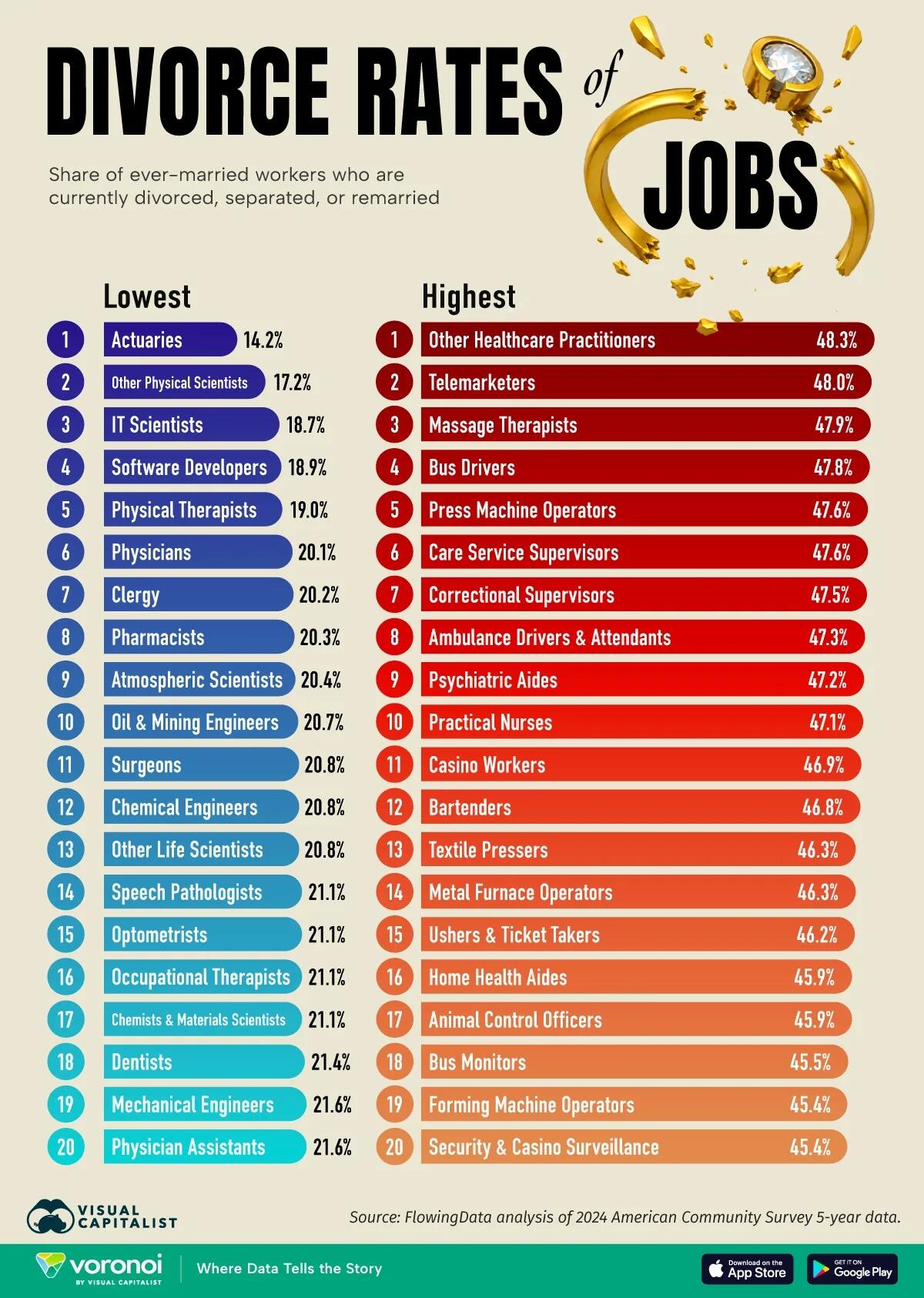
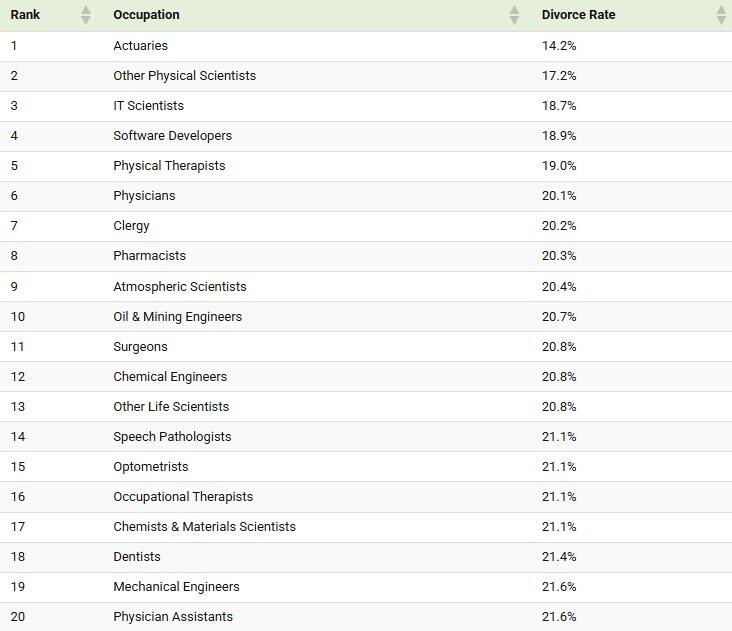
Actuaries have America’s lowest divorce rate at 14.2%.

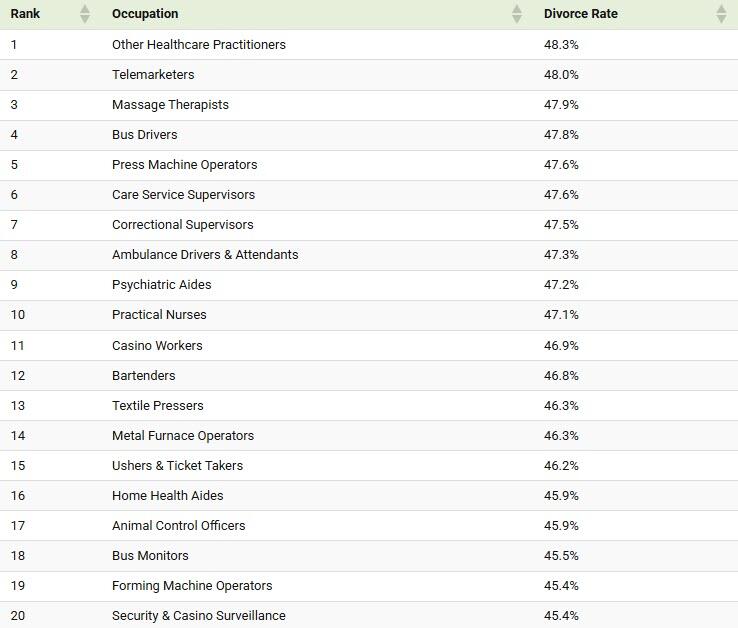
At the other extreme, several occupations report divorce rates near 48%, highlighting a striking divide across the U.S. workforce.

Using American Community Survey data compiled by FlowingData, Visual Capitalist's Dorothy Neufeld created the following graphic ranking the occupations with the highest and lowest divorce rates among more than 500 jobs.

One of the ranking’s most surprising findings is that healthcare occupations appear on both sides. Physicians, dentists, and physical therapists rank among America’s lowest-divorce occupations, while home health aides, psychiatric aides, and practical nurses rank among the highest.

The contrast suggests that schedules, working conditions, and job structure may play a larger role than industry alone.

The Jobs With the Lowest Divorce Rates

America’s lowest-divorce occupations are remarkably similar. Most require years of advanced education, professional licensing, or specialized technical expertise.

Education appears to be one factor. Census-based research shows divorce rates generally decline as education levels rise.

Individuals with only a high school diploma experienced a divorce rate of 38.8%, compared with 30.1% for those with an associate degree and 25.9% for those holding at least a bachelor’s degree.

Notably, America’s lowest-divorce occupations include not only high earners such as physicians and dentists, but also clergy, one of the few modest-paying professions in the group.

The Jobs With the Highest Divorce Rates

Telemarketers, bus drivers, bartenders, home health aides, psychiatric aides, casino workers, and security personnel all rank among America’s highest-divorce occupations, with rates exceeding 45%.

The occupations at the opposite end of the ranking share a different set of characteristics. Many involve irregular schedules, shift work, public-facing responsibilities, or emotionally demanding working conditions.

Work schedules may be part of the explanation. A landmark study of more than 3,400 married couples found that irregular schedules, such as night shifts, were associated with significantly higher odds of separation or divorce than regular daytime work.

Other research has linked night-shift work to greater marital instability and work-family conflict, particularly for new parents.

The Surprising Healthcare Divide

One of the ranking’s most surprising findings is that healthcare occupations appear on both sides.

Physicians, surgeons, dentists, physical therapists, optometrists, and physician assistants all rank among the lowest-divorce occupations in America.

Yet healthcare support roles tell a very different story. Home health aides, psychiatric aides, practical nurses, ambulance attendants, and other healthcare support workers rank among the highest-divorce occupations.

The divide suggests that job conditions may matter as much as industry. Workers in healthcare can face vastly different schedules, levels of autonomy, educational requirements, and workplace pressures, even while serving similar patient populations. In other words, two people can work in healthcare and face entirely different relationship pressures depending on their role.

What the Rankings Reveal

The rankings suggest that occupation and family life may be more connected than many people realize. While no profession determines whether a marriage succeeds, factors such as work schedules, stress levels, educational attainment, and job autonomy appear to be linked with markedly different divorce outcomes.

The healthcare divide is perhaps the clearest example. People working in the same industry can face entirely different relationship pressures depending on the role they hold.

To learn more about this topic, check out this graphic on America’s 30 highest-paying jobs.

Tyler Durden Wed, 06/10/2026 - 06:55

10 Wednesday AM Reads

The Big Picture -

My mid-week morning train WFH reads:

University Endowments Are About to Strike It Big on the SpaceX IPO: WSJ on the endowment mark-ups about to land. The illiquid bet, finally meeting the liquidity event — and a reminder that the smart-money story is mostly an access story. (Wall Street Journal)

Driverless Trucks Are Here — and They’re Delivering Bags of Doritos: WSJ on PepsiCo’s autonomous freight rollout across the Sun Belt. The future arrives via the snack aisle, as it usually does. PepsiCo has 41 trucks on the road in Arizona, Texas and Arkansas, bringing the technology into the mainstream (Wall Street Journal) see also Waymo is winning in San Francisco: New data shows that the self-driving car service has captured more than a quarter of the city’s rideshare market in just 20 months. Waymo has reportedly surpassed Lyft in market share in San Francisco. A recent poll shows that more San Francisco voters see self-driving cars positively. The robotaxi inflection happened while everyone was looking somewhere else. (Fast Company)

How Wise is the Crowd in Prediction Markets: QuantPedia surveys the empirical literature on prediction-market accuracy. Wise on average, dumb at the tails, and easy to manipulate when liquidity is thin. (QuantPedia)

How Americans Caught Gold Fever Again: Soaring gold prices, viral panning influencers, macho gold-mining reality shows, and Trump’s gold obsession have ignited a craze for prospecting not seen since 1849. New Yorker on the cultural return of gold-as-savings as faith in the dollar slips at the margins. The metal always tells you something about the moment. (New Yorker)

The 24-Year-Old AI Wiz Who Counts Jane Street as an Investor: WSJ on the young founder Jane Street decided to back. Half origin story, half cautionary tale about who’s getting handed market infrastructure. (Wall Street Journal)

Don’t Look Down: Reflections on Cross-Asset Drawdowns: Every asset draws down. The question is when, how deep, and what else is falling with it? Diversification may help, but won’t solve all your problems all the time. Over the past century, the major asset classes haven’t all crashed at once. But seldom have all been simultaneously in the clear Man Group with a rigorous walk through cross-asset drawdown statistics — and what they tell you about correlation regimes you don’t see until you need them. Sober piece for sober times. (Man Group)

Body Language: Communication technologies have been reshaping the human body in a slow migration down the arm. They’ve run out of body. Now they’re reshaping the message. A short, sharp essay on the ways our bodies broadcast what our minds are trying to hide. Worth the five minutes. (Terry Godier)

12 Things Orthopedic Surgeons Do to Maintain Speed, Balance, and Longevity. “I train legs like my life depends on it,” he says. “And statistically, it does.” Time’s service piece on the habits ortho surgeons actually run on their own bodies. Less novel than billed, more useful than the average wellness listicle. (Time)

Why Everyone Wants Jon Ossoff to Run for President: NYT op-ed on the Ossoff-for-president bubble forming inside the Democratic donor class. A reminder that “electable” usually means “familiar to the people who pay for ads.” (New York Times)

A record die-off of sea stars was followed by something that stunned biologists: The creatures almost went extinct along the West Coast a decade ago. Recently, they have been making a comeback After the worst sea-star die-off ever recorded, a surprise rebound on parts of the West Coast. Genuinely heartening science. (Washington Post)

Video of the day: Why No One Wants to Stay in New York’s Most Iconic Building


Be sure to check out our BONUS Masters in Business with Joe McLean, Managing Partner at MAI Capital Management, where he leads firm’s Sports & Entertainment division, serving 100s of pro athletes/entertainers across NBA, NFL, MLB, PGA + NASCAR. His path to finance runs directly through the locker room as a 4-year NCAA Division 1 player at U of Arizona. Dubbed the athlete’s “Money Whisperer” by the New York Times, he is known for his non-negotiable 60% savings mandate for clients.


Are investors beginning to shy away from the tech giants that dominate the stock market?    Source: Bloomberg


Sign up for our reads-only mailing list here.

The post 10 Wednesday AM Reads appeared first on The Big Picture.

Chinese Firm To Deploy 100 Humanoid Robots To Households For Daily Chores

Zero Hedge -

Chinese Firm To Deploy 100 Humanoid Robots To Households For Daily Chores

Authored by Kaif Shaikh via Interesting Engineering,

A Chinese robotics company has begun placing its humanoid robots inside real homes, marking a significant step in the race to develop machines capable of performing everyday household tasks.

Wuhan-based GigaAI recently deployed the first batch of 100 SeeLight S1 humanoid robots for household testing, according to reports from China. The trial is being positioned as China's first large-scale real-home test of a general-purpose humanoid robot designed for domestic use.

While humanoid robots have become increasingly adept at performing carefully choreographed demonstrations, researchers say the real challenge lies in operating inside unpredictable human environments.

From Robot Demos To Real Household Work

In a demonstration apartment in Wuhan, two SeeLight S1 robots carried out a variety of household chores. According to Global Times and China Daily reports, one robot prepared breakfast by retrieving food items, heating chicken in a microwave, clearing dishes, and loading a dishwasher. Another removed laundry from a dryer, folded clothes, and organized them in a wardrobe.

According to GigaAI, the robots learned these tasks through less than a month of on-site training. The company's executives argue that household robotics represents a fundamentally different challenge from the acrobatic robot videos that often dominate social media.

"Tasks such as dancing or performing flips mainly rely on what we can call the robot's cerebellum," GigaAI co-founder and chief scientist Zhu Zheng told Global Times. "Household robots, however, depend on the brain."

That distinction reflects a broader challenge in robotics known as embodied AI, where machines must perceive their surroundings, understand spoken instructions, plan actions, and adapt to constantly changing environments.

Why Are Homes Harder Than Factories?

Factories are structured and predictable. Homes are not. Furniture gets moved, objects are left in unexpected places, lighting conditions change throughout the day, and every household follows different routines.

Researchers often point to Moravec's paradox, a long-observed phenomenon in artificial intelligence where tasks humans consider difficult, such as advanced mathematics or strategic games, can be easier for machines than seemingly simple activities like folding clothes, grasping objects, or navigating cluttered rooms.

The SeeLight S1 attempts to address this challenge through what GigaAI describes as an embodied foundation model. Rather than following pre-programmed action sequences, the system is designed to process natural-language instructions, interpret its surroundings, create a plan, and execute tasks autonomously. According to the company, the robot can also adapt when furniture layouts change and continue operating even when interrupted during a task.

Still Far From A Robotic Maid

Despite the impressive demonstrations, reports from users and observers suggest there is still considerable room for improvement.

According to Global Times, some household tasks remain slow. Organizing a few books can take several minutes, while folding a single piece of clothing may require more than ten minutes. The robot has also reportedly struggled with tasks such as handling cups without spilling liquids.

Those limitations highlight the gap that still exists between controlled demonstrations and practical household automation. The current SeeLight S1 is therefore less a finished consumer product and more a data-collection platform designed to learn from real-world environments.

GigaAI plans to launch an upgraded SeeLight S2 later this year with a smaller chassis, longer battery life, improved arm reach, and more advanced AI algorithms. The company also intends to expand testing into homes with elderly residents, children, and various living arrangements to expose the robots to a wider range of real-world scenarios.

While humanoid assistants capable of seamlessly handling household chores remain a work in progress, the deployment of 100 robots into actual homes represents an important experiment. The question is no longer whether robots can perform tasks in carefully staged demonstrations. It is whether they can cope with the messy, unpredictable reality of everyday life.

Tyler Durden Wed, 06/10/2026 - 06:30

Marriage Benefits Men's Life Expectancy More Than Women's

Zero Hedge -

Marriage Benefits Men's Life Expectancy More Than Women's

One data point has recently caused much astonishment, confusion and also anger online.

As Statista's Katharina Buchholz details below, it is the finding that men benefit more from being married in terms of life expectancy than women do.

In other words, that men live longer and healthier lives if they are backed up by a spouse in doing so, while women don’t see the same support in prolonging their length and quality of life.

The notion that men rob years of life from their wives and basically tag them on to theirs is, however, not supported by (most) research on the topic.

Yet, the differences in how men’s and women’s lives are affected by marriage or the lack thereof are still significant.

 Marriage Benefits Men's Life Expectancy More Than Women's | Statista

You will find more infographics at Statista

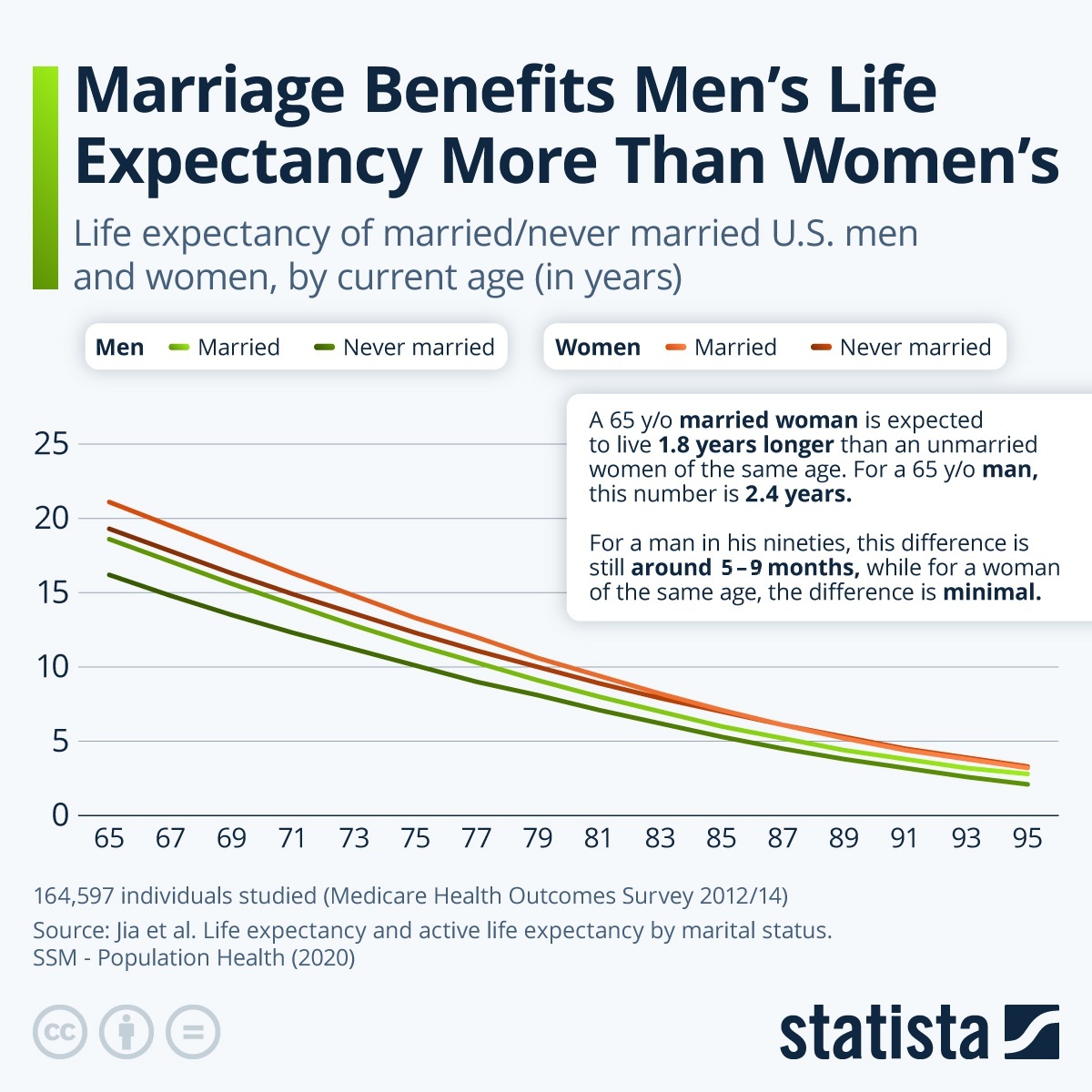
In general, women tend to live longer and healthier lives than men for a variety of reasons, including greater health consciousness and a tendency to avoid risky behaviors, but also genetic and hormonal factors. A study published in 2020 in the Journal SSM – Population Health shows that at 65 years old, U.S. women were expected to live for an additional 19 to 21 years, while for U.S. men, this number only stood at around 16 to 18.5 years. Nevertheless, the devil is once again in the details and reveals itself when looking at the differences in sex and marital status.

Here, married men aged 65 gain almost 2.5 years of life expectancy over their unmarried counterparts of the same age, boosting their outlook on life significantly. The data shows how having a spouse brings the life expectancy of married men quite close to that of never-married women - quite significant if one considers how fundamental the longer life span of women has been across ages and cultures. Married and never-married women, on the other hand, have a more similar expected lifespan. However, marriage also benefits women and increases their life expectancy, if only by 1.8 years on average compared to never-married females.

Another study looking at Danish people at age 50 even shows that men benefited from an added life expectancy of around eight years through marriage, while married women could expect to live approximately five years longer compared to never-married women. This gave men an increase that was 60 percent bigger than that of women, compared to the 33 percent U.S. researchers found in 65-year-olds. A study in Asia even found benefits of marriage in reducing mortality only in men, but not in women, concluding that more traditional Asian marriages where female partners take on a lot of household and child-rearing chores on top of possible employment might cancel out any potential benefits.

The role women play in marriages as planners and facilitators of medical care as well as advocates for healthy habits becomes clear when looking at divorced and widowed men’s life expectancy. In the U.S., it falls to basically the same level as that of never-married men when considering 65-year-olds. In the case of U.S. women, the differences are again not that stark. Even if a women is divorced or widowed, her life expectancy is still somewhat above that of a never-married woman, highlighting how women benefit from the overall advantages of marriage rather than just their spouse. These come in the form of so-called marriage protections, like adopting better habits, better mental health outcomes and better social connectedness. They are also often explained by so-called marriage selection, the idea that those individuals who manage to get married are already starting out with a better outlook on life.

Newer research into these factors has added an important distinction to these theories, however. It finds that while overall, marriages tend to provide benefits to a majority of individuals, this doesn’t mean that every marriage is beneficial. A bad marriage or one that places a lot of additional burdens on both or one of the individuals involved can diminish the positive effects of marriage significantly. Likewise, smaller differences between the life expectancies of married, divorced, widowed and never-married women potentially mask a set of more diverse outcomes for women.

Where men’s benefits stemming from marriage seem more widespread and typical, women may still often find positive outcomes from a marriage that is going well for them, but many might also see minimal or even adverse effects, culminating in a less clear picture of marriage and female longevity.

Tyler Durden Wed, 06/10/2026 - 05:45

Health Team To Monitor Wastewater, Social Media At World Cup For Outbreak Detection

Zero Hedge -

Health Team To Monitor Wastewater, Social Media At World Cup For Outbreak Detection

Authored by Kimberley Hayek via The Epoch Times,

Public health specialists have launched a dedicated surveillance operation to detect infectious disease threats early during the 2026 World Cup by analyzing wastewater samples and monitoring online chatter.

The 39-day tournament begins on Thursday in Mexico. Organizers estimate more than 6.5 million soccer fans from more than 100 countries will attend 104 matches spread across venues throughout the United States, Canada, and Mexico. The global travel of a worldwide audience to packed stadiums across North America creates conditions for the rapid transmission of pathogens, according to health security experts. The United States will host 78 of the 104 matches.

A team led by Rebecca Katz, director of Georgetown University’s Center for Global Health Science and Security in Washington, has transformed a university laboratory into an epidemiological command center. The facility pools resources from academic institutions, nonprofit groups, and private companies to support government agencies.

The group already publishes daily status reports that flag emerging risks for hospital emergency managers and public health authorities at local, state, federal, and international levels, as well as for FIFA, soccer’s governing body.

In advanced wastewater analysis, researchers use DNA and RNA sequencing to identify genetic strands from microbes in sewage, without first requiring the growing of cultures in a laboratory setting.

“It’s incredibly powerful,” Katz said.

Collection sites in the United States and Canada, together with additional monitoring across the three host countries, already supply data to the team, with the potential to catch an outbreak in its early stages, giving clinicians time to watch for specific symptoms that might otherwise go unrecognized and allowing public health officials to issue timely precautions.

The operation also incorporates social listening tools.

Staff members analyze anonymized electronic health record data and scan open social media platforms for signs of illness clusters.

Katz noted one earlier case in which officials flagged a gastrointestinal outbreak after noticing a sudden increase in online conversations about toilet paper purchases.

The systems include new layers of aerial and ground monitoring over fans and public spaces for the duration of the event.

Measles is high on the priority watch list. U.S. case counts this year are approaching record territory, with approximately 2,000 reported so far. The highly contagious virus has also resurged in parts of Mexico and Canada.

Mosquito-borne illnesses like dengue, also known as breakbone fever, as well as its close relative chikungunya heighten the level of concern. Infected travelers could bring these tropical diseases to local mosquito populations in host cities.

An Ebola outbreak persists in Congo, which has been at the center of the current crisis in Africa. Katz said the often-fatal hemorrhagic fever holds a “very low risk to the general public” in North America. World Cup players and support staff from Congo completed a precautionary quarantine in Belgium ahead of traveling to the United States.

The new surveillance network comes as U.S. public health officials continue their work to manage risks from multiple outbreaks, including measles, Ebola, and hantavirus.

Tyler Durden Wed, 06/10/2026 - 05:00

Pages