Feed aggregator
"Resetting Business": Xbox Layoffs Loom As New CEO Supercharges Overhaul
Microsoft's Xbox gaming division is preparing for a major round of job cuts at the end of the month as new Xbox CEO Asha Sharma moves to "reset" the unit amid a confluence of negative and worsening pressures, including shrinking revenue, soft hardware sales, plateauing Game Pass momentum, and what management now describes as an ongoing "hardware component crisis."
Bloomberg first reported that Microsoft will announce an upcoming round of layoffs after the company's fiscal year ends on June 30. The report was based on sources familiar with the upcoming restructuring plan, though it did not mention whether AI adoption and efficiency gains are driving the cuts.
In a memo to staff, Xbox CEO Asha Sharma and Matt Booty said the gaming division's first 100 days under new leadership showed early signs of progress.
"Now we start the next 100 days. It is important to have both optimism and realism as we work to reset the business," the executives wrote in the memo titled "Next 100 Days: XBOX Reset."
They continued, "Excluding Activision Blizzard King, over the past five years, we have spent over $20 billion on ongoing investments in our content, platform and hardware subsidy, but our annual revenue has declined nearly half a billion during that time. Going forward, this cannot continue."
The memo outlined Xbox's harsh realities it must navigate to achieve a turnaround strategy:
1. Over 1 billion players choose to play XBOX and our games each year, for a total of 72 billion hours across Console, PC, Mobile, and Streaming (excluding much of China and a few other properties). Our franchises are also among the largest and most beloved globally and are now breaking records in TV and film. Going forward, our competition is attention. There are more great games, TV series, franchises, creators, content formats, apps, etc., than ever before
2. We will end this fiscal year at about a 3% accountability margin, down year-over-year. Excluding Activision Blizzard King, over the past five years, we have spent over $20 billion on ongoing investments in our content, platform, and hardware subsidy, but our annual revenue has declined nearly half a billion during that time. Going forward, this cannot continue.
3. We are in a hardware component crisis. When I joined as CEO in February, the price we paid for console storage components was over 2x as high as we paid last fall. These costs have since doubled again. And as we plan for the 2027 holiday season, we expect another significant increase, taking us over 5x the prices we paid only two years earlier. Memory costs have followed a broadly similar trajectory. While the entire industry is facing a components crisis, we believe we have been impacted more greatly than many of our peers due to the choices we made over the last half decade. We are currently unable to make as many consoles as players want to buy, and we need a new business model and partnerships for hardware as we remain committed to Helix.
4. We expanded our studio system when we needed a pipeline of content to meet multiple strategies across subscription, streaming, and devices. In the process, we have found ourselves over extended as we executed on changing strategies in a landscape of more readily available content. We are the fortunate stewards of industry-defining franchises that have enormous potential and player demand, but we have not adequately funded them to compete and win. At the same time, as we saw this past weekend at Showcase, a reliable pipeline of first- and third-party exclusives and new IP are critical to our success. We need to reassess the balance between these and our investment priorities for the next 5 years.
5. Our current platform infrastructure is not built for the battle ahead. Our systems are overly complex, spanning hundreds of dependencies, which hinders our ability to move fast. We've become too reliant on vendors to operate our systems and must become more self-reliant as an engineering culture to build for the future. We must increase the value we ship to players while decreasing the time it takes to do so. Going forward, we'll evolve and rebuild our stack and look at capabilities across all of XBOX and potential M&A to help us win in hardware, PC, mobile, and streaming.
In February, the CEO told the audience at the Bloomberg Tech conference that she planned on "resetting the business," which was "not in a healthy spot."
How it started vs how it’s going | #XBOXShowcase pic.twitter.com/ntww9Pk0GN
— XBOX (@XBOX) June 7, 2026
Xbox and the entire gaming industry have faced mounting headwinds.
TD Securities analyst Doug Creutz pointed out Thursday that mobile gaming remains strong, but console gaming has lost momentum this year:
Industry View: Mobile Had a Really Strong Q1; Tempering Console Expectations
We believe U.S. mobile game spending grew +14% y/y in Q1, comfortably above our expectations, based on reported results at public companies. Note that our model does at least attempt to incorporate the impact of what are rapidly growing DTC businesses across the industry. We expect +10% y/y growth in U.S. mobile game spending for 2026. On the other hand, we previously reduced our 2026 console global software/services spending estimate from +7% y/y to +1% y/y based on (1) the impact of the recent price cut to Xbox Game Pass and (2) the apparent lack of a tentpole title in Nintendo's 2026 slate.
Xbox reaches more than 1 billion players annually across console, PC, mobile, and streaming, but can't generate profits? It may be time for AI and automation to streamline the gaming unit, which likely means layoffs are imminent.
The gaming industry is waiting for the launch of Grand Theft Auto VI later this year to rekindle demand.
Tyler Durden Fri, 06/12/2026 - 06:5510 Friday AM Reads
My end-of-week morning train WFH reads:
• You Have No Idea What a Trillion Dollars Is — and We Have Proof: WSJ runs an interactive on what a trillion actually means as Musk closes in on it. Useful corrective for headline numbness. (Wall Street Journal)
• People love working from home. But does it love them back? A new study says no: Remote work has soared in popularity since the COVID-19 pandemic. But, a new study suggests the practice has made workers more socially isolated, anxious and depressed compared to people who work in-person in offices and other settings. NPR summarizes new evidence that remote work is producing measurable isolation costs. Worth a read whether or not you’d ever give up the home office. (NPR) see also The Record Divide Between Corporate Profits and Worker Pay: Labor’s share of economic output just hit an all-time low, while the profit share hit a near record. It helps explain why consumers feel so glum. WSJ with the chart: corporate margins at a multi-decade high, labor’s share at a multi-decade low. The kind of spread that does not stay this wide indefinitely. (Wall Street Journal)
• Wall Street Is Adding More Finance Jobs To NYC Than Anywhere Else: And NYC tech is a bigger (but not as high wage as Wall Street) employer. Jonathan Miller on the surprising return-to-NYC pattern in finance hiring. The Miami narrative is real, but the gravitational pull of Manhattan never actually went away. (Housing Notes)
• How a virtual space battle lost gamers £400,000: Every item in the game – from ships and space stations to weaponry – is manufactured by players, who can sell them to one another for in-game currency. Building these assets can take hundreds of hours, but players can also spend real money to acquire them, generating revenue for Icelandic developers Fenris Creations. For example, a Titan-class ship is worth about £741. James Cunningham estimates he has spent about £6,000 on the game since he started playing in 2017. A high-earning friend, he says, claims to have spent closer to £30,000. While spending money on video games is not uncommon, EVE Online stands out because players’ assets can be permanently destroyed; their real-world cash outlay gone in seconds. (BBC)
• How Britain Became as Poor as Mississippi: A case study in self-sabotage: The Atlantic on the UK’s two-decade productivity collapse and what’s filling the political vacuum. A useful warning shot for anyone confident in American exceptionalism. (The Atlantic)
• The Congresswoman Who Got Trump’s Name Off the Kennedy Center: Representative Joyce Beatty sued over the president’s control of the arts complex. The effort to keep it open isn’t over. On Joyce Beatty’s quiet legislative win to strip Trump’s name from the Kennedy Center renovation. Small process fights, real cumulative effect. (The Atlantic)
• How a mysterious particle could explain the universe’s missing antimatter: The Big Bang should have produced equal amounts of matter and antimatter, which would have annihilated each other in a spectacular burst of pure energy. But it didn’t. New experiments focused on understanding the enigmatic neutrino may offer insights. (Knowable)
• Football Clubs Try Training a Body Part They’ve Ignored: The Brain: Bloomberg on the European clubs investing in cognitive training the way they used to invest in physios. Decision-making is the last frontier of soccer performance. As the World Cup begins, more coaches say “game intelligence” can be taught. (Businessweek)
• These Best Friends Turned Their Chemistry Into a Comedy Empire: WSJ profile of Bowen Yang and Matt Rogers and the Las Culturistas business. The audience has the wallet now. They have parlayed their podcast ‘Las Culturistas’ into a glossy brand with a glamorous awards show and a book on the way. (Wall Street Journal)
• The Right Hand of God Game: The Knicks needed a miracle. What they got was the greatest comeback in NBA Finals history. The Ringer on Game 4 of the Finals — OG Anunoby and a Knicks comeback that’s going to live in New York forever. The kind of game the city earns once a decade. The single greatest New York Knicks moment of the 21st century requires a name. Something pithy. Evocative. Iconic. Probably with every word capitalized. It can’t be The Shot (already taken), or any variation thereof. It can’t be The Tip-In (too hyphenated), or The Tap (too dull). What unfolded late Wednesday night at Madison Square Garden, with the Knicks’ title hopes teetering and 20,000 Gothamites gasping, requires more grandeur. (The Ringer)
Video of the day: How Clarkson’s £45M Farm OUTSMARTED The Entire Industry – They Never Saw It Coming!
Be sure to check out our Masters in Business interview this weekend with Jean Eric Salata, Chair of EQT Group and Chair of EQT Asia. EQT is a purpose-driven global investment organization with over $310 billion in total assets under management, making it the largest private markets firm headquartered outside the United States.
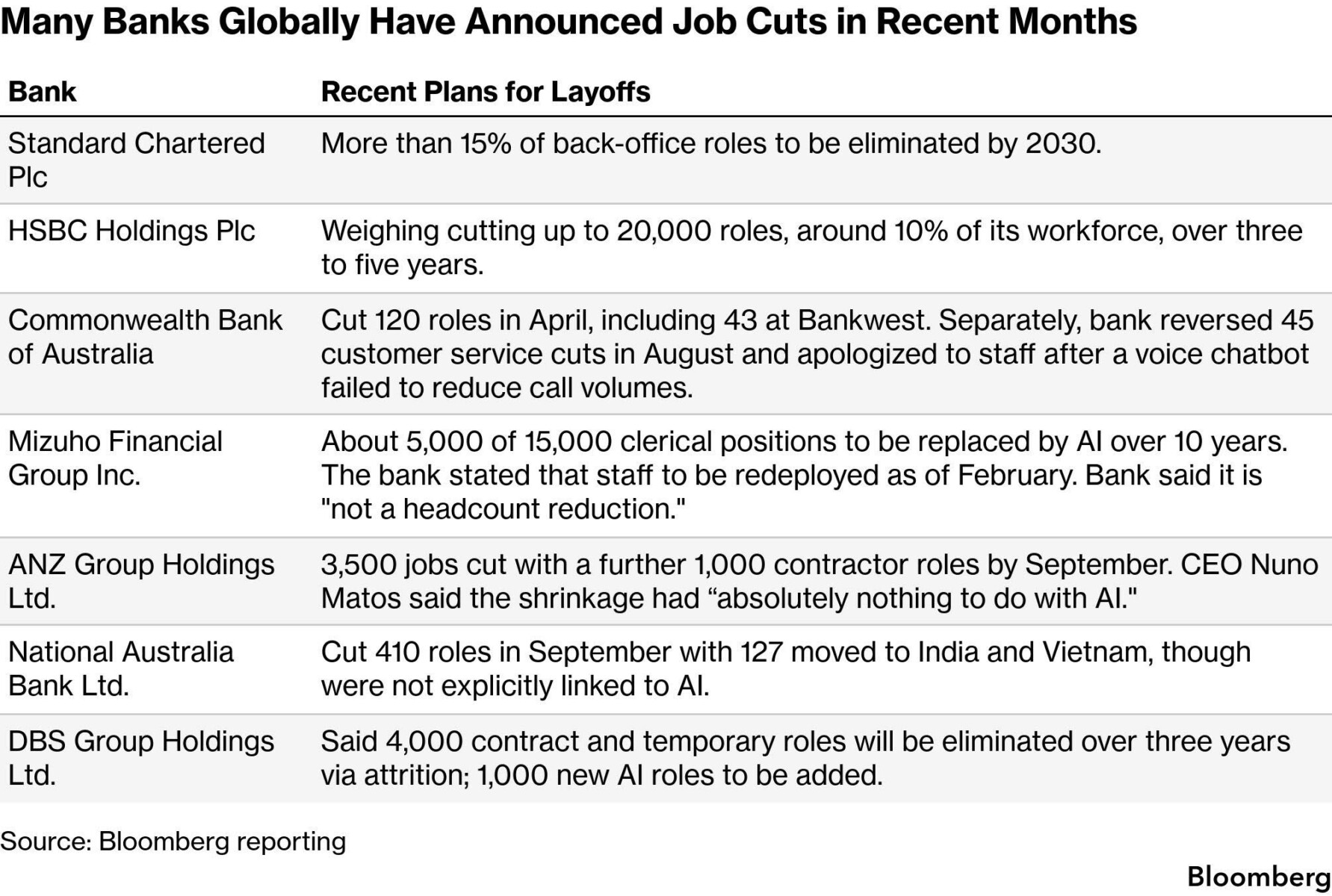
Banks are laying the groundwork for AI-driven workforce cuts, with executives warning that automation will eliminate some roles

Source: Bloomberg
Sign up for our reads-only mailing list here.
The post 10 Friday AM Reads appeared first on The Big Picture.
China Is Learning To Use Less Oil, And That's A Bigger Deal Than It Sounds
By Julianne Geiger of OilPrice.com
Three months into the biggest oil supply disruption in modern history, China appears to have discovered something that should make oil bulls at least a little uncomfortable.
It can get by on less fuel than anyone thought.
China's gasoline and diesel demand has been falling for years as electric vehicles gained market share and economic growth slowed. But the latest drop has surprised even seasoned observers.
According to Reuters, gasoline sales at Sinopec, China's largest refiner and fuel retailer, fell 8% year over year in April, while diesel sales dropped 6%. Goldman Sachs estimates that consumption of gasoline and related products may have fallen by as much as 20%.
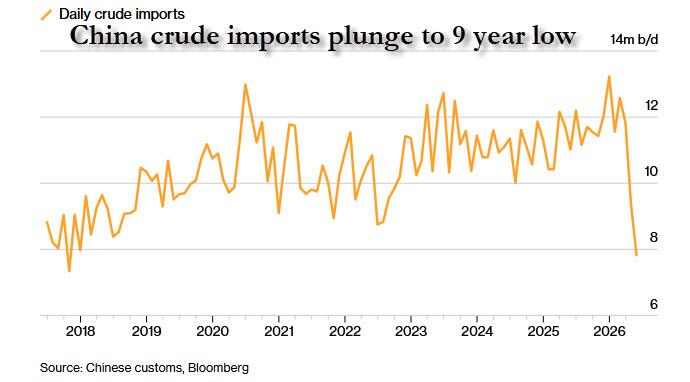
China has slashed crude imports since the Iran war began, with May imports plunging 29% to 7.8 million barrels per day—the lowest level in eight years. Until recently, many analysts viewed those cuts primarily as a function of China's enormous oil stockpile and high crude prices.
Now another explanation is emerging: China may simply need less fuel.
Rail travel rose roughly 10% in March and April. Subway ridership continues to climb. Electric taxis are becoming increasingly common. Most notably, EV charging volumes surged 69% from a year earlier to a record high in April, according to the China Charging Alliance.
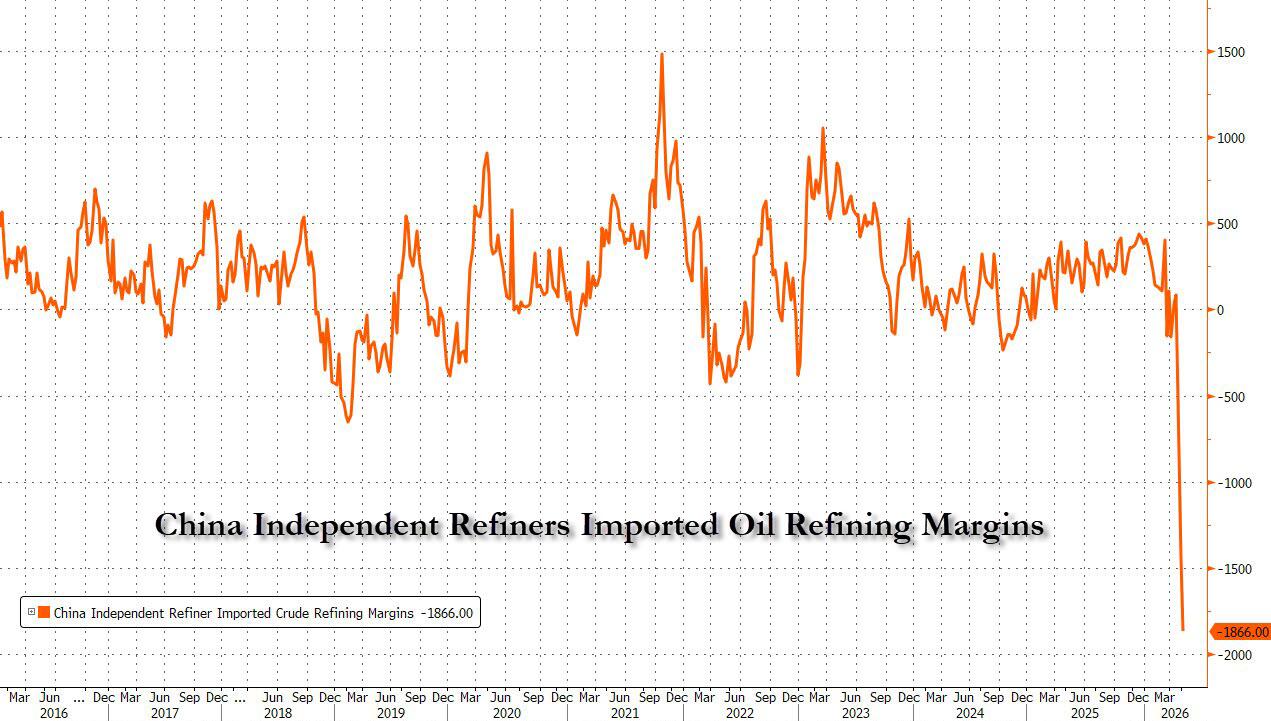
That shift comes as China's refiners are already grappling with weaker economics. Sinopec cut refining runs earlier this year as Middle Eastern supply disruptions squeezed crude availability, while Beijing has sharply reduced fuel exports to preserve domestic supplies.
The property downturn isn't helping either. Diesel demand from construction, long one of China's most reliable sources of consumption growth, continues to weaken as projects stall and budgets tighten.
The question now is whether the trend sticks.
China's refiners can only draw on inventories for so long. The country still maintains one of the world's largest crude stockpiles, but even a billion barrels eventually run out. At some point, imports will need to recover.
What remains unclear is whether gasoline demand will recover with them.
For decades, China's economic growth was one of the oil market's most dependable bullish arguments. Today’s reports may have some rethinking the strength of that argument.
Tyler Durden Fri, 06/12/2026 - 06:30BofA Sees "Runaway Price Risk" In Spot Sulfur As Global Supply Chain Freezes
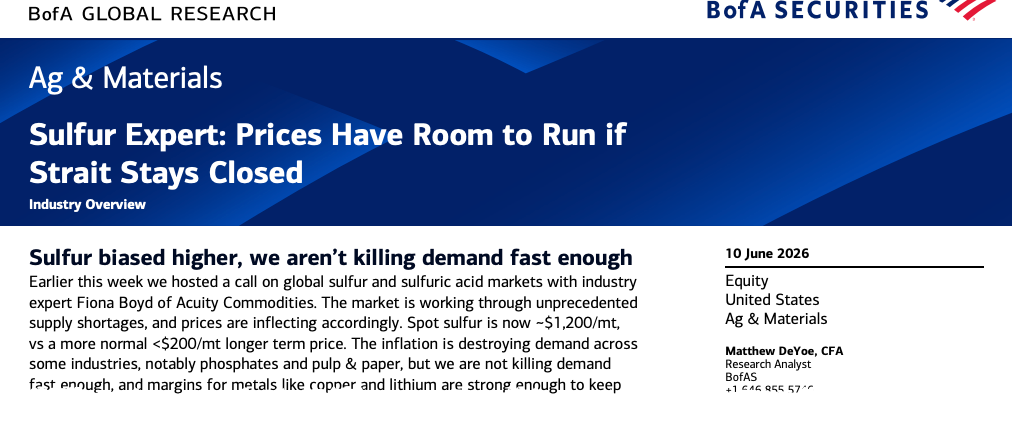
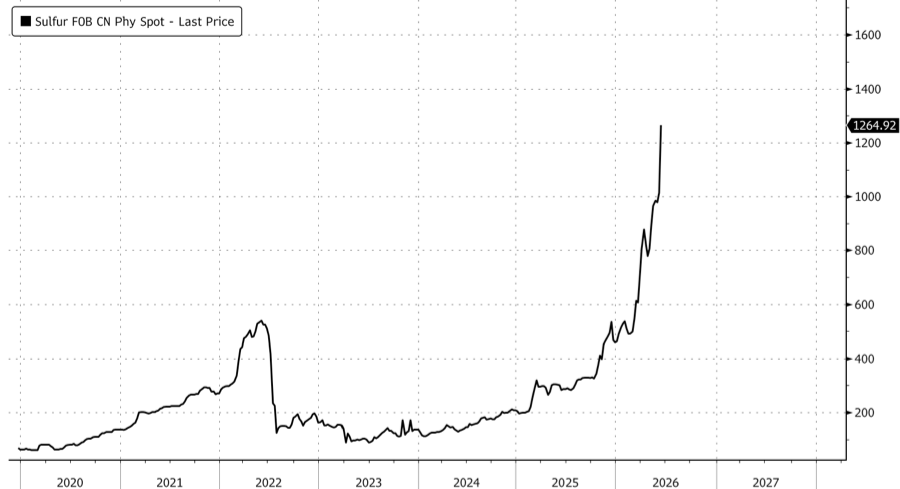
Sulfur is a critical industrial input produced as a byproduct of oil refining and natural gas processing. With roughly half of the world's seaborne sulfur trade trapped behind the Hormuz maritime chokepoint, another 15% stuck in Kazakhstan due to export-logistics blockades, and demand destruction still insufficient across global markets, Bank of America analysts warn that spot sulfur prices have further upside potential.
Matthew DeYoe, research analyst at BofA Securities, covering all things ag, materials, and chemicals, wrote in a note, "The market is working through unprecedented supply shortages, and prices are inflecting accordingly. Spot sulfur is now ~$1,200/mt, vs a more normal <$200/mt longer term price."
"The inflation is destroying demand across some industries, notably phosphates and pulp & paper, but we are not killing demand fast enough, and margins for metals like copper and lithium are strong enough to keep prices bid," DeYoe noted.
DeYoe said his team spoke earlier this week with Fiona Boyd of Acuity Commodities about global sulfur and sulfuric acid markets, coming away with a clear takeaway: the market is facing an unprecedented supply shock, yet demand destruction has not gone far enough. With supply trapped behind the Hormuz chokepoint, export logistics disrupted in Kazakhstan, and metals producers still able to absorb higher input prices, Boyd warned that spot sulfur prices likely have more upside from here.
DeYoe warned, "Hormuz + Kazakhstan + Russia = runaway price risk."
He explained further:
Roughly 50% of the world's seaborn traded sulfur is caught behind the SOH and another 15% is trapped in Kazakhstan given export logistic blockades. In total this represents ~30% of the world's sulfur capacity, though it is compounded by sulfuric acid export bans from China and a 3-4mn tonne shortfall to annual Russian exports on account of attacks by Ukraine. Inventory liquidation is helping to buffer, notably in China, which is drawing down its stocks, and Canada, which has ample supply. However, the latter is expensive and slow to mobilize, while the former is running out (Boyd expects 2-4 weeks of safety stock left). Because sulfur is largely a processing byproduct, it is price inelastic, so don't expect more supply because economics are better. Alternatives, such as pyrite, are increasingly sought, but it can't fill the hole. This all puts upside risk to sulfur price.
The near-term fix for the energy crunch, which extends far beyond sulfur markets, is reopening the Hormuz chokepoint. Yet DeYoe warned that even if Hormuz were reopened soon, it would take months to rebalance the market and repair damaged assets. This suggests prices will remain elevated through the end of the year.
Related coverage on the sulfur market:
DeYoe highlights that Mosaic is in focus. Sulfuric acid is a key input for phosphate fertilizer production, and Mosaic relies on sulfur from US Gulf Coast refineries. He noted that high sulfur costs could pressure Mosaic's second-half profits and cash flow, potentially requiring a debt raise. He also added that the odds of US government intervention to restrict sulfur exports to protect domestic DAP fertilizer production could increase.
Professional subscribers can find much more on Gulf energy shock here at our new Marketdesk.ai portal.
Tyler Durden Fri, 06/12/2026 - 05:45Whither SpaceX? Who knows
Traders Are Shorting Oil As If The Hormuz Crisis Is Over
Authored by Tsvetana Paraskova via OilPrice.com,
-
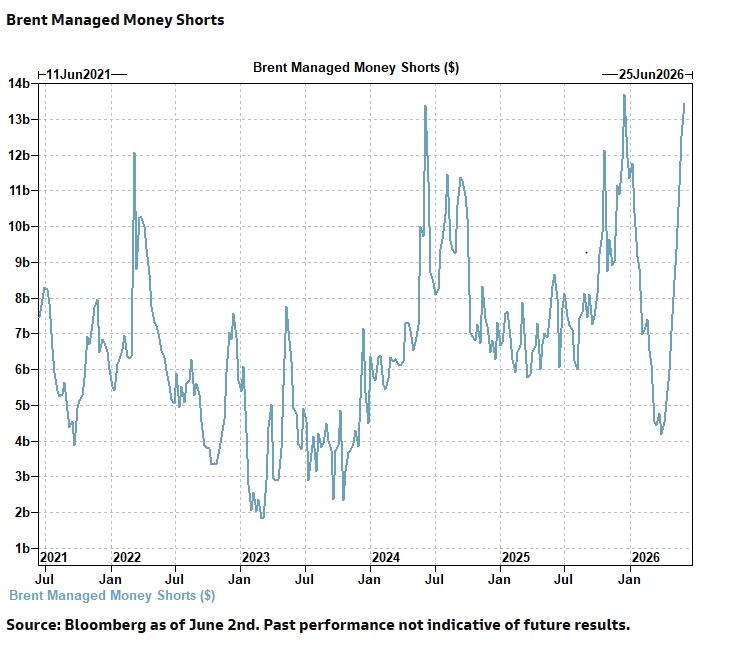
Oil traders are increasingly betting on lower prices, with short positions in Brent crude tripling since late March despite the loss of roughly 13 million bpd of supply from the Middle East.
-
Physical market fundamentals are tightening rapidly, as global inventories have fallen by about 250 million barrels and key storage hubs like Cushing are approaching critically low levels.
-
Analysts warn the market may be underestimating supply risks, with even a reopening of the Strait of Hormuz unlikely to provide immediate relief.
In yet another sign that the paper oil market may be too complacent about the magnitude of the supply disruption in the Middle East, trades have been boosting their short positions in oil futures for most of the past two months.
Since the beginning of April, portfolio managers have been increasingly betting that oil prices would fall, according to the latest available commitment of traders (COT) data from exchanges as of June 2.
Shorts on Brent Crude tripled between the end of March and the beginning of June, per the data compiled by energy analyst John Kemp.
As of June 2, the short positions in Brent Crude had jumped to their highest level since January, when the U.S. captured Venezuelan leader Nicolas Maduro and the market expected increased supply from Venezuela in the coming months.
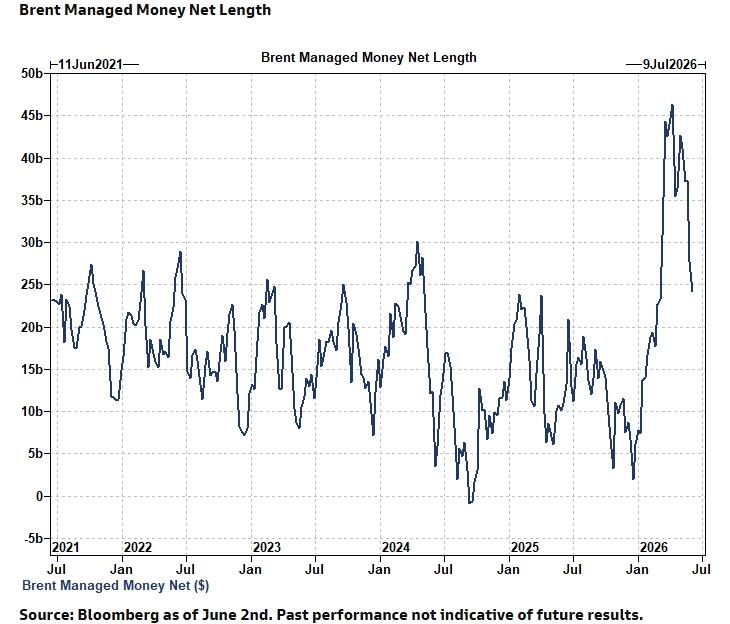
The surge in short positions and the weeks-long selloff of longs in the past eight weeks suggest traders are betting that supply will be restored soon.
The paper market plays on hopes, expectations, sentiments, and fears, and the sum of all these right now appears to be that the hedge fund and portfolio manager community is reluctant to bet on a summer of actual physical supply shortages.
But the paper market may soon face the reality of crumbling global inventories, including in the United States, where stocks at Cushing, the delivery point for WTI Crude, are just a few weeks away from dropping to minimum operational levels.
Too much noise about the ceasefire, which is being tested almost daily with one strike or a retaliatory hit after another, doesn’t help the paper market that may have become too detached from the magnitude of the supply loss.
Traders react to every signal of ‘imminent deal’ with selloffs, only to start buying oil futures again when Israeli strikes in Lebanon, U.S. ‘self-defense’ strikes on Iran, or Iranian hits at regional infrastructure threaten to unravel the fragile ceasefire.
All the while, paper market participants continue to hope for an imminent resolution and a reopening of the Strait of Hormuz that would flood the market with oil. And that’s been their hope for three and a half months now.
The thing is, even a full reopening of the Strait would not lead to immediate relief for buyers. First, ship owners and operators will need to have guarantees that they wouldn’t be caught off-guard with stranded tankers again. Then, the oil cargoes will need weeks to reach buyers—weeks that the market may not have amid peak summer demand season.
The world has lost about 13 million barrels per day (bpd) of oil supply, the International Energy Agency (IEA) said in its market report for May.
“Mounting supply losses from the Strait of Hormuz are depleting global oil inventories at a record pace,” the IEA said, adding that observed global inventories, including oil on water, were drawn down by 250 million barrels over March and April, or by 4 million bpd.
Sooner rather than later, oil on water volumes and onshore inventories will be depleted, leaving demand destruction the only buffer to cap oil price spikes.
Moreover, the extreme price volatility and the noise about a deal coming any day now are sidelining part of the trader community.
“Participants continue to sit on the sidelines, given the market's fluidity, uncertainty, and headline-driven nature,” ING’s commodities strategists Warren Patterson and Ewa Manthey said in a note on Wednesday.
“This is reflected in the aggregate open interest in ICE Brent, which has continued to trend lower and stands at its lowest level since August 2025.”
Many traders have been shorting oil since April in the hope that the ceasefire and the negotiations would yield a peace deal before the world runs out of buffers to offset most of the supply disruption.
“The buffers and the shock absorbers are being steadily drawn down, and the ability for the market to absorb this imbalance is drastically diminished today versus where we started and over the next few weeks,” Chevron’s CEO Mike Wirth said at the Bernstein 42nd Annual Strategic Decisions Conference at the end of May.
“We're likely to see those pressures flow through more directly to physical prices, and there's more upward pressure that I would expect as we get into June and certainly into July.”
According to the Wednesday note of ING’s strategists, “With no imminent deal in sight and with the global oil market tightening significantly every day, we see upside to prices, particularly if these disruptions linger into the third quarter, a period of seasonally stronger oil demand.”
Tyler Durden Fri, 06/12/2026 - 05:00FTAV’s further reading
Is Tether the Coppernose of our time?
Inflation and Revisiting Section 230 – Make Musk and Zuckerberg Pay
The post Inflation and Revisiting Section 230 – Make Musk and Zuckerberg Pay appeared first on CEPR.
Australian Financial Watchdogs Back New Powers To Curb Money-Laundering Via Crypto
Authored by Rex Widerstrom via The Epoch Times,
Australian crime-fighting and financial agencies are moving to prevent the use of cryptocurrency for money laundering, scams, and money-mule activities.
Illustration of Bitcoin and Ethereum coins held together in front of diverses EURO banknotes in Paris, France, on June 5, 2026. Joao Luiz Bulcao/Hans Lucas/AFP via Getty Images
The Australian Banking Association (ABA), Transparency International, and the regulator, AUSTRAC (Australian Transaction Reports and Analysis Centre), are backing a proposal to amend the Anti-Money Laundering and Counter-Terrorism Financing Act.
The change means the CEO of AUSTRAC can limit or stop a "reporting entity" or institution from using a "high-risk mechanism," such as cryptocurrency, to transfer funds.
The CEO must be satisfied that transferring funds has or will cause "significant harm to either the financial system, the Australian community, or both."
Currently, there are around 19,000 reporting entities, including banks and credit unions; non-bank lenders and stockbrokers; gambling and bullion service providers; and remittance service and virtual asset service providers (VASPs).
All are required to have processes and controls in place to protect their systems from criminal misuse.
Yet that number will soon expand to over 100,000 when new sectors, including lawyers, accountants, conveyancers, real estate professionals, and dealers in precious metals and stones, come under Australia's anti-money laundering and counter-terrorism financing regime from July 1 this year.
Sector-Wide Powers Needed, AUSTRAC ArguesSenator Michaela Cash asked what evidence suggested AUSTRAC's current powers were inadequate.
Daniel Mossop, the centre's national manager for policy rules, said current law mandated that the agency take a case-by-case approach, looking at individual businesses.
"What we can't do is have a look at a sector or a channel or a product and say, 'On the basis of what we are seeing here, there is an unacceptable risk,' [and] when you're dealing with really high-risk things, [it] becomes more inefficient.
"What we've seen over the last few years is a proliferation of new channels, payment methods, and products ... the real diversification of the market.
"When we have looked at some of these channels, what we have seen is high levels of criminal misuse in particular sectors, and that has caused us, along with the department [of Home Affairs], to start questioning whether the policy and legislative settings are right to deal with that type of threat," Mossop said.
Cash then asked officials whether they would support a change requiring the AUSTRAC CEO to report to Parliament on any prohibitions imposed.
Andrew Warnes, first assistant secretary of Home Affairs' criminal justice division, said there would be a "range of information" available and that lawmakers could always overturn the CEO's decision.
"We do not expect the power will be used particularly regularly," Warnes said.
"It will be a power that will be used occasionally, at best, based on our discussions with AUSTRAC. And when you look at the use of other powers in AUSTRAC's legislation, this is going to sit at the higher end, and you will have that parliamentary review, ostensibly of [every decision].
"A review mechanism is ultimately a matter for parliament, if it wants to do it. I expect this will be used on such a sparse occasion that your review will only be looking at one example. The next mechanism that might be banned might not have even been invented yet."
Crypto ATMs Major Area Of ConcernOne are of concern is cryptocurrency ATMs, which have proliferated from 23 machines in 2019 to about 2,000 today - Australia has the third highest volume of such machines globally.
AUSTRAC told the committee it estimates that almost 150,000 transactions, totalling over $275 million, occur every year via crypto ATMs, with about 99 percent being cash deposits to make purchases.
The ABA says (pdf) they have been linked to "significant scam-related activity, high-risk cash-based transactions, and the rapid movement of illicit funds."
The recent Crypto Crime Report, shows a 162 percent year-on-year increase in the amount of cryptocurrency received by criminals.
That led the ABA to suggest the new powers be used on that channel than on banks.
"Banks are already subject to prudential supervision by APRA (Australian Prudential Regulatory Authority) and market conduct regulation by ASIC (Australian Securities and Investment Commission), both of which hold comparable product intervention powers," said Chris Taylor, the ABA's chief of policy.
"Extending the AUSTRAC CEO's power to ADIs (Authorised Deposit-taking Institutions) creates overlapping regulatory authority without a corresponding uplift in risk mitigation."
Further, crypto ATMs charge fees of up to 17 to 19 percent, or more, on the purchase of cryptocurrency.
"There's clearly some degree of consumer harm or some risk of consumer harm going on," Taylor argued.
"AUSTRAC's data is clearly showing that people who are using these ATMs are either themselves subject to a scam or they are involved in money mule activities, which is helping to move criminal proceeds, either from scams or from other types of illicit activities, so we really struggle to see a legitimate use case here."
A large number of scam victims tricked into sending money via crypto ATMs were elderly, Taylor said.
"When AUSTRAC first released this data, they talked about an 85-year-old woman who had physically fed in, over the course of a year, $325,000 of her life savings. That's heartbreaking."
The banks also want the period during which any channel was prohibited to be reduced from 3 years to 18 months, in line with the powers of ASIC.
Transparency International supported the bill, saying in its submission that, "For too long, Australia has been a major destination for kleptocrats, organised crime gangs, and corrupt officials to wash their illicit funds. Much of this dirty money flows out of low and middle-income countries."
The bill also amends the meaning of financing terrorism to include new offences of providing monetary support to a state sponsor of terrorism.
Tyler Durden Thu, 06/11/2026 - 20:05Cops Bust India-Based Gold Scam Before Widow Loses $700K
A widow who was told her Social Security funds were being used to support terrorism nearly lost $700,000 in a gold scam, according to WOOD ABC 8.
The fraudsters convinced her to buy gold, but a suspicious coin dealer alerted authorities before the transaction could be completed. Ben Soldaat, owner of Grand Rapids Coins, noticed several red flags. The woman seemed confused, unusually urgent, and showed little interest in the gold itself. Concerned she was being manipulated, he contacted the Kent County Sheriff’s Office.
Investigators learned the woman had been told by a caller posing as a Social Security agent that criminals were using her account for terrorism, drug trafficking, and money laundering. She was instructed to buy gold so law enforcement could supposedly track the offenders.
Yug Chauhan
Working with detectives, authorities set up a sting operation. Instead of real gold, an undercover officer posing as the woman delivered a package of chocolate gold coins to the courier sent to collect it.
The report says that the courier, 20-year-old Yug Chauhan of Illinois, was arrested and charged with false pretenses over $100,000 and using a computer to commit a crime—both 20-year felonies.
Investigators believe the scam originated in India and are continuing to pursue those behind it.
Officials say gold-related scams targeting seniors are becoming increasingly common nationwide, often involving callers who impersonate government agents. They stress that family members and businesses play a critical role in spotting warning signs before victims lose their savings.
The targeted woman ultimately recovered her money and later thanked Soldaat for intervening. She hopes her experience serves as a warning to others, noting that many scam victims are not as fortunate.
Tyler Durden Thu, 06/11/2026 - 19:40Raising Girls Who Won't Be Bullied Off The Starting Line
Authored by Patti Garibay via RealClearPolitics,
The parents of California high school track athlete Reese Hogan did something no parent should have to do. They went to the press to ask why Gov. Gavin Newsom is fine letting a biological boy compete against their daughter for a girls' title. Reese put in the hard work required for a girl to take home the title. Reese is the one who deserves the trophy. But in 2026, asking for a fair race makes you the troublemaker.
A few hundred miles up the coast, Nicki Minaj said she's done biting her tongue. Her California home keeps getting "swatted," and Newsom's office hasn't lifted a finger. She accuses Jay-Z and Roc Nation of trying to destroy her career.
To be clear, Minaj has made choices and taken positions many conservative Christians wouldn't endorse. But that's precisely what makes this so revealing. Even someone who once fit in so comfortably within an elite cultural crowd can be cast out the moment she refuses total ideological conformity. She has become a whistleblower of what many women already knew: The woke crowd celebrates women only as long as they stay compliant. The second you deviate from the approved script, you're on your own.
Let's think about that for a minute. A rap star with millions of fans feels she's run out of room in today's celebrity culture. If she can't speak her mind, what hope does a stay-at-home mom in Cincinnati have when she shows up to a school board meeting?
These examples illustrate that feminism is no longer about women. It's about sticking to a script. Question the script - about your body, your faith, your daughter's locker room, your right to stay home and raise babies - and the same crowd that once chanted about your "liberation" will call you a danger to society.
Our girls grow up watching this unfold, learning very early what kind of woman this culture will tolerate.
Nowhere is the script more obvious than in the fawning reception over the new novel "Yesteryear." The book imagines a so-called "tradwife" taken back to 1855 to suffer for the sin of choosing motherhood and modesty. The reviews are exhausting. The point is not subtle. Women who choose home, husband, and Sunday morning church are to be pitied or mocked. Never mind that those women are some of the happiest people I know. Never mind that the moms I meet for coffee tell me their grandmothers had something we lost, and they want it back.
More than 30 years ago, mothers like me looked at what the Girl Scouts had become and knew we needed an alternative. Our daughters deserved more than moral relativism dressed up as girl power. We started with 10 American Heritage troops in Cincinnati. Today we have tens of thousands of members across the country. Not just because we are counter-cultural, but because we are anchored, and we're clear about who these girls are and Whose they are.
Here's what clarity looks like for girls today. It's a seven-year-old learning to tie a square knot and pray confidently out loud with her troop for the first time. It's a 12-year-old earning her camping badge while learning the simple, biological fact that God created us male and female. It's a high-schooler putting her phone in a basket at troop meetings and rediscovering what her own voice sounds like.
That is the future. It is bold and brave in a way that the loudest voices cannot tolerate. It's a simple yet profound message I will keep sharing with young girls every chance I get. I hope other women break free of perceived barriers about what women should say or think. When they do, they'll find genuine freedom in choosing courage, conviction, and clarity, and stepping into the calling God himself placed on their lives.
To Nicki, and to every woman who feels she has been kicked out of a club she didn't even want to join, I would say this: You are not crazy, and you are not alone. Real freedom was never found in burning down every wholesome thing your great-grandmother believed in. That isn't liberation. It's just a new kind of bondage, dressed up as progress. Real freedom is what God designed for us from the beginning - life inside the guardrails of His perfect love and wisdom.
To the parents of Reese Hogan, and to every parent watching this nonsense and wondering if anyone is paying attention: We are. We are raising girls who will grow into women who refuse to be bullied off the starting line.
The feminism our culture peddles today has decided to trash women. But common-sense Americans will be over here doing what we have always done - raising bold and brave girls, one campfire and one prayer at a time.
Tyler Durden Thu, 06/11/2026 - 19:15Trump Nominates US Attorney Jay Clayton As Director Of National Intelligence
Authored by Jack Phillips via The Epoch Times,
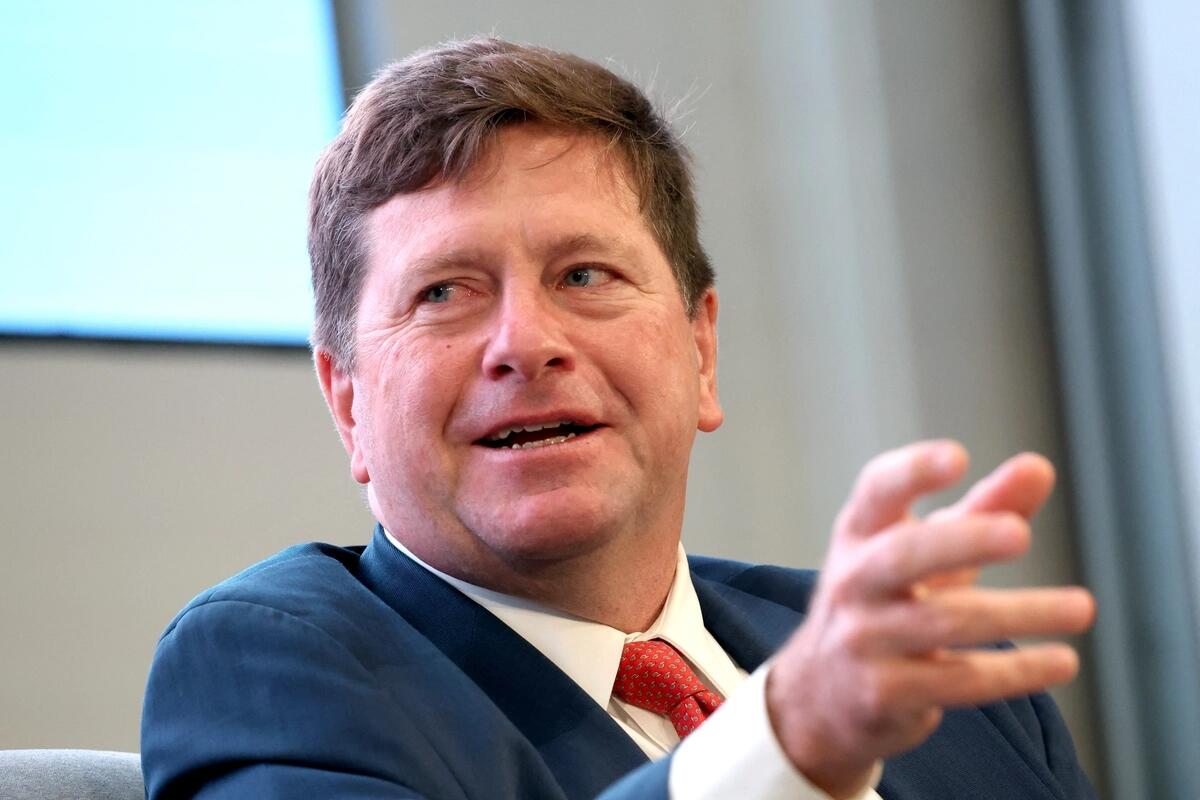
President Donald Trump on Thursday said he is nominating Jay Clayton, the U.S. Attorney for the Southern District of New York, to be his director of national intelligence.
The move comes weeks after former intelligence chief Tulsi Gabbard said she is stepping down from the role.
Trump, in announcing the decision on Truth Social, wrote that “few people anywhere” in the legal community have as much respect as Clayton, the former head of the Securities and Exchange Commission (SEC), whom the president also described as “highly respected.”
“I encourage the United States Senate to confirm Jay as soon as possible,” he wrote in the post.
Last month, Gabbard announced she was stepping down as the head of the Office of the Director of National Intelligence (ODNI) because her husband was diagnosed with a rare form of cancer.
Federal Housing Finance Agency Director Bill Pulte was named by Trump to serve as acting director in a move that drew pushback from Democratic and some Republican lawmakers.
Pulte will serve as the acting U.S. intelligence chief and would take over from Gabbard later in June, Trump said on Tuesday.
Last week, the president told the Wall Street Journal that he would encourage Pulte to downsize parts of the intelligence office, which oversees 18 federal agencies and units.
“I’d like to see it smaller. I think there are a lot of people in there that shouldn’t be there,” Trump said on June 5, adding that Pulte has broader latitude to make significant changes due to his being the acting head of the ODNI.
“You’re less shackled,” he said. “It sort of gives you more power, you know, for a somewhat limited period of time.”
Going further, Trump suggested that the ODNI could even be “terminated” in its entirety, noting that a similar downsizing process was undertaken at the Department of Education.
“We’ve made the Department of Education much smaller, and likewise, this should be much smaller,” he added.
Trump praised Pulte as a “very smart guy” while speaking to reporters last week and added that he “may find out some things about the rigged elections.”
The decision to name Pulte as acting director, however, prompted Democratic opposition to renew Section 702 of the Foreign Intelligence Surveillance Act (FISA) in a vote earlier this week.
“Just voted NO again on a clean FISA reauthorization. We shouldn’t allow the government to conduct warrantless surveillance of Americans—especially with Bill Pulte in charge,” Rep. Sara Jacobs (D-Calif.) wrote in a post on X as the House failed to extend the provision.
Some Republican senators, meanwhile, indicated they would not have voted to appoint Pulte if Trump nominated him.
“The Senate doesn’t have any role to play in terms of confirming acting officials, but I see no evidence of any qualifications for that job,” Sen. John Cornyn (R-Texas) told The Hill about Pulte.
Clayton had served as head of the SEC from May 2017 until December 2020. He also served as the head of the prominent law firm Sullivan & Cromwell, one of the largest in the world.
Tyler Durden Thu, 06/11/2026 - 18:25One Forgotten Housing Supply-Side Lever Could Unfreeze Affordability
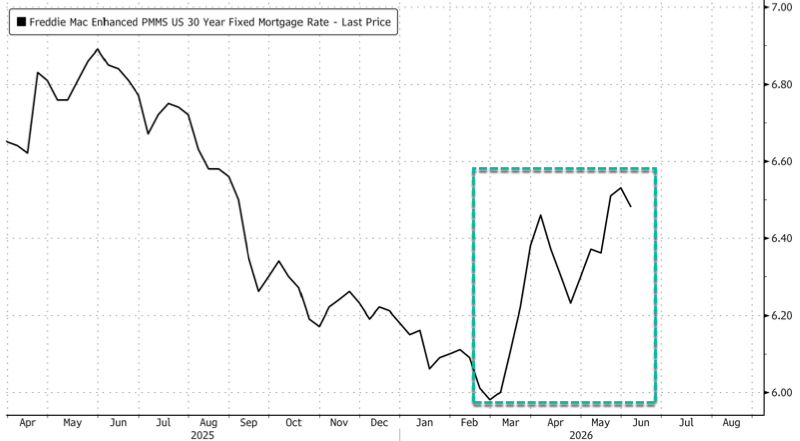
Rental affordability remains far superior to mortgage affordability, with the U.S. 30-year fixed mortgage rate trending around 6.5% in early June. With home prices still at record highs, last week's housing report showing sellers pulling listings at a near-record pace as buyers balk at prices is yet another warning sign that the frozen housing market remains well intact.
The Trump administration's affordable housing strategy focuses on market deregulation, expanded homeownership, stricter citizenship requirements for federal housing assistance, and Fannie Mae and Freddie Mac purchasing $200 billion of their own mortgage-backed securities to artificially lower mortgage rates and increase home affordability.
Even with all that, the housing market remains locked in a deep freeze into early summer, as the math for prospective homebuyers just does not add up, largely due to a housing shortage.
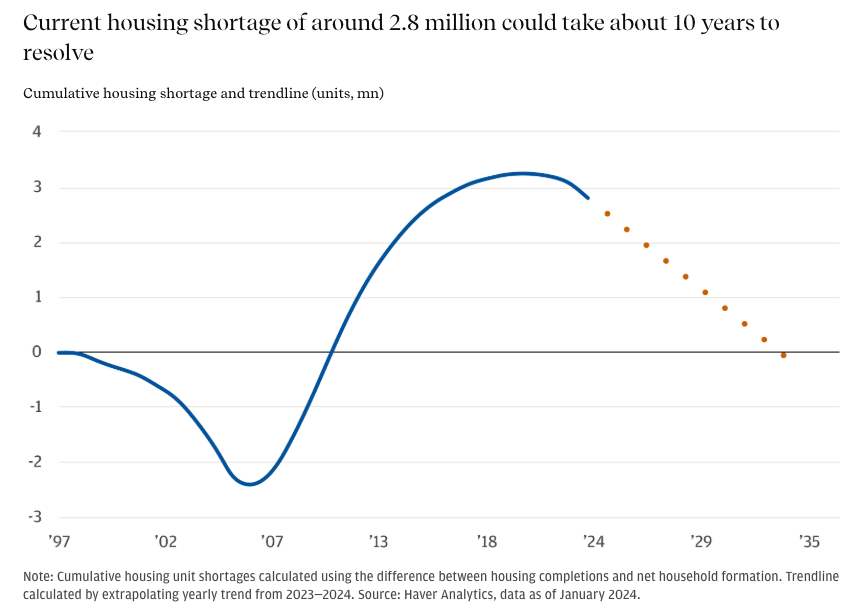
JPMorgan analysts recently said that the current housing shortage of around 2.8 million homes could take about 10 years to resolve. That is simply not enough time for the Trump administration to make good on its promise to unfreeze the market, as younger generations are forced into rentals.
But there is good news: Goldman analysts led by Arun Manohar outlined that manufactured housing remains one of the most underused affordability tools, as the estimated housing shortage is well north of 3 million and as high as 4 million homes.
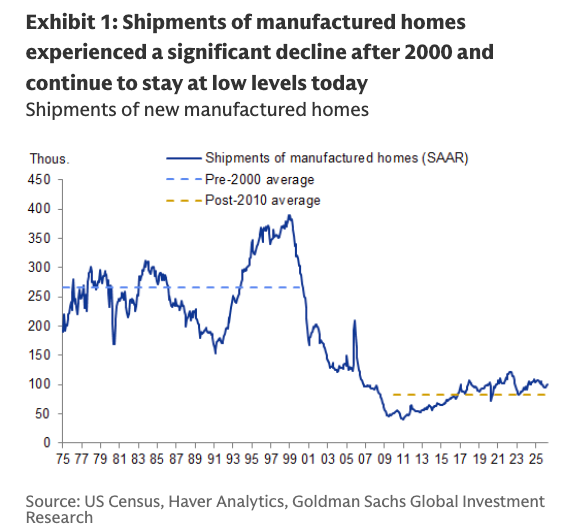
Manohar pointed out that shipments of manufactured homes averaged about 265,000 units annually before 2000, but plunged to around 80,000 per year since 2010 after the 1990s boom ended in delinquencies, tighter lending standards, and more zoning restrictions.
"One approach for increasing the supply of homes at more affordable price points is to promote access to manufactured housing," Manohar wrote in the report last week.
Manufactured homes now account for about 6% of owner-occupied U.S. housing, down slightly from roughly 7% in 2010. There are about 8.4 million manufactured housing units nationwide, mostly concentrated in the South and Southeast.
Mostly situated in rural areas.
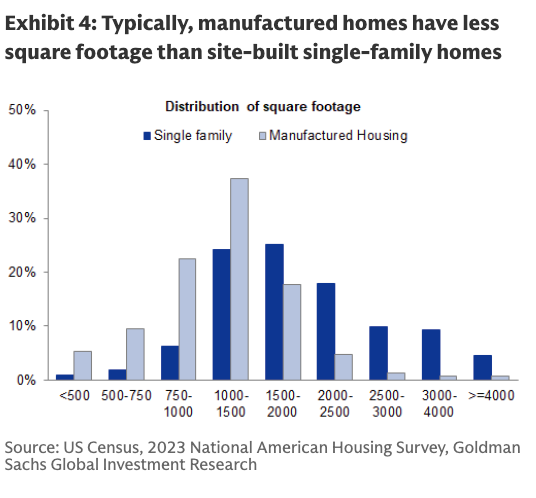
... and typically have less square footage than a traditional single-family home.
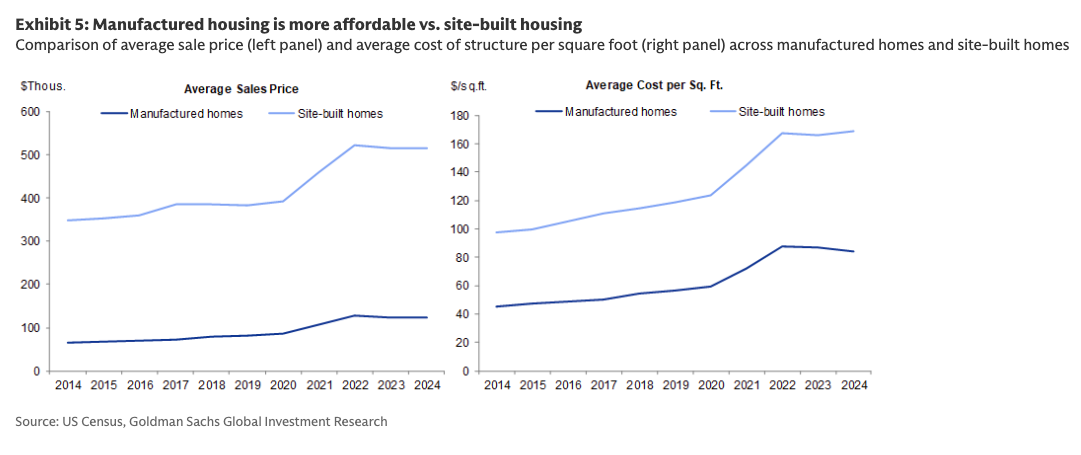
Manohar continued that these manufactured housing units are "residences that are prefabricated in a factory setting and then transported to their final location for installation," adding, "This method not only streamlines the construction process but also offers significant cost savings compared to traditional site-built homes, making manufactured housing a promising solution for those seeking affordable housing options."
Manufactured homes are cheaper and faster to build than stick-built homes.
These tiny homes could be a meaningful supply-side lever to improve housing affordability, especially for lower-income and first-time buyers, as the frozen housing market is expected to take years to normalize.
How To Profit
Professional subscribers can read the full note here at our new Marketdesk.ai portal.
Tyler Durden Thu, 06/11/2026 - 18:00At The Money: How Fixed-Income Investors can use ETFs to their Best Advantage
At The Money: How Fixed-Income Investors can use ETFs to their Best Advantage (June 11, 2026)
Investors seeking yield were once required to purchase individual bonds or mutual funds. Today, investors can purchase low-cost bond ETFs in just about any flavor you can imagine.
Full transcript below.
~~~
About this week’s guest:
Steve Laipply is managing director at BlackRock and Global Head of iShares fixed income ETFs. Previously, he was the head of iShares fixed income strategy. He helps oversee more than a trillion dollars in fixed income assets.
For more info, see:
~~~
Find all of the previous At the Money episodes here, and in the MiB feed on Apple Podcasts, YouTube, Spotify, and Bloomberg. And find the entire musical playlist of all the songs I have used on At the Money on Spotify
TRANSCRIPT:
Barry Ritholtz with Stephen Laipply, Managing Director and Global Head of iShares Fixed Income ETFs, BlackRock
Barry Ritholtz: Investors who are looking for yield were once required to purchase individual bonds or mutual funds. Today, ETFs have changed the fixed income market just as surely as they’ve changed the equity markets. Investors can purchase low-cost bond ETFs in just about any flavor you can imagine.
I’m Barry Ritholtz, and on today’s edition of At the Money, we’re going to explain how fixed income investors can use ETFs to their best advantage. To help us unpack all of this and what it means for your portfolio, let’s bring in Stephen Laipply. He’s Managing Director at BlackRock and Global Head of iShares Fixed Income ETFs. Previously, he was Head of iShares Fixed Income Strategy. He helps to oversee more than a trillion dollars in fixed income assets.
So Steve, let’s just start simply: Why ETFs? What are the advantages over bond separately managed accounts or mutual funds?
Stephen Laipply: Good to see you, Barry. Thanks for having me. This has been a bit of a journey that spans decades, actually. To really understand the power of bond ETFs, you have to go back before they existed.
So let’s call that the late nineties. The very first bond ETF came out in Canada in the year 2000, and then in the US in 2002. But if you go back to the nineties, buying bonds was a non-trivial exercise. It was very much a voice-driven market: You pick up the phone, you call several people, you get several quotes, hoping the market’s not moving on you at the same time, not quite sure if you exactly got the best price. There was very little transparency, and kind of uneven access — depending on who you were and what kind of wallet you had, you might get different treatment. That was a problem for some investors, not for all. Investors who had access maybe viewed that as an advantage, but for a lot of us, it was really challenging to build a high-quality, diversified bond portfolio.
So what did bond ETFs do? They opened that whole world up to transparency. You now had not even a single bond, but a portfolio of bonds that trades on exchange. You know what’s in it. You can see the price on exchange every second, ticking by. You don’t have to pick up the phone and call people — you can simply trade on exchange, and you know you’re getting the best price that’s quoted on exchange. Now, again, like anything, you have to use proper discipline when executing orders. But it was just a shocking, revolutionary thing to be able to trade bonds on an exchange.
Barry Ritholtz: That makes a lot of sense. I remember when this market was very dealer-driven, but there was always an option — at least over the past, let’s call it 40 years — of bond mutual funds. There are obvious advantages for equity ETFs over equity mutual funds. How does that translate to fixed income ETFs? What are their advantages over fixed income mutual funds?
Stephen Laipply: Well, there are a couple. Mutual funds still play a role — you’ll tend to see them in 401(k)s and things like that; that’s more of an architecture thing. But away from that, mutual funds price one time a day, at the end of the day, right? So you don’t know in the middle of the day what the valuation really is. I think a lot of advisors and investors have found the idea of being able to trade intraday at a known price really attractive. Because as you can imagine, Barry, let’s just say you get a strong inflation number or an employment report or what have you, and you want to move on that. You could put in an order for your mutual fund, and sure, that’ll get filled at the end of the day — but you really don’t know at what value. With a bond ETF, you can just go on exchange immediately, you can decide whether that’s the right price or not, and you can act on it. So there’s that.
The second part of it would just be the transparency issue. For mutual funds, you may have quarterly reporting or what have you, as opposed to daily for most bond ETFs — and that includes active strategies. So a lot of investors are attracted to that daily transparency as well.
Barry Ritholtz: And there used to be, I don’t know, tens of thousands of mutual funds out on the fixed income side. What sort of selection do ETFs present for bonds or fixed income in the exchange-traded fund wrapper?
Stephen Laipply: Well, it’s been exploding, particularly, I would say, since the ETF rule in 2019. And then also the pandemic and the subsequent policy responses, I think, unleashed a whole new level of demand with the normalization in yields. But standing here today, I think we’re over a thousand bond ETFs in the United States alone. iShares has over 160 in the US; we have over $900 billion in assets in the US, and $1.3 trillion globally.
The selection is enormous now. And it spans not just asset class — meaning Treasuries, credit, high yield, emerging markets, et cetera — but also, within a given asset class, you now have maturity cuts, you have outcome overlays on top of that, you have hedged products. So it’s been very, very much built out. And you also now have quite a lot of active strategies within those asset classes or sectors.
Barry Ritholtz: One of the criticisms that the equity side of ETFs always gets is, “Well, just wait till the next crash or period of stress — you’ll see how poorly these perform.” That didn’t happen during the pandemic crash. And then we started hearing the same criticisms about fixed income ETFs: Just wait till a moment of stress. How did ETFs perform in 2020 during COVID, and how did fixed income ETFs perform during the rate shock in 2022?
Stephen Laipply: Yeah, and this is what I think really garnered the next wave of adoption. Over the years, if you go back to the global financial crisis, they existed then, and we did have a lot of investors who were interested in them just because of this idea that, okay, during a crisis, I can see where things are trading on exchange — and that’s valuable, because now I can look at an investment grade credit ETF like LQD, or a high yield ETF like HYG, during the crisis and see what’s happening, which was very hard to do, if you remember back then. So the criticism was: Well, they’re small, they haven’t been around that long, I’m not really sure if I want to use them yet. I need to see them get larger and go through more stress tests. Okay — between the global financial crisis and 2020, there were kind of minor bumps here and there, but nothing severe.
I think 2020 — especially February and March, when even some Treasuries and investment grade were struggling to trade — finally got people over the line. Because at the worst of it, it was hard to trade off-the-run Treasuries, it was hard to trade investment grade. But ETFs, even though they may have been trading at a discount, were tradable, and they were trading in record volume. I think that finally got a lot of people over the hump. That was the test they were waiting for.
Barry Ritholtz: The rate shock — and they definitely passed with flying colors.
Stephen Laipply: Yeah. And then the rate shock was just icing on the cake — another stress episode, which further cemented investor confidence in the wrapper.
Barry Ritholtz: Let’s move beyond the structure of ETFs and start talking about fixed income investing in ETFs. Money markets are at 3.6%, 3.7%. And as we’re recording this, yields went up a little bit today on non-farm payroll data, but you’re not that far off from 4% — pretty competitive with the middle of the curve for bond yields. Why should investors think about rolling out of money markets and into bond ETFs in this rate environment?
Stephen Laipply: This is the question, and I think it doesn’t have to be a binary choice, right? What we’ve been saying is, if you think about what happened with views on the Fed over the last, call it, six months, it’s changed a lot, right? We went from having some cuts priced in to — as we’re standing here today — a full hike priced in by the end of the year, with another one priced in for next year, maybe more. And that could change just as rapidly going the other way.
So it’s really less about trying to time or finesse this, and more about just diversifying. Sure, you’re going to be able to earn decent carry in your money market account right now. But as a diversifier, what we’ve been saying is: Take at least some of that and step out on the curve — let’s call it intermediate, maybe three to seven years, something like that. Because in the event that things do change — for example, the geopolitical picture could change very, very rapidly; you could get oil prices receding, inflation kind of coming back down, et cetera — that will get us back off to the races in the other direction. And you know what’s really funny, Barry: If you look at the 10-year yield over the last three years, it kind of looks like a sine wave. You’ve been from 3.60 up to 5 and everywhere in between, over and over and over again. So it’s very, very hard to time this, right? Just don’t put all your eggs in one basket — have your bets spread out on the curve, because you never know how fast it’ll change.
Barry Ritholtz: Yeah, it’s kind of fascinating talking about the reversals. How long were we waiting for the Fed to start cutting? It seemed like it took years and years of people being wrong. And now we’re not only reversing the idea of cuts, but — given the war, given what’s going on with inflation — it’s amazing that it took such a short period of time to price in two hikes. But given where we are in the Fed cycle — I don’t even want to say cutting cycle — what does this lack of clarity mean for fixed income investors? How should they think about: Are we cutting? Are we raising? Are we going into a recession? Are we not going into a recession? It seems like it’s been an especially confusing period.
Stephen Laipply: Yeah, and this is what’s really fascinating to watch. Very interestingly, just based on the flows, we’re having record flows yet again this year, and that’s on top of records the prior several years. We are seeing investors kind of look through this volatility. And so far, I want to say that we’re up somewhere around 20 to 30% relative to last year. So investors don’t seem to be too concerned by the dramatically changing landscape here.
What they are focused on is the income opportunity. The majority of fixed income assets are now yielding above 4%. That was not the case — I think it was something like 20% between the crisis and the pandemic. So investors are actually looking at this as an opportunity where they can now earn income in fixed income for the first time in many years. They’re very focused on that, as opposed to just the 10-year, whether it’s at 4 or 5%. They’re focused on the income, and that’s how they’re allocating.
Barry Ritholtz: So we’re talking a little bit about inflation. I would be remiss if I didn’t bring up the iShares TIPS ETF. Our clients are owners of this; it’s done really well over the past couple of years. Tell us a little bit about why people should think about having a TIPS bond ETF in their portfolio.
Stephen Laipply: Yeah, and it’s proven to be really, really powerful, because it was not expected — everybody had pronounced inflation dead. We saw it come roaring back, and then there was the idea of a very strong policy response to rein it back in. Now we’ve gotten a supply shock in energy, which has sort of thrown things a little bit in doubt again. So it goes to the point that you should have a resilient portfolio, and that resilience — some of it has to be anchored in trying to protect against inflation.
It’s up to the investor to decide how much or how little they want to lean into that. You can buy individual TIPS bond ETFs, like STIP or TIP — we even have a shorter one, which is one-year, called ICPI — if you really want to just peg inflation itself. But I think other exposures are now incorporating it. We just launched, late last year, a broader bond ETF — so you think of the Agg, the Universal — we have something called the Total, which is BTOT, that includes an inflation component. The Agg and the Universal don’t have that; this one does. And that is a nod to the idea that going forward, you probably want to have some protection against inflation. It’ll wax and wane, but I think it shows you now that it’s necessary.
Barry Ritholtz: So TIPS are one sort of opportunity in the fixed income ETF area today. What other areas are attractive? Do you like investment grade corporates, high yield, munis, even agency mortgages and active bond ETFs? Where do you see the greatest opportunity set in the world of ETFs and fixed income?
Stephen Laipply: So let’s do that in two steps. Overall, I think you want to be in sort of that high-quality tilt, right? For many investors, that is a comfortable thing from a risk-profile standpoint. So getting back to the two dimensions here, credit and duration: On credit, we’ve seen the flows go mostly into very high quality — think Treasuries, investment grade, et cetera — but also kind of that intermediate duration component, as opposed to being much longer out on the curve. So investors are sort of anchoring on high-quality, intermediate duration.
Away from that, what also has been getting a lot of interest — going back to the income theme — investors really like what we’re calling these “plus” sectors. And what that means is: Okay, outside of Treasuries and investment grade, what do you have? You have high yield and emerging markets, which may not suit all investors, but you also have things like securitized assets, which offer a pretty attractive income profile relative to their duration risk. Think of mortgages as one part of that, but you can also have asset-backed securities, commercial mortgage-backed securities, things like that. So securitized assets have been really popular as well.
On the active side, as you know, Rick Rieder launched a multi-sector income ETF called BINC that has exposure to a lot of those plus sectors. And that fund has proven to be enormously popular — again, that income theme without taking outsized risk. So it’s that sort of general theme: Lean into income, de-emphasize duration, don’t take a huge amount of credit risk. I think that captures a lot of what we’re seeing investor interest in.
Barry Ritholtz: Last question: How should investors be thinking about the fact that we have a new FOMC chair in Kevin Warsh? What does that mean in terms of thoughts about duration, especially given how hawkish so many members of the committee are, and how publicly he’s stated he’s interested in Fed cuts?
Stephen Laipply: Well, this gets to something we’ve talked about in the past, Barry, which is that the market itself has already priced in what it thinks will happen. So the real question is less about who’s at the head of the Fed right now, and more about — if you look at where the market’s pricing Fed action, meaning we talked about this earlier in the conversation, we went from cuts to a hike priced in this year and maybe more next year — do you as an investor believe that?
Right? And that’s the question. Because if you look at the futures contracts, or if you look at the shape of the yield curve, you have to make up your mind: Do you believe that or not? If you don’t believe it — are you more hawkish than that? Are you more worried about inflation than that? — you may want to rein in your duration risk. If you think that none of that’s going to materialize, and then you could even go back to cuts, you may want to move out further on the curve. However, for many investors, if you don’t even want to try to call that — again, just be diversified, right? Maybe just sort of anchor in the middle part of the curve, the intermediate duration. Don’t go all the way to the short end; don’t go all the way to the long end. You don’t really know how this is all going to play out, and most investors aren’t really interested in trying to predict that. So just get your exposure, lean into income, and then be patient.
Barry Ritholtz: So to wrap up: Investors who want some fixed income exposure have a variety of choices today that they didn’t have just as recently as five years ago. It doesn’t matter if it’s mortgage-backs, inflation-hedged, global Agg, domestic — whatever you want in terms of exposure to fixed income, you can get that through bond ETFs.
I’m Barry Ritholtz. You are listening to Bloomberg’s At the Money.
~~~
Find our entire music playlist for At the Money on Spotify.
The post At The Money: How Fixed-Income Investors can use ETFs to their Best Advantage appeared first on The Big Picture.
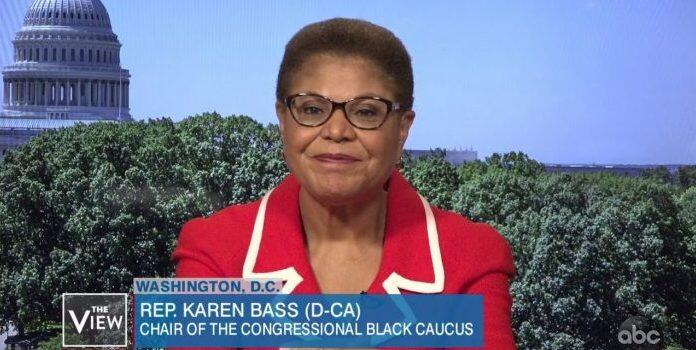
Karen Bass' Brother Joins Class-Action Lawsuit Against Karen Bass over LA Wildfires
Authored by Luis Cornelio via Headline USA,
The brother of embattled Los Angeles Mayor Karen Bass has sued the very city government his sister leads, alleging officials failed to protect homeowners and business owners during the destructive Palisades Fire.
Kenneth Bass and his wife Cindy joined a class-action lawsuit in May against the City of Los Angeles, alleging the city failed to fill the Santa Ynez Reservoir when the wildfire broke out on January 7, 2025, according to multiple reports.
The lawsuit, filed on May 18, was first reported by L.A. Material.
It includes more than 180 plaintiffs and names multiple defendants, including the Bass-run Los Angeles Department of Water and Power.
In the lawsuit, Kenneth Bass alleged he and his wife suffered smoke inhalation injuries, as well as emotional distress stemming from the destruction of their home.
The couple previously owned a property with a pool and panoramic views of the Malibu Pier, according to L.A. Material.
Mayor Bass has publicly referenced her family's loss, telling reporters in 2025: "The loss that you're going through, I share indirectly. It's hit my family too."
Bass adviser Yusef Robb dismissed questions about the lawsuit, telling reporters that there was "nothing new here."
"Thousands of people are plaintiffs in this action, which names 18 public and private sector defendants," Robb added.
A spokesperson for the Los Angeles City Attorney's Office downplayed the lawsuit, saying the city is confident it is not liable for the wildfires.
Meanwhile, a Frantz Law Group attorney representing Kenneth Bass told the California Post the lawsuit is part of a broader mass tort process and said his family ties are "irrelevant" to his claims.
"As part of the mass tort legal process, Mr. and Mrs. Bass' names were formally added as some of the nearly 40,000 victims who suffered losses," the attorney stated. "Their family connections are irrelevant, and as non-public citizens they are entitled to respectful privacy as they pursue their legal rights along with all represented victims."
Bass was elected mayor in 2022, after serving for over a decade in the U.S. House of Representatives. She is facing a tough re-election campaign amid criticism over her administration's handling of the wildfire response.
Tyler Durden Thu, 06/11/2026 - 17:00Direct Spending and Revenue Effects of H.R. 8800, the National Defense Authorization Act for Fiscal Year 2027
New CFTC Prediction Market Proposal Would Ban War And Terrorism Bets While Allowing Sports Markets
The Commodity Futures Trading Commission (CFTC) has unveiled a proposed framework for prediction markets that would prohibit contracts tied to violent or harmful events, including terrorism, war, and political assassinations, while largely preserving sports-based markets, according to Bloomberg.
Under the proposal, "gaming" would be interpreted more narrowly, focusing on activities driven primarily by chance. As a result, most existing sports event contracts would remain permissible.
According to CFTC Chairman Michael Selig, the agency's goal is to "protect the integrity of our regulated markets without standing in the way of responsible innovation."
The proposal is intended to modernize and clarify how event contracts are evaluated, replacing broad restrictions with a more targeted approach. Dorothy DeWitt, a former CFTC market oversight official, said the framework "provides clarity as to what types of contracts are unlikely to be readily susceptible to manipulation."
Bloomberg writes that the regulator also signaled concern about contracts whose outcomes can be influenced by a single individual or specific in-game actions, suggesting those markets may face heightened scrutiny.
The initiative follows the rapid expansion of prediction markets after legal victories opened the door to election and sports-related contracts. As trading activity and investor interest continue to grow, the industry has sought clearer guidance on which markets are acceptable under federal oversight.
Supporters view the proposal as a step toward a more predictable regulatory environment that could encourage further investment and participation. Critics argue it risks legitimizing gambling-like activity within financial markets and could divert the agency from its traditional mission.
The proposal marks another milestone in the ongoing debate over how prediction markets should be regulated and where the line between investing and wagering should be drawn.
Tyler Durden Thu, 06/11/2026 - 16:40Even 'Trust The Election' Pundits Are Suspicious
Authored by J.B. Shurk via American Thinker,
California’s rigged elections are difficult to defend...
California Democrats have rigged another election, and outsider Spencer Pratt has been bumped from the Los Angeles mayoral race. On Election Day, Pratt’s lead over third-place Nithya Raman was so large that she publicly cried over her loss. After a week of mail-in-ballot shenanigans, Raman has surged to secure a coveted spot on the November ballot — a statistical improbability in any jurisdiction familiar with arithmetic and basic ethics.
This “come from behind victory” has made it difficult for the usual election-fraud-deniers to pretend that California’s elections are free, fair, legal, or remotely based in reality. I noticed that National Review writer Dan McLaughlin — who spent a lot of time after 2020’s stolen election defending Joe Biden’s “victory” — felt compelled to make this small concession: “I’m suspicious of the voting in LA. For now, in the absence of evidence, that’s just vague suspicion unsupported by proof, but the vote-counting process reeks.”
I wrote a number of essays describing the historic irregularities of the 2020 election after Joe Biden supposedly “won” more than fifteen million extra votes than Barack Obama had secured in his re-election victory. In the 2020 election, President Trump won almost every traditional bellwether county across the country by double-digits. He expanded his voter support in almost every demographic and did better with black voters than any Republican since Eisenhower. He exceeded expectations in swing states. Economic variables and historic precedent strongly forecast a Trump victory. It was entirely reasonable to look at the statistical improbabilities of the 2020 election outcome (another race that was “decided” more than four days after Election “Day”) and conclude that the numbers did not make sense. It was entirely appropriate for Americans to gather outside the Capitol on January 6, 2021, and demand that Congress refrain from certifying an election irreparably tainted by mail-in-ballot fraud. Nevertheless, McLaughlin took time to mock me (and many others) and suggest that I had never heard of “split-ticket” voting. McLaughlin-type pundits have a difficult time understanding anybody who doesn’t blithely repeat back talking points mass-distributed by the corporate “news” machine.
It strikes me as ridiculous that McLaughlin finds it necessary to couch his “suspicions” about California’s elections behind verbal acknowledgments that, absent “evidence” and “proof” of fraud, no clear conclusions can be drawn. If you arrive home to find your front door smashed open, your house ransacked, and all your valuables missing, it is not a “vague suspicion” to conclude that your home has been burgled. I get the sense that McLaughlin would tell police, “In the absence of evidence, any conclusion that I’m the victim of burglary is just vague suspicion unsupported by proof.” I think this is why common-sense Americans have no interest in listening to pundits these days; doing so requires a level of pretending that makes most people feel dirty.
I don’t know Dan. Maybe he’s a nice guy. Maybe he believes what he writes. But he seems like somebody who would defend a future Democrat president who rounds all of us up into “MAGA Camps,” so long as CNN quoted Eric Holder as saying that the whole thing was legal and right. At some point, a person has to put his “thinking cap” on and start asking questions. Government bureaucrats and politicians are not truth-tellers; they’re propagandists. If you don’t have the sand to question authority, you’re just a parrot begging for a cracker. And if California’s most recent rigged election is the first time you’ve had “vague suspicions” about the legitimacy of America’s elections, then your punditry has the same whiff of freshness as a carriage horse’s bun bag.
Across the board, Americans do not trust the election process.
Every presidential election since the 2000 contest between Bush and Gore (which took thirty-five days to settle) has been sullied by allegations of fraud, disenfranchisement, illegal voting, ballot spoilage, electoral violations, and all manner of ethical misconduct. Members of the New Black Panther Party intimidated voters in Philadelphia in order to secure a Pennsylvania election victory for Barack Obama in 2008. Hillary Clinton and Barack Obama deceived Democrat voters by perpetuating the lie that Russia “stole” the election for Donald Trump in 2016. While the corporate news media and Silicon Valley’s social media tsars censored reporting on Hunter Biden’s “laptop from Hell” in the lead-up to the 2020 election, Democrat-controlled cities reported more mail-in-ballots for Sleepy Joe than lawful registered voters. Since Trump’s 2024 landslide victory over Kamala Harris, Democrats have claimed that Elon Musk stole all the swing states for the president.
Nobody believes that our elections are on the up-and-up.
The fifty states do not uniformly require official photo ID. Election statutes are not uniformly enforced. Judges routinely step in to alter the rules for some areas but not others. Election “Day” has become Election Months because most states permit early voting that lasts for weeks, as well as the late tabulation of mail-in-ballots that arrive well after the election.
In many Democrat-controlled jurisdictions, multiple ballots arrive at every home, apartment, post office box, chicken coop, doghouse, street corner, vacant field, Walmart, convenience store, parking lot, and homeless encampment. American citizens don’t control election outcomes through their votes. Campaign operatives control election outcomes through ballot “harvesting” — whereby blank ballots are mailed out, filled out, and collected without ever involving the “voters” whose “votes” are cast in their names.
Once the vote counts are officially posted, most jurisdictions are incapable of verifying the legality of each vote cast or replicating the results with matched ballots and voter records. The local and state election commissions instead defer to the “Trust us, bro” standard of government accountability.
The whole electoral process is corrupt.
Everybody knows it. Democrats and Republicans have different reasons for distrusting the outcomes. But the point remains: Nobody trusts the outcomes. Pundits such as Dan McLaughlin exist to reassure the public that everything is hunky-dory. Don’t trust your eyes or the organ between your ears, they say.
Trust the process and the Establishment politicians who benefit from that process.
Why not?
These are the same professional “authorities,” after all, who “rationally” handled the arrival of the mostly-harmless COVID virus by closing schools, churches, and businesses; locking us up in our homes; creating arbitrary mask rules; forcing us to follow ludicrous “safety” protocols; and threatening to take our children away if we refused to submit to experimental injections redefined as “vaccines.” If you didn’t learn to “trust the experts” during COVID, I don’t know what to tell you. After we “flattened the curve in fifteen days,” we also proved that owning property causes “climate change” and that Dementia Joe Biden was the most popular president in American history! It was a banner few years!
Notwithstanding the proven track record of the Establishment Class, California’s recent “election” is forcing more people than ever to question whether this whole voting monstrosity in America is legitimate. When even “I will defend the integrity of the 2020 election to my dying breath” Dan McLaughlin admits that the radically shifting results for the Los Angeles mayoral race have made him “suspicious” of the voting process in California, the tide might be turning. Who knows. Maybe Dan will start to wonder whether it really makes sense that Joe Biden — a political candidate who struggled to receive more than single-digit support during prior attempts to reach the White House — won eighty-two million votes in 2020, eclipsing voter support for both President Obama and President Trump.
Common sense isn’t for everybody. Some people prefer to trust corrupt election officials. As Dan McLaughlin says, “The machine wins.” Well, the machine does tend to win when pundits refuse to recognize, confront, and condemn fraud.
Tyler Durden Thu, 06/11/2026 - 16:20


Recent comments