The BLS employment report shows the unemployment rate ticked down by 0.2 percentage points to 7.7%. The reason for the unemployment rate decrease is less people participated in the labor force in November. Superstorm Sandy had little effect on the monthly employment figures.
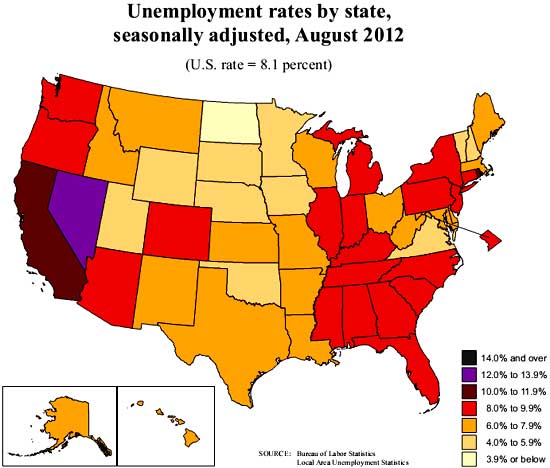
The mantra for the October state employment statistics is little change from September. Over and over we see dropping unemployment rates yet too little significant growth in actual jobs. Only seven states had unemployment increases, six had no change and 35 plus the District of Columbia showed declines. Below is the BLS map of state's unemployment rates for October 2012.
The September state employment statistics show a drop in unemployment rates yet little significant growth in actual jobs. Only six states had unemployment increases whereas 41 plus the District of Columbia showed declines. Below is a map of state's unemployment rates for September 2012.
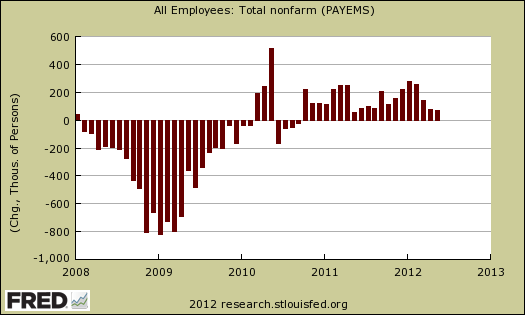
The BLS unemployment report shows total nonfarm payroll jobs gained were 114,000 for September 2012 and the unemployment rate dropped to an artificial 7.8%. Some better news was August's payrolls were revised up by 40,000 jobs to 181,000 and July was also revised up by 46,000 jobs to show a gain of 142,000 in nonfarm payrolls. The below graph shows the monthly change in nonfarm payrolls employment.
The August 2012 state unemployment rates climbed in 26 states and 21 states plus the District of Columbia show a decrease in payrolls. Another month and another horrific set of state employment statistics.
The August 2012 BLS unemployment report shows total nonfarm payroll jobs gained were 96,000. Even worse news, the last two months of job gains were revised down. July's gains are now 141,000, revised from 163,000 payroll jobs and June is a now a measly 45,000 jobs, also revised down from 64,000.
The July 2012 BLS unemployment report shows total nonfarm payroll jobs gained were 163,000. Don't get too excited, while above expectations this is still a mediocre report. June's payrolls were revised down, from 80,000 to 64,000. May's payrolls were revised up, from 77,000 to 87,000. The below graph shows the monthly change in nonfarm payrolls employment.
The June 2012 BLS unemployment report is another abysmal jobs report. Total nonfarm payroll jobs gained were only 80,000. May's payrolls were revised up, from 69,000 to 77,000. April job gains were revised down, again, from 77,000 to only 68,000. The below graph shows the monthly change in nonfarm payrolls employment.
The May employment report was dismal. This overview shows the situation is even worse than dismal, it is depressing in more ways than one. Officially there are 12.72 million people unemployed and the unemployment rate is 8.2%. We calculate below an alternative unemployment rate of 16.8%, which shows 27.11 million people need a full-time, real job.
The May 2012 BLS unemployment report is abysmal. Total nonfarm payroll jobs gained were only 69,000. April job gains were revised down, from 115,000 to only 77,000. March payrolls were also revised down, from 154,000 to 143,000. The below graph shows the monthly change in nonfarm payrolls employment.
May shows only 82,000 private sector jobs gained while government payrolls shrank another -13,000. In addition, 9,200 of those jobs were temporary.

Recent comments