Zero Hedge

Emails Show Senior DOJ Officials Questioned Biden-Era Memo To Probe School Board Threats

Emails Show Senior DOJ Officials Questioned Biden-Era Memo To Probe School Board Threats

Authored by Matthew Vadum via The Epoch Times,

Internal emails from the Biden-era Department of Justice (DOJ) show that senior officials objected to then-Attorney General Merrick Garland’s plan to use the FBI to investigate parents opposed to school policies.
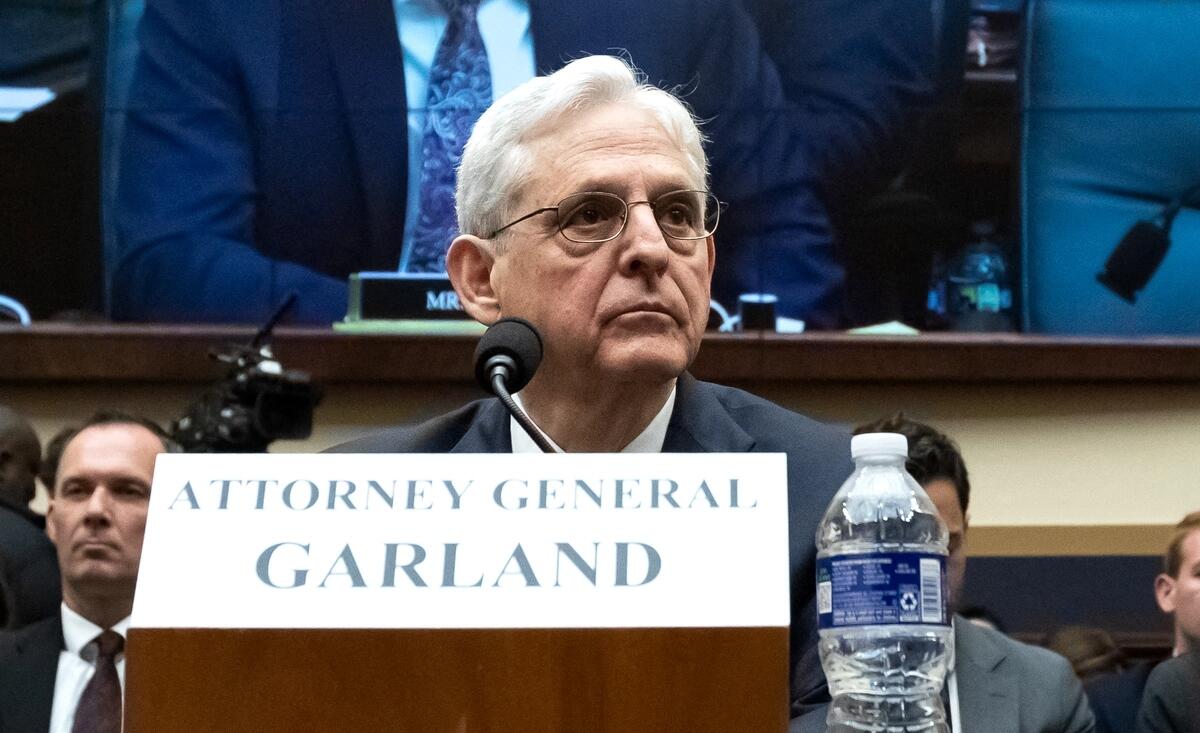
Critics at the time said the policy change, which was contained in a memo signed by Garland, was calculated to intimidate parents protesting policies such as mask mandates and curriculum. Many of those who protested the memo were themselves heavily criticized by memo supporters.

The DOJ’s internal communications suggest that top officials in the DOJ opposed the policy days before it was publicly unveiled.

A DOJ source who did not wish to be identified confirmed to The Epoch Times late on June 10 that the emails, posted on X by independent journalist Lara Logan, were authentic.

The controversy itself goes back almost five years. Garland released a memo on Oct. 4, 2021, that called for federal law enforcement to deal with harassment and threats of violence allegedly made against school board members, teachers, and school employees.

“Threats against public servants are not only illegal, they run counter to our nation’s core values,” he said at the time.

“The Department takes these incidents seriously and is committed to using its authority and resources to discourage these threats, identify them when they occur, and prosecute them when appropriate,” he wrote in the memo.

In an email thread dated two days before that, senior DOJ officials discussed the upcoming shift in enforcement focus.

Minutes after Associate Deputy Attorney General Kevin Chambers advised his colleagues of the policy change, they began to push back.

Acting Assistant Attorney General for the Criminal Division Nicholas McQuaid wrote, “I strongly object to adding school official threats to the USAO meetings,” referring to meetings of the U.S. Attorney’s Office, a subagency of the DOJ that represents the federal government in court.

“They are not equivalent and treating them as such will damage our election threats work without actually having any real benefit in my view.”

Deputy Assistant Attorney General Kevin Driscoll wrote:

“I don’t think it’s possible to state how strongly I object to this.

“It will completely and totally nuke our election threats efforts, and will damage the reputation of the Public Integrity Section into the bargain.

“It’s like [they’re] affirmatively trying to make this thing not work and look political. If they do this, they might as well rename the damn thing the Anti-MAGA Task Force.”

Corey Amundson, head of the DOJ’s Public Integrity Section, replied:

“Exactly! Stupid, stupid, stupid.”

Driscoll answered, writing, “We will not do this. There is no conceivable connection to [Public Integrity Section] (indeed, I’m not seeing a federal interest of any kind). And if they’re going to make the AG’s memo to the field about this and election threats, I’m going to strongly recommend that they not send it.”

Amundson replied, saying, “Agreed. Also, makes no sense to have DOJ/FBI suddenly become the threats police. No limiting principle at all.”

Months after the memo was released, Senate Judiciary Committee Republicans, led by Sens. Charles Grassley of Iowa and Marsha Blackburn of Tennessee, asked detailed questions concerning federal targeting of parents who voice their opinions at local school board meetings.

The 11 Republican lawmakers on the committee told then-Secretary of Education Michael Cardona in a Jan. 18, 2022, letter: “We recently learned that you may have requested that the National School Boards Association (NSBA) send to President [Joe] Biden its September 29, 2021, letter, which compared concerned parents speaking out at local school boards to domestic terrorists.

“That letter was the proximate cause of Attorney General Garland issuing a memorandum on October 4, 2021, directing the FBI and the various U.S. Attorneys to focus on harassment, intimidation, and threats of violence directed at school officials.

“That action by Attorney General Garland has created a dramatic chilling effect on parents throughout the country and is an inappropriate deployment of federal law enforcement.”

Tyler Durden Thu, 06/11/2026 - 12:20
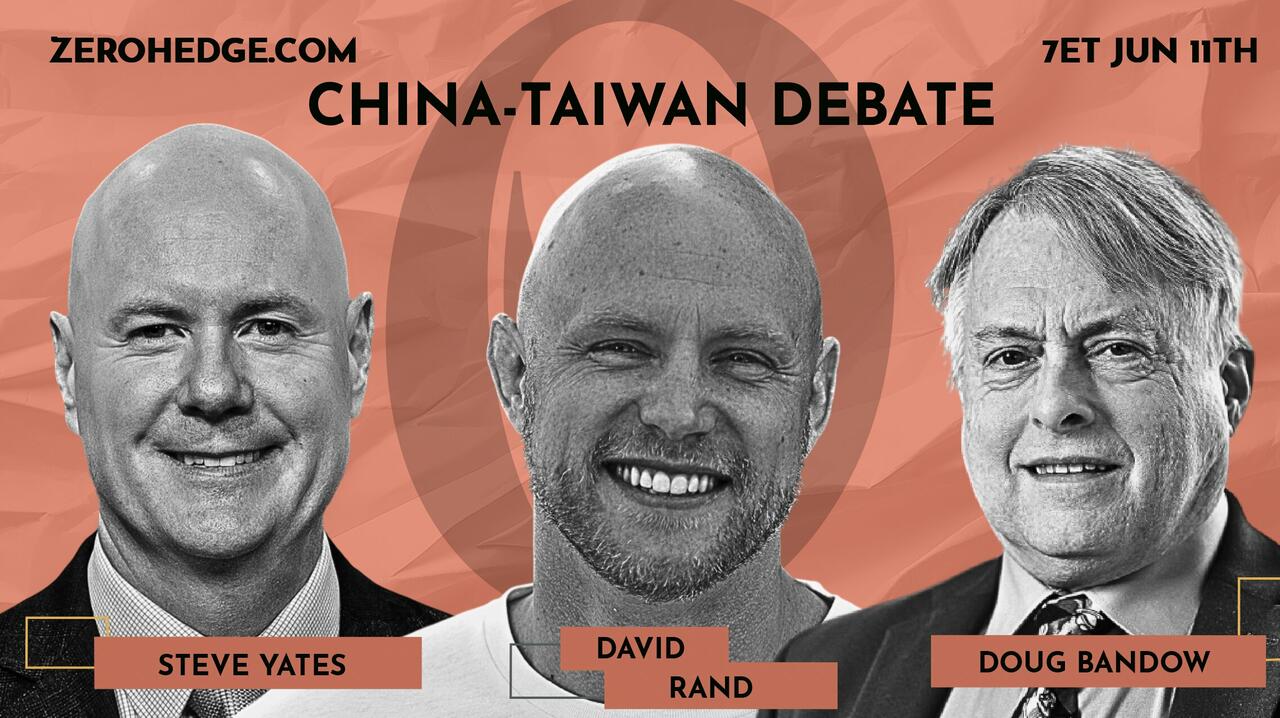
Cato Vs Heritage: Should the U.S. Go to War if China Invades Taiwan?

Cato Vs Heritage: Should the U.S. Go to War if China Invades Taiwan?

LIVE:

************************

While President Trump has softened his rhetoric on China since his recent visit to Beijing, he has continued to keep the answer to one question close to his chest: would the United States go to war to defend Taiwan if China attempts to seize the island by force?

Though perhaps a better question is Should we? Tonight, the Cato Institute and Heritage Foundation join ZeroHedge Debates to tackle that question.

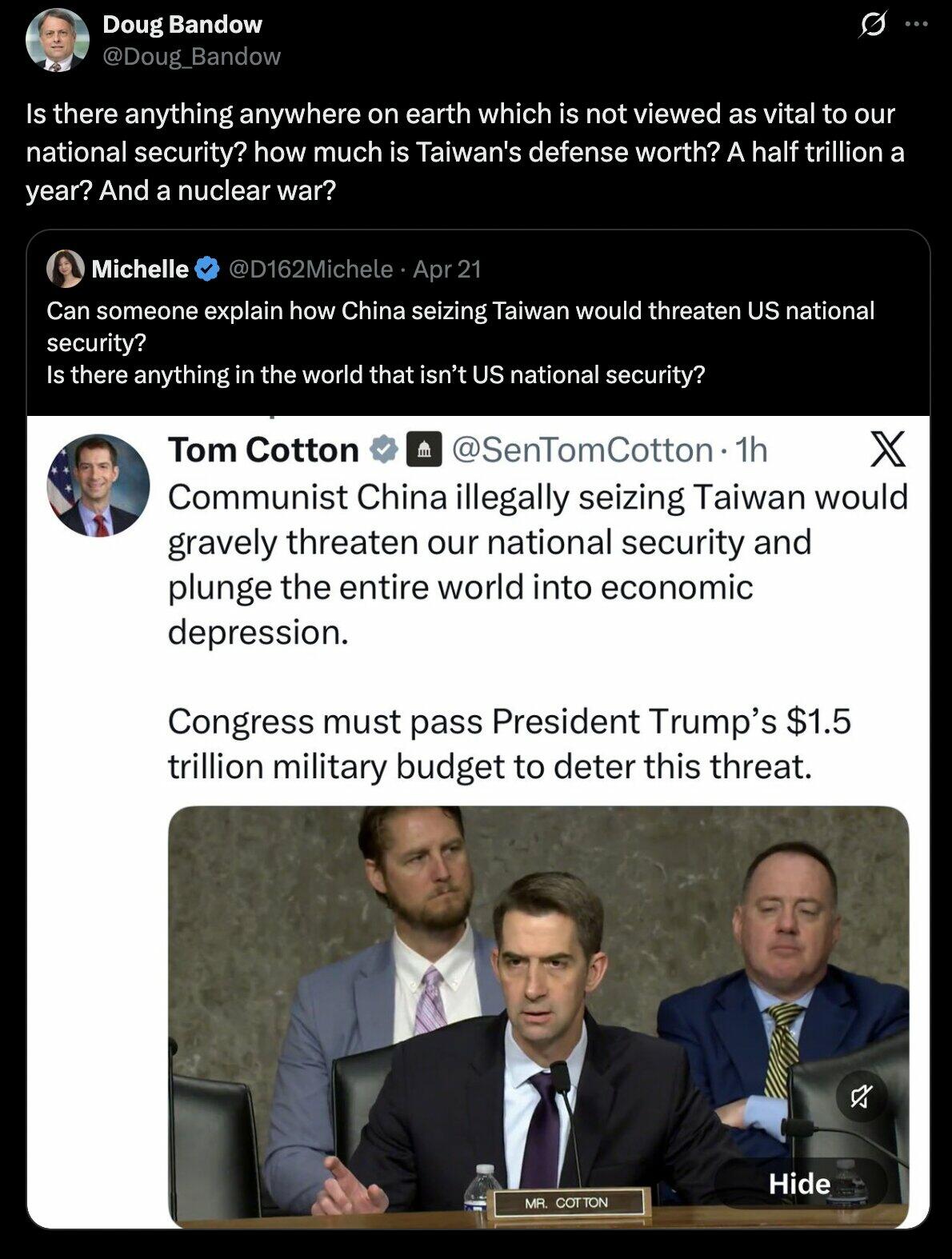
Taking the case against military intervention is Cato’s Doug Bandow, who argues that a war with China over Taiwan would impose enormous costs on the United States while serving interests that are ultimately peripheral to American security, and well… there’s the risk of nuclear war.

Advocating intervention is Steve Yates of Heritage, who contends that abandoning Taiwan would shatter U.S. credibility throughout Asia, embolden Beijing, and fundamentally alter the global balance of power in China's favor.

Our returning host David Rand of the Human Reaction podcast will ask whether Taiwan represents a vital American interest or a dangerous strategic tripwire. And, assuming Taiwan is a vital interest, is diplomacy superior to provocative acts (ie arms packages) in the name of “deterrence”?

Despite Trump’s and Xi’s shared kind words, the U.S. approved an $11 billion arms package for Taiwan last December. There was to be another package amounting to an additional $14 billion, which was recently paused amid the Iran war, sending hawks into a frenzy. 

Debaters will also address the once-controversial Pentagon policy paper recommending the U.S. military blow up Taiwanese chip manufacturing plants in the event of a Chinese invasion… something the current #3 at the Pentagon, undersecretary of war for policy Ebridge Colby, called “table stakes”:

Elbridge is the grandson of former CIA Director William Coby.

The debate begins tonight at 7pm ET, here on the ZH homepage, X feed, and YouTube and will also stream on the Human Reaction podcast.

Tyler Durden Thu, 06/11/2026 - 12:00

Pentagon Lockdown: Multiple Floors Evacuated Over Hazardous Materials Air Quality Incident

Pentagon Lockdown: Multiple Floors Evacuated Over Hazardous Materials Air Quality Incident

Several floors and corridors of the Pentagon were locked down and partially evacuated Thursday morning following the detection of a hazardous materials incident and air quality concerns, according to officials and multiple reports.

What we know...
  • Floors 2 through 5 in corridors 4 through 7 are currently locked down.
  • Personnel observed wearing gas masks and full chemical protective gear.
  • Pentagon Force Protection Agency’s HazMat team, along with Arlington County Fire Department, are on scene.
  • Shelter-in-place order issued for affected areas; additional testing underway (estimated 1–2 hours).
  • No injuries reported at this time.

Pentagon spokesman Sean Parnell confirmed that building systems detected an air quality issue, triggering standard hazardous materials response protocols. Response teams are actively investigating the source.

Developing...

Tyler Durden Thu, 06/11/2026 - 11:20

Bessent Pulls Trigger On Using Frozen Funds To Reimburse Gulf Allies: 'Iran Will Pay'

Bessent Pulls Trigger On Using Frozen Funds To Reimburse Gulf Allies: 'Iran Will Pay'

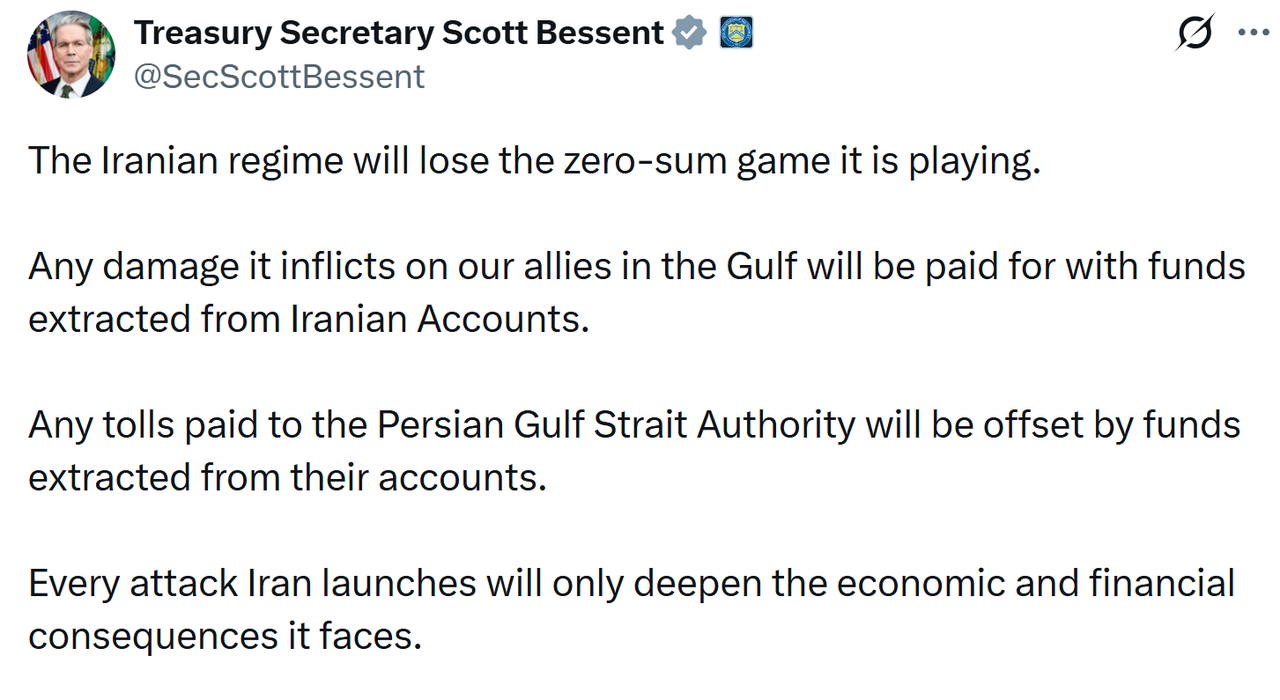
US Treasury Secretary Bessent announced on X Thursday morning that Washington is moving forward on a plan to compensate America's Gulf regional allies for damage sustained during Iranian counterattacks on their energy and civic infrastructure.

He made clear that any damage to Gulf allies would be paid for with frozen Iranian funds, which Tehran leadership has long blasted as blatant theft.

According to Bessent's latest announcement: "The Iranian regime will lose the zero-sum game it is playing." The Treasury Secretary listed out the following new policy and plan:

  • Any damage it inflicts on our allies in the Gulf will be paid for with funds extracted from Iranian Accounts.
  • Any tolls paid to the Persian Gulf Strait Authority will be offset by funds extracted from their accounts.
  • Every attack Iran launches will only deepen the economic and financial consequences it faces.
via Reuters

Interestingly, there is implicit here a possible acknowledgement that US forces won't be able to immediately be able to stop Iran from enacting its toll collection protocol, which it has hinted is being done in coordination - or at least with an 'understanding' - from Oman, which itself has come under pressure from the Trump administration of late.

Over eighty oil, gas, and vital infrastructure facilities across the Gulf have been hit - with most of the attacks having occurred in March and April - with one recent report estimating up to $58 billion in damage. Iran has sought to justify these attacks as 'retaliation' for these Gulf countries hosting American bases during the US unprovoked assault on the Islamic Republic.

An unnamed US official had previously told ABC's Senior White House correspondent Selina Wang last weekend: "Treasury will utilize all tools available to allow Iranian assets to be made available to our Gulf allies to support rebuilding and repairs for any future damage caused by Iran."

"The Secretary has also directed his team to assess conditions amongst our Gulf allies and request comprehensive estimates of the costs associated with repairing damage Iran has inflicted since the start of the conflict," the source had added.

Also as part of that earlier reporting, it was revealed:

The Iranian assets could include frozen assets and ships the U.S. has seized. The administration is reaching out to Gulf allies right now and asking for their evaluation.

This is only likely to further derail efforts to get Tehran and Washington back to the negotiating table. Already the US has balked at Iran's own insistent it be given reparations for damage done.

Iran is meanwhile still demanding that its billions in funds long frozen by Washington be given back as part of a deal. The Trump administration has so far rejected this, at least in terms of its public-facing position.

Tyler Durden Thu, 06/11/2026 - 10:00

War And Piece

War And Piece

By Michael Every of Rabobank

Sorry, Bank of Canada (rates held at 2.25%), Chinese CPI and PPI (1.2% and 3.9% y-o-y headline) US CPI (0.5% m-o-m and 4.2% y-o-y headline, 0.2% and 2.9% core), and the ECB today: you all matter but are just pieces of the global picture one now needs to finish: the war vs. Iran.

Changing the recent pattern, President Trump said he would strike Iran again today and did. At time of writing, nearly 50 Tomahawk missiles had been fired alongside airstrikes against radar and drone installations, with a disputed report that a petrochemicals plant was also hit. Even by the standards of the ‘peacefire’ --which, as I’d argued yesterday morning, Iran’s leadership then agreed no longer suits them-- this is a major escalation.

However, the US is still holding back compared to what it can do militarily, and Israel is sitting on its hands. Notably, Trump told Fox News he has been in direct contact with senior Iranian leadership, a new development, and they had asked him to stop bombing: to which he claims he told them to sign the deal on the table, or on Thursday evening he will “Bomb the s**t out of them.” In other words, hits against infrastructure, energy, and nuclear sites, can’t be ruled out.

The immediate Iranian response has been to declare Hormuz entirely closed to all ships. However, despite the fact that Iran was prepared for these US strikes there have, as yet, been no successful counterstrikes against US bases in the Middle East or against GCC energy and water infrastructure. Will this happen with a lag? If not is Iran unable to do so, or just unwilling to? Equally, will Iran act with the Houthis to close the Bab-el-Mandeb and Red Sea, making this energy crisis far worse?

These are staggeringly important geopolitical questions on which global markets, and the BoC and Chinese and US inflation, will ultimately pivot.

So far, the market reaction has been relatively mild – oil only up around $2. Perhaps part of that is down to another piece of the Iran puzzle that has befuddled energy experts and visitors from outside the field – what is happening in terms of oil flows from Hormuz.

Trump had yesterday announced the US is taking “millions of barrels of oil” from Iran, causing the usual consternation. A breakdown of what he meant comes from shipping maven @mercoglianos, who argues the US secretly resumed Project Freedom to escort ships through Hormuz using autonomous vehicles, aircraft, and drones to escort ships through the southern Strait near Oman. Very Large Crude Carriers are exiting the Gulf, conducting ship-to-ship transfers to smaller tankers near Oman, then returning to pick up more oil. In that regard, oil can flow even as the number of ships stuck in the Gulf appears unchanged. War risk insurance, potentially provided by the US Development Finance Corporation, could be covering these few ships making the transits. Yet Iran has been targeting them and the US responding with airstrikes: the Apache helicopter just shot down, triggering a new US attack, was likely part of this operation.

Of course, what may have been happening invisibly, despite 24/7 market coverage, can’t compensate for normal Gulf flows, which is why the plunge in the US and Japan’s SPR and a huge drop in China’s oil imports --none of which are sustainable-- are doing the heavy lifting to keep oil below $100. That dynamic always pointed to escalation: will it be military now, via the US; with others later as more energy panic kicks in; or via more backchannel diplomacy from China? 

Regardless, it’s hard to make economic or central bank forecasts without one for the Iran War, as the FT says airlines are drawing up cuts for an 'ugly' winter’ due to stubbornly high jet fuel prices; Reuters notes global container shipping rates are soaring and “Fuel analysts and maritime experts warn it could take around a year for bunker fuel supplies to return to normal even if Trump is able to quickly clinch an Iran deal”; and the UK Telegraph argues farmers may have to stop planting crops without government support.

But geopolitics and geoeconomics are to the fore everywhere and it’s not only energy and petrochemicals being squeezed.

In the Middle East, Turkey’s President Erdogan claimed Israel’s strikes on Lebanon and Syria threaten it and “its aggression must be stopped”, after talking about the liberation of Jerusalem. Israel’s diplomatic response was equally undiplomatic; Saudi Arabia resumed imports from Lebanon after a five-year hiatus; and a Saudi-Turkey rail link may be completed within three years.

In the Americas, Trump suggested he may not renew the USMCA trade deal with Mexico and Canada; and US Secretary of War Hegseth warned Cuba that any arms procurement by it seen as threatening the US could invite a confrontation - we are talking about 1956 at the moment, so why not 1962 too?

In Europe, five capitals are reportedly calling to freeze voting rights for new EU members, radically changing the structure of the Union; Politico reports ‘French far-right firebrand’ Zemmour is embracing MAGA to try to pay political dividends at home ahead of the 2027 presidential election; and the South China Morning Post asks ‘As de-dollarisation trends persist, can the yuan take the euro’s place?’, meaning taking the #2 spot in global settlements from the single currency.

In Australia, the political scene continues to churn with talk of a ‘non-compete’ clause and voting preference deal between the centre-right Liberals and populist right One Nation that has suddenly soared in the polls.

In Asia, Taiwan fired US mobile missile launchers into the waters facing China for the first time as “a message of resolve”, according to the Wall Street Journal; the US has asked China to resume rare earth exports to Japan, which have been cut off, as Tokyo pivots to US tungsten scrap exports to fill that gap, and the Democratic Republic of Congo’s curbs on cobalt exports have sparked shortages for everyone, including China; Japan’s parliament passed a revised economic security law to support overseas projects (as Bloomberg asks ‘Who’s Afraid of ‘Japanese Neo-Militarism’? Nobody’ - that’s arguably not true; and BOJ Governor Ueda has been hospitalized and is expected to miss the June policy meeting. Get well soon and perhaps be can follow the Iran news from there.

Indeed, now back to whatever piece of the war you happen to be focusing on.

Tyler Durden Thu, 06/11/2026 - 09:40

AI Price Wars Begin: OpenAI Considers "Drastic Price Cuts" In Pursuit Of Anthropic Customers

AI Price Wars Begin: OpenAI Considers "Drastic Price Cuts" In Pursuit Of Anthropic Customers

Earlier today, in a report discussing how "AI bills are out of control", JPMorgan tech guru and TMT salesman, Mark Schilsky wrote that "most of my high level investor discussions focus on one major topic: when will the party end? Put another way, tech investors have made so much money in Semis so quickly that they are looking for potential warning signs that the music is about to stop. Predicting such an end is incredibly difficult. As such, investors are searching for forward-looking indicators that might suggest the AI party is nearing a peak." 

Here, the JPM trader highlighted perhaps the clearest indicator that the music was about to stop: "A slowdown in the growth of the annualized run-rate revenues of the major AI labs. If there is any sort of second derivative ‘kink’ in their growth algorithms, that could portend a future problem for the AI trade."

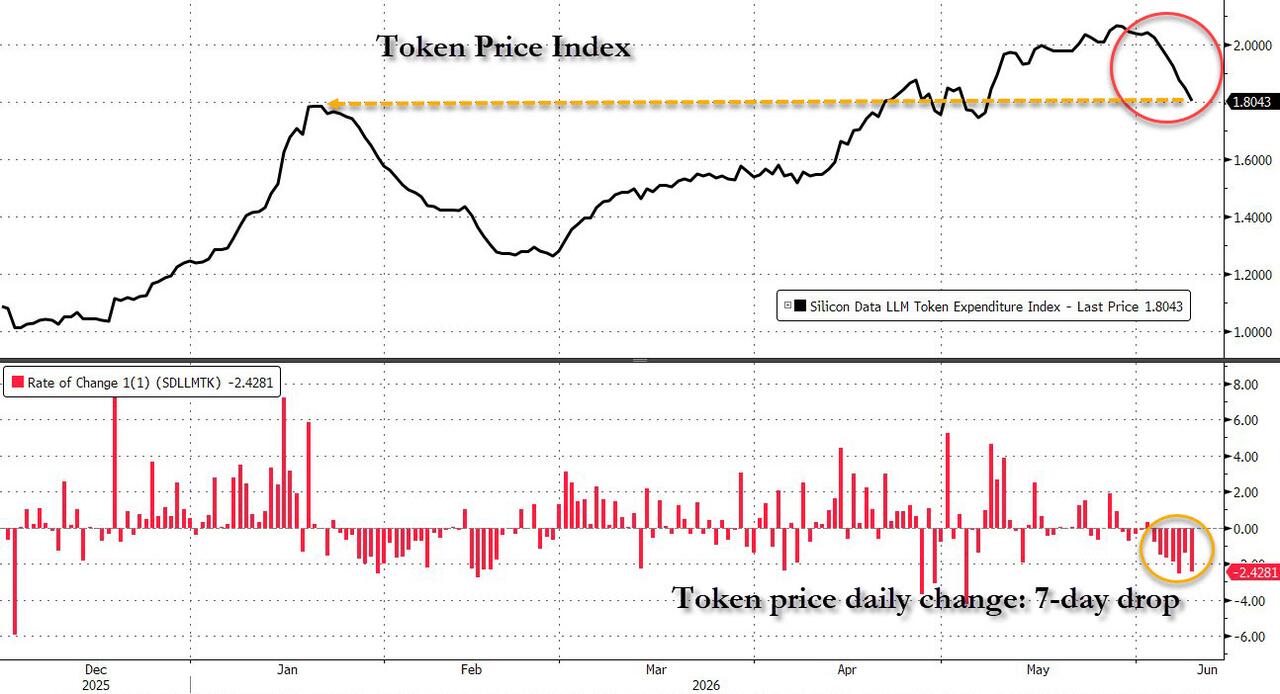
In response to this, we pointed to just such a "slowdown in the run-rate revenues", when we showed that the Silicon Data token price index is down for 7 straight days to a level last seen in mid-January, or long before the current agentic craze started. Almost as if it knew something... 

Source

Turns out it did: late on Wednesday, with futures surging and Korean stocks erasing a nearly 5% drop and turning green, and euphoria generally back front and center, the WSJ may have burst the AI bubble when it reported that - contrary to conventional wisdom that token prices will magically go to infinity - OpenAI, which has been badly lagging both the revenue and IPO race with Anthropic in recent months - was considering "drastically lowering the prices it charges users" in a panic scramble to regain market share and win back customers from archrival Anthropic.

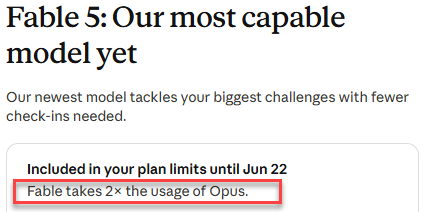
And so, at a time when there is suddenly a mass realization that token prices had been soared in recent weeks, a wake-up call which JPM lovingly described as follows: "investors have been discussing the possibility that much of the token spend that corporate America is currently incurring is ‘wasted’. Anecdotes from companies like UBER aren’t helping this narrative", OpenAI is weighing significant cuts to what it charges for tokens. Hilariously, the move would be in anticipation of similar cuts the company expects at Anthropic, which is trying to double how much it charges for its latest model, Fable, which provides at best a very modest modest improvement in performance over Opus 4.8.

In short, we now have a classical deflationary race to the bottom, precisely the opposite of what the profit-strapped industry desperately needs to grow into its gargantuan balance sheets (and massive SPVs); Instead, the AI world is about to get hit with a collapse in both revenues and profit margins, while cash burn goes into full-on incinerator mode.

Warning that "business executives have begun to balk at the high prices for AI usage", the WSJ writes that OpenAI CEO Altman said at a recent event that costs had become “a huge issue.”

“I think we’ll have a lot of ways we can help people get more value for less spend,” he said.

In other words, LLMs tried to push up token prices to and beyond their breaking point... and succeeded.

And now it's time for the brutal drop: a drastic price war will erode the profit margins of both companies, which already lose billions of dollars because of the enormous cost for computing resources needed to run AI systems. 

Altman's decision to start a price war was prompted by OpenAI's attempt to catch up with its younger rival in the race to win enterprise customers that are paying large amounts of money for AI tools that can improve workplace productivity. Anthropic’s revenue recently surged
"after its coding tool Claude Code went viral among software engineers, and the five-year-old startup surpassed OpenAI’s valuation for the first time."

Or at least that's the WSJ version of events. In reality what happened is that Anthropic quietly annualized the one-time bumper revenue from Feb-May during the agentic splurge when nobody had any idea what they were paying, to come up with the ludicrous $47BN ARR, which they then actively paraded ahead of their IPO. But let's see what Anthropic's ARR is next month will be after clients finally check their token bills.

Sure enough, as we have been writing repeatedly in recent weeks, "some corporations poured so much money into Anthropic’s products that their leaders are now seeking to rein in spending. Earlier this year, an Uber executive said the company had maxed out its 2026 budget for agentic, or autonomous, AI use, and another company leader said last month that it was difficult to link AI coding productivity improvements to new customer features."

In other words, yet again the age-old question of whether and when AI will have a positive ROI rears its ugly head, and the answer is not any time soon... if ever. 

Such comments from many executives have triggered a broader debate within Silicon Valley about so-called “tokenmaxxing,” or the practice of using as many tokens as possible to boost productivity, including in ways that don’t generate returns on investment. That may have worked 6 months ago when LLMs were giving out compute for free to capture market share, but it doesn't work now that all the major AI companies are suddenly charging an arm and a kidney for an "agent" that responds to emails. 

As the WSJ concludes, "a price war would be an early test of the strength of both companies’ business models ahead of hotly anticipated public listings." OpenAI and Anthropic have captured the majority of revenue from new AI products, powering their rise. But an underlying risk that investors have long identified is the interchangeability of their products, and the ease with which customers can abandon one for the other. 

There is a bigger risk: as we noted one week ago, in the coming price war, neither OpenAI nor Anthropic will win. Instead it will be the country that has made reverse engineering Western technology and then selling it back to the west at 90% off, into an art form. Yes, China is about to enter the chatbot. 

Tyler Durden Thu, 06/11/2026 - 09:15

US Initial Jobless Claims Jump To 4-Month-Highs

US Initial Jobless Claims Jump To 4-Month-Highs

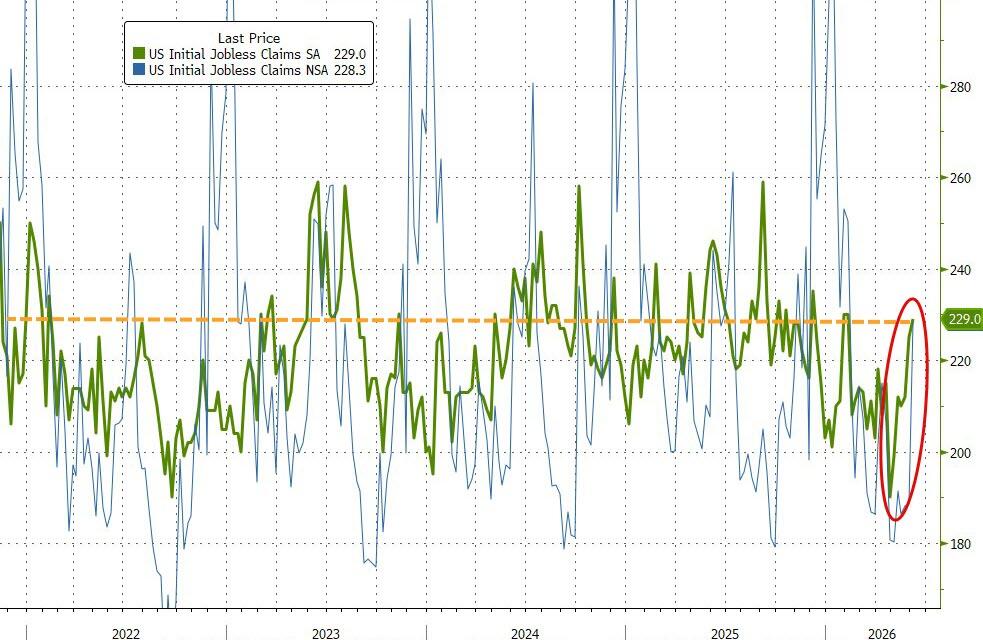
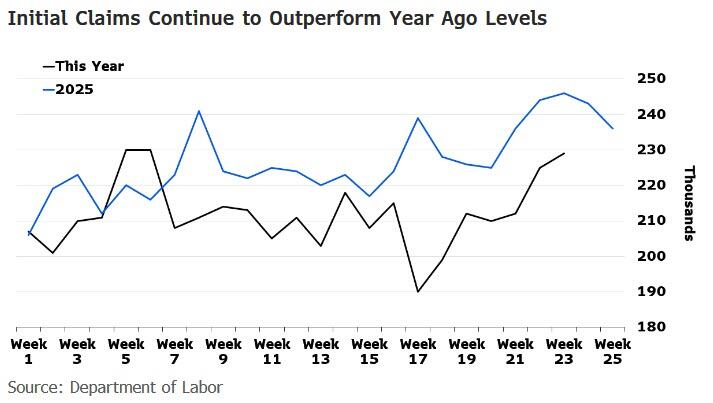
The number of Americans filing for unemployment benefits for the first time jumped to 229k last week (more than the 220k expected) and the highest in four months...

Source: Bloomberg

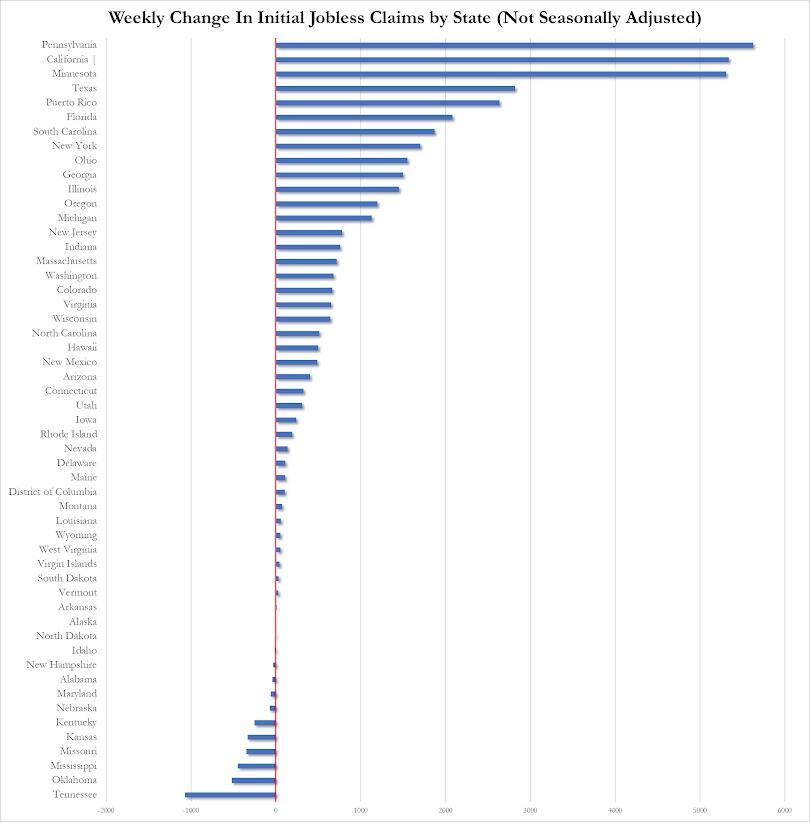
Pennsylvania, California, and Minnesota are the states seeing the largest rise in claims last week...

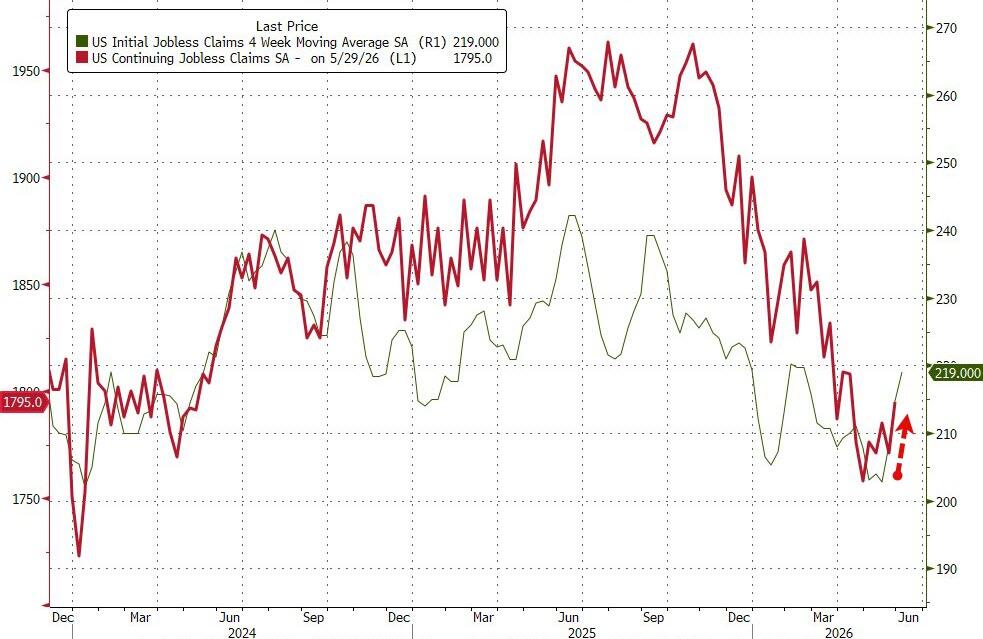
Continuing jobless claims also rose last week to 1.795mm Americans - highest in two months, but still relatively low in the context of the last two years...

Source: Bloomberg

The bottom line is that while initial jobless claims are rising, they remain low by historical standards and continue to run below year-ago levels.

Taken together with the May payrolls report, the data suggest that labor-market momentum remains firm.

Tyler Durden Thu, 06/11/2026 - 09:08

Bill Gates Tells Congress That Epstein Exploited Knowledge Of His Adultery

Bill Gates Tells Congress That Epstein Exploited Knowledge Of His Adultery

Microsoft founder and mega-billionaire philanthropist Bill Gates told Congress that Jeffrey Epstein exploited knowledge of Gates' multiple marital infidelities. Gates insists, however, that he committed no crimes and that the women he had adulterous sexual relations with were not associated with Epstein. Nonetheless, Gates' highlighting of Epstein's leveraging of Gates' sexual secrets fans suspicions that he sought to exploit similar secrets of other powerful people. 

"I never witnessed nor had any indication that Epstein was engaged in ongoing criminal conduct. I never went to his island, his ranch, or his Florida home. I have never victimized anyone. While he may have sought to foster a personal relationship, I was never interested in that and never reciprocated," Gates said in his opening remarks, which were published by the House Oversight committee. His testimony on Wednesday was given behind closed doors. 

Bill Gates with an unidentified but manifestly well-proportioned brunette number, in a photo from the Epstein files (House Oversight Committee)
Gates told legislators that Epstein became aware of Gates' serial philandering with three different women via a mutual acquaintance.  “Based on what has been released in the files, Epstein was working to use information about my infidelities—in addition to many lies that he layered on top—to pressure me to re-engage with him,” Gates said. “He was unsuccessful in this effort, but it shows some of the ways he tried to leverage his interactions with me to further his agenda.”

The three women were two Russians and another woman who's been described as a doctor, according to a leak of Gates testimony leaked to the Wall Street Journal. Committee Democrats held a press conference in which they said Gates acknowledged having been in the company of women that were abused by Epstein or his colleagues. It's expected that the Oversight Committee will release a transcript of Gates' give-and-take with lawmakers, which reportedly became combative at times. 

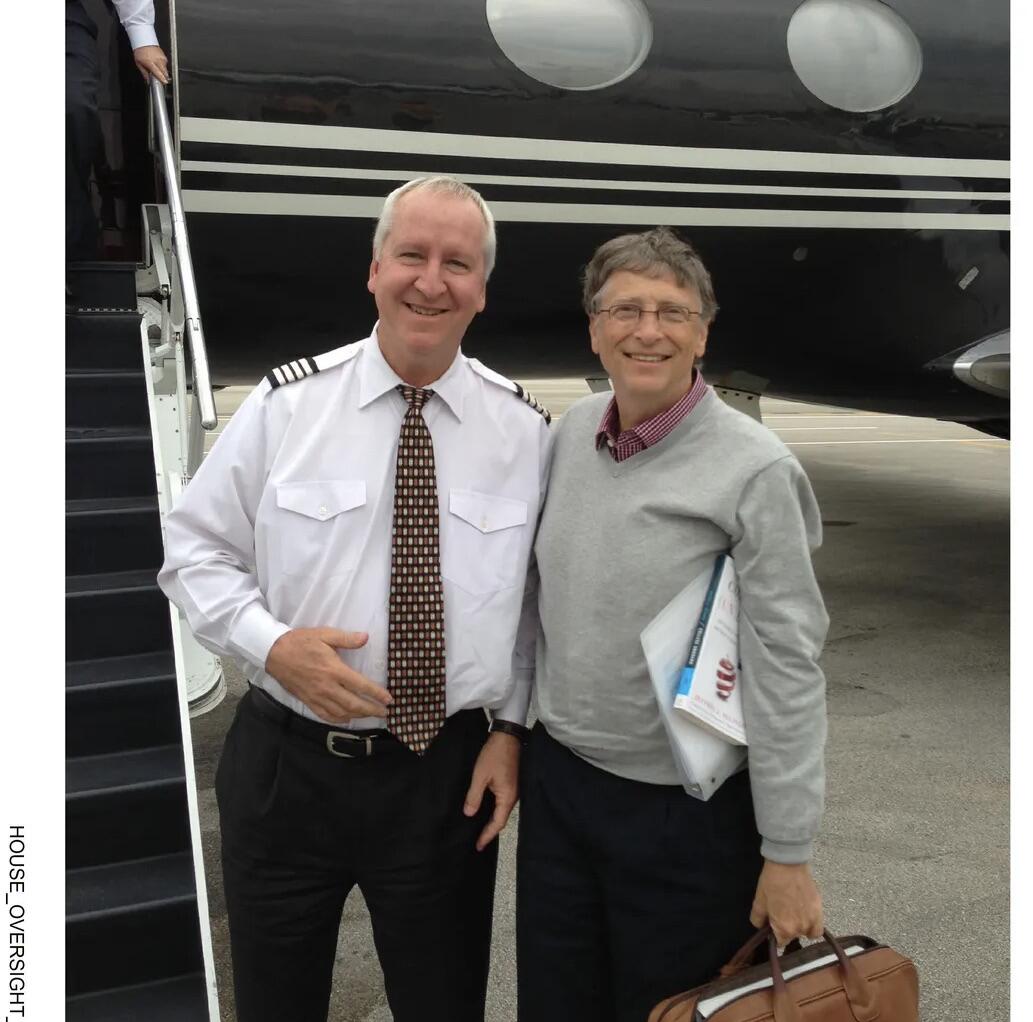
Documents from the Epstein files revealed that Epstein and Gates met on several occasions after Epstein's 2008 conviction. Gates told the House committee that he met Epstein through "people I trusted in my professional and philanthropic work," and that Epstein promoted his ability to give tax and estate guidance. Gates expressed regret for not vetting Epstein. "I recall being aware that Epstein had faced prior legal issues, but I did not fully understand the extent of the crimes he committed. I accepted the introduction without applying the scrutiny I should have," said Gates in his opening remarks. He said he stopped communicating or meeting with Epstein in December 2014, after concluding that Epstein "would never deliver on his promises" of reeling in donors for the Gates Foundation.  

In an undated photo, Gates appears with Jeffrey Epstein's pilot, Lawrence Visoski (House Oversight Committee Democrats via USA Today)
Tapping a tiny sliver of his net worth of more than $100 billion, Gates went to truly extraordinary lengths to prepare for his appearance on the Hill -- even assembling a mockup of the room in which he would testify. That replica was put together in Palm Desert, California, near his home, the Journal reported:

The replica included a podium on one side with wood paneled furniture flanked by gold curtains to display where lawmakers would traditionally sit. The other side featured a large wooden table for the person responding to questions, along with microphones and several cameras, to mimic the space in Washington. 

Defying President Trump's wishes, the Epstein files were forced into public view by House representatives led by Republican Thomas Massie and Democrat Ro Khanna. Massie used a "discharge petition" to force a vote on legislation requiring the release of the documents. Last month, Massie lost a primary challenge funded by pro-Israel billionaires whose involvement in the contest made it the most expensive primary race in US history.  

On a recent Meet the Press appearance, Massie said there are many files still hidden from the public, and he accused the acting US attorney general of violating the Epstein Files Transparency Act: "Todd Blanche is violating the law. There's still millions of files they haven't released." Massie promised to name more people whose identities are still redacted in the Epstein files. He also made an intriguing reference to Trump's First Lady: 

"I don't think it's possible to get to convictions with Todd Blanche at the top and with the FBI director, Kash Patel, at the top, because they have effectively both perjured themselves by saying there's nobody else in the files. Even Melania doesn't believe that. The First Lady knows that Jeffrey Epstein didn't act alone."

Massie has another seven months to help us understand exactly what that means -- a time during which he's empowered to spill Epstein-file secrets on the House floor with impunity, thanks to the Constitution's Speech and Debate Clause.  

Tyler Durden Thu, 06/11/2026 - 08:45

Core Producer Prices Cooler Than Expected In April, Goods Costs Jump Most On Record

Core Producer Prices Cooler Than Expected In April, Goods Costs Jump Most On Record

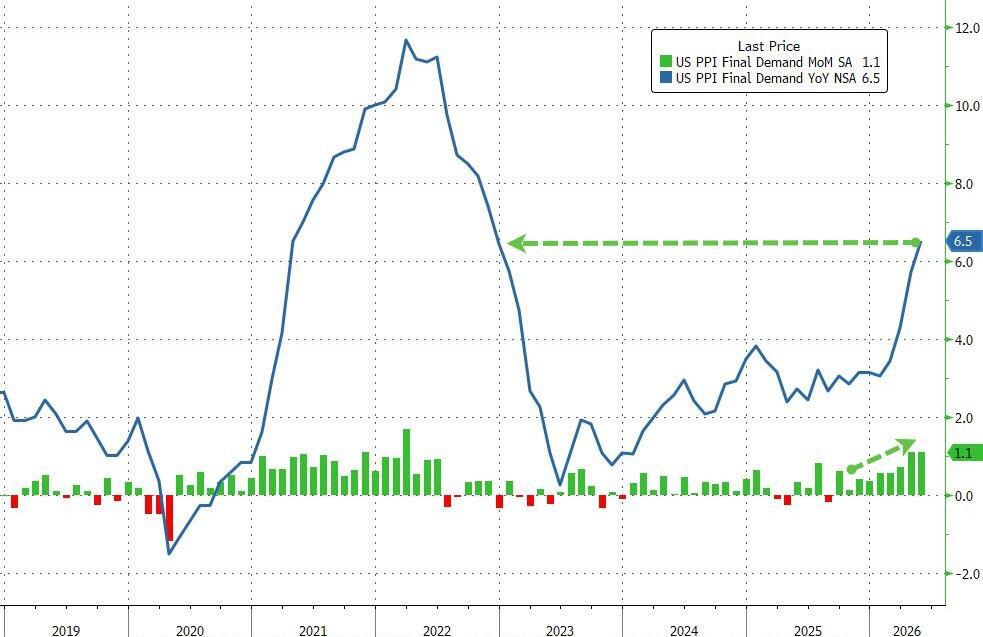
After yesterday's mixed bag from consumer prices (headline in-line but core cooler than expected and goods deflating), US Producer Prices were expected to keep accelerating higher (on a YoY basis) in May and they did... by more than expected.

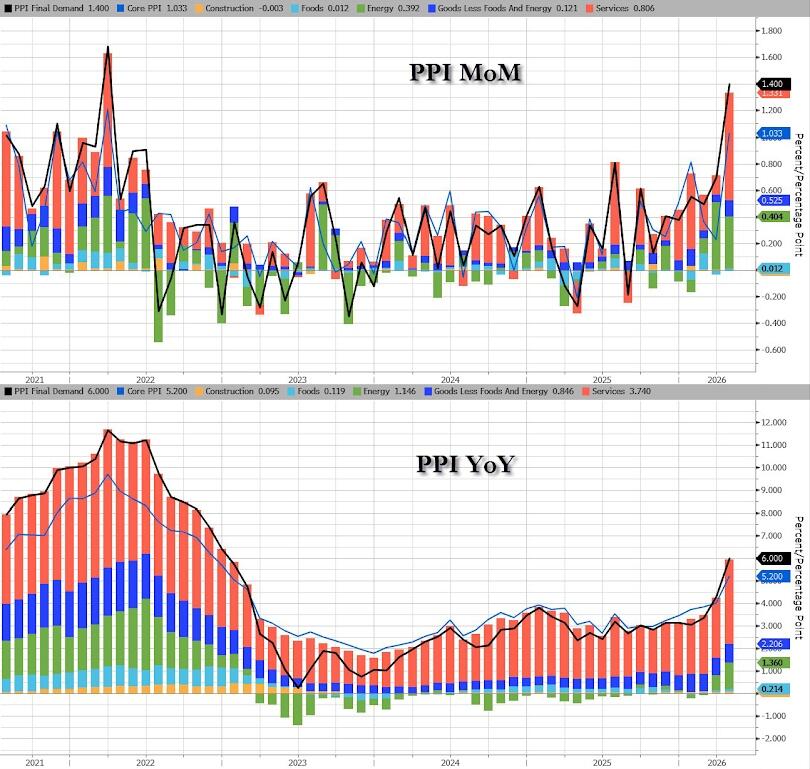
Headline PPI rose 1.1% MoM in May (much hotter than the 0.7% MoM exp) but April's 1.4% MoM rise was revised down to +1.1% MoM. This left producer prices up 6.5% YoY (vs 6.4% exp and up from revised lower 5.7% in April)...

Source: Bloomberg

Services costs are the biggest contributor to the rise in the headline print...

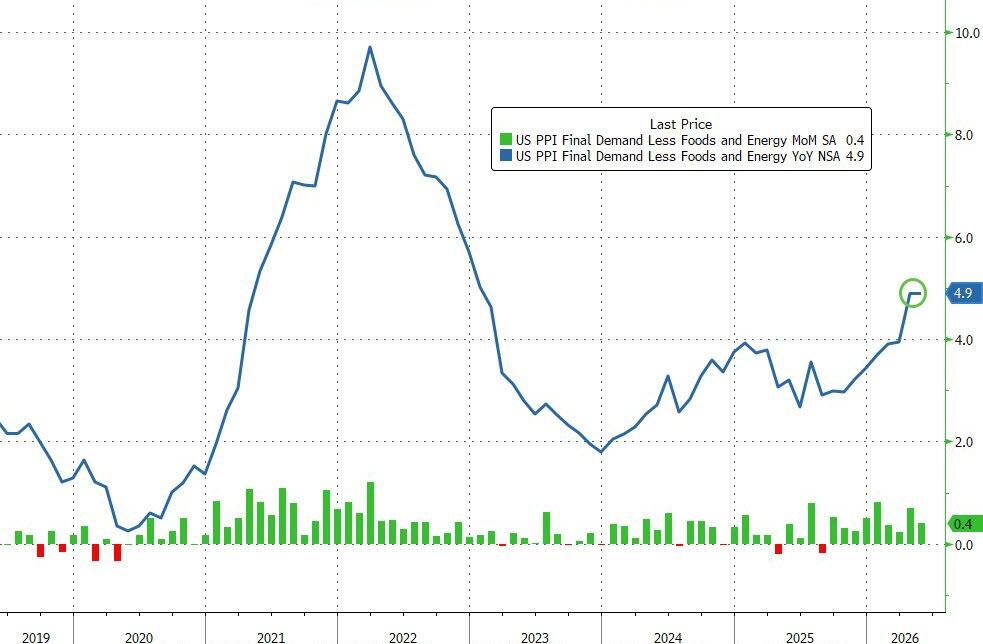
    And, echoing CPI, Core PPI (ex Food and Energy) printed cooler than expected at +0.4% MoM (+0.5% exp) with core PPI up 4.9% YoY (well below the 5.4% YoY exp and flat with April's revised lower 4.9%)...

    Source: Bloomberg

    PPI details:

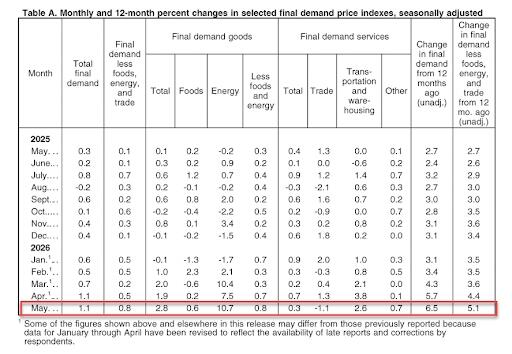
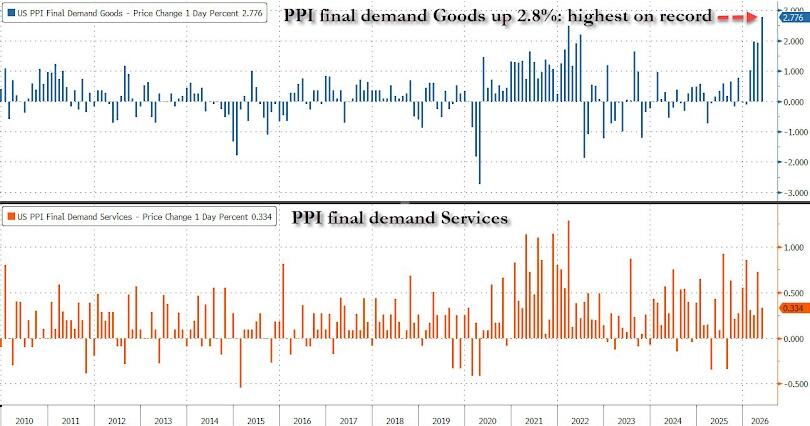
    Final demand goods: The index for final demand goods moved up 2.8% in May, the largest increase since data were first calculated in December 2009. 80% of the broad-based advance can be traced to a 10.7-percent jump in prices for final demand energy. The indexes for final demand goods less foods and energy and for final demand foods also rose, 0.8% and 0.6%, respectively.

    • Product detail: Over half of the May advance in prices for final demand goods is attributable to a 23.4% increase in the index for gasoline. Prices for diesel fuel, jet fuel, plastic resins and materials, industrial chemicals, and natural gas liquids also rose. In contrast, the index for pork fell 10.1 percent. Prices for residential electric power and for sanitary paper products also declined.

    Final demand services: The index for final demand services moved up 0.3% in May following a 0.7% advance in April. Leading the May increase, prices for final demand services less trade, transportation, and warehousing rose 0.7%. The index for final demand transportation and warehousing services moved up 2.6 percent. Conversely, margins for final demand trade services decreased 1.1 percent. (Trade indexes measure changes in margins received by wholesalers and retailers).

    • Product detail: Over 40% of the May advance in the index for final demand services can be traced to a 4.8-percent rise in prices for portfolio management. The indexes for truck transportation of freight; securities brokerage, dealing, investment advice, and related services; chemicals and allied products wholesaling; food wholesaling; and airline passenger services also increased. In contrast, margins for machinery and equipment wholesaling fell 1.9 percent. The indexes for fuels and lubricants retailing and for residential real estate loans (partial) also moved lower.

    Trade Services dipped 1.1% MoM but Goods prices surged 2.8% MoM (driven by spiking Energy costs)...

    This is the biggest jump in PPI Goods on record...

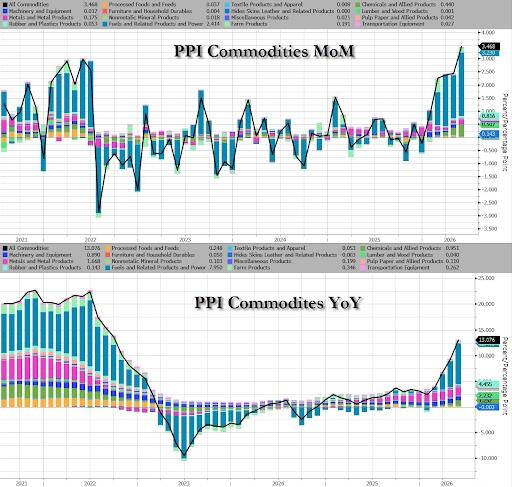
    Commodity prices are accelerating...

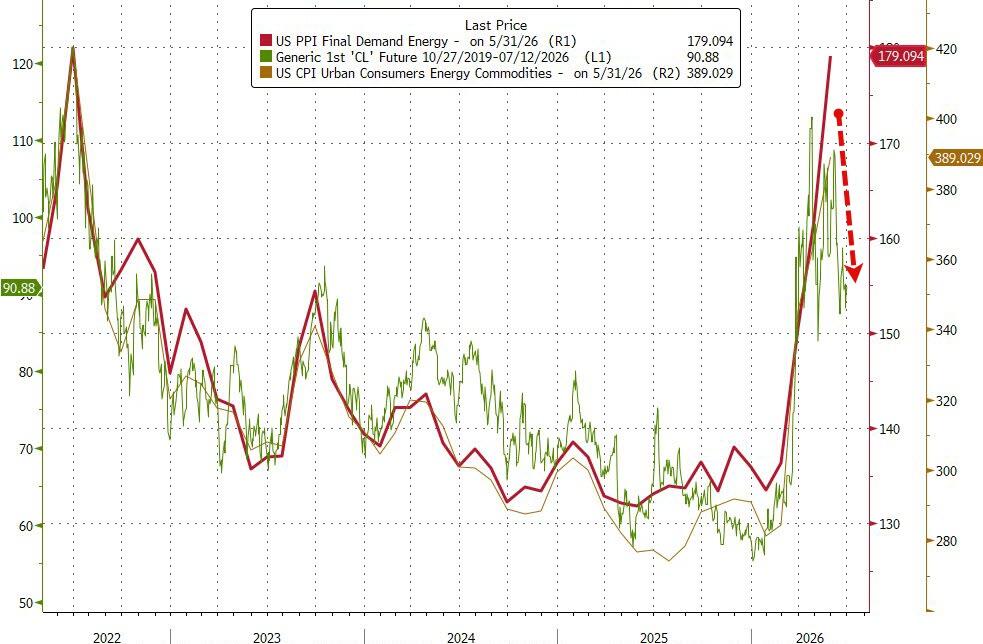
    But, arguably, the Energy component has peaked here...

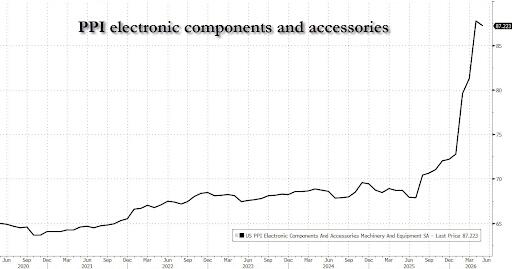
    And memory prices actually dipped according to PPI data...

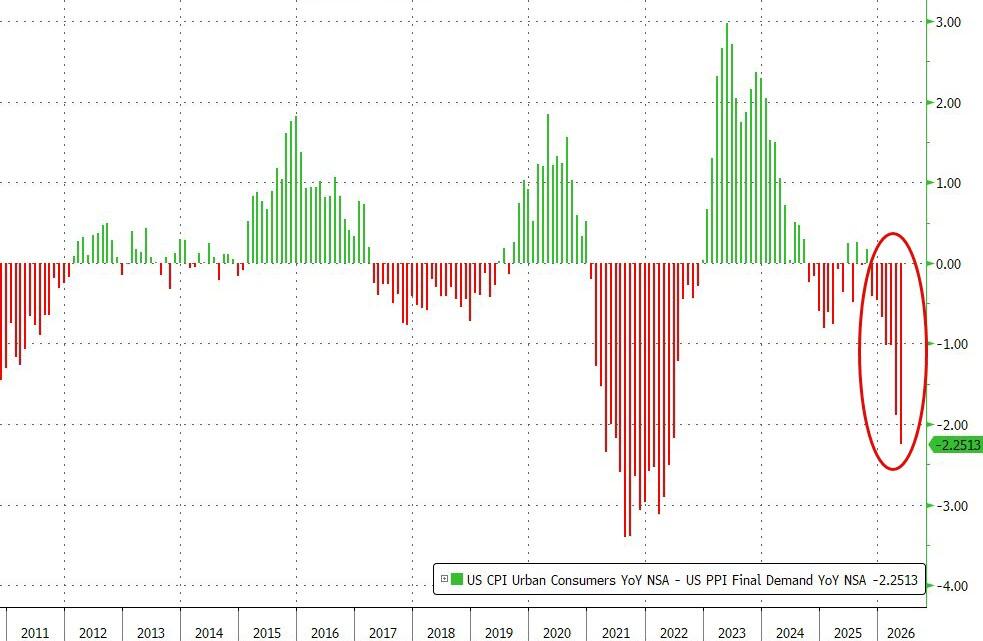
    The CPI-PPI spread is signaling increased pressure on corporate margins...

    Source: Bloomberg

    Rate-hike expectations ticked higher on the report (but are stable around one fuill hike in 2026 for now).

    Tyler Durden Thu, 06/11/2026 - 08:40

    ECB Hikes Rates For First Time Since 2023 (As Expected); Cuts Growth, Hikes Inflation Outlook

    ECB Hikes Rates For First Time Since 2023 (As Expected); Cuts Growth, Hikes Inflation Outlook

    As fully expected, The ECB hiked its key rate by 25bps (for the first time since 2023) as the policymakers battle with the dilemma of economic weakness combined with rising inflation.

    Obviously, raising rates to dampen inflation could further slow the economy, while easing rates to support growth increases the risk that higher inflation becomes persistent.

    Clearly, Lagarde et al went with the former with its well-jawboned baseline having long been a hike in June with risks skewed toward a follow-up move in September (although a move in July can’t be ruled out).

    “The Governing Council is committed to setting monetary policy to ensure that inflation stabilizes at its 2% target in the medium term.

    In line with this commitment, it today decided to raise the three key ECB interest rates by 25 basis points.

    The war in the Middle East is generating inflation pressures, and the decision to raise rates is robust across a range of scenarios mapping out how the shock might evolve and affect the medium-term outlook for the euro area.”

    On the ECB's growth/inflation dilemma, they wrote:

    “The outlook remains uncertain, with upside risks for inflation and downside risks for economic growth.

    The full implications of the war for medium-term inflation and growth will depend on the intensity and duration of the energy price shock, as well as the scale of its indirect and second-round effects.

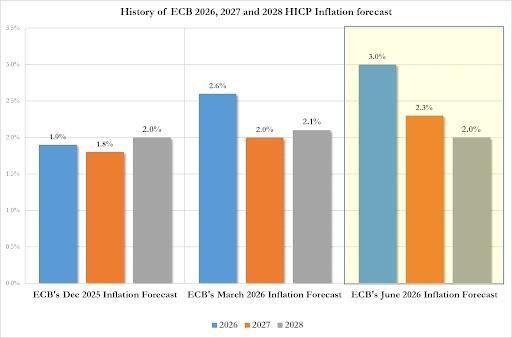
    The ECB’s new economic projections revise inflation upwards for 2026 and 2027 due to “a higher path for energy prices, which, to some extent, is expected to feed into food, goods and services inflation.”

    New (higher) inflation forecasts suggest more short-term pain with 2027 and 2028 seeing price pressures ease :

    • *ECB SEES 2026 INFLATION AT 3%; PRIOR FORECAST 2.6%
    • *ECB SEES 2027 INFLATION AT 2.3%; PRIOR FORECAST 2%
    • *ECB SEES 2028 INFLATION AT 2%; PRIOR FORECAST 2.1%

    Growth is seen slowing in the same period due to the impact of the war on commodity prices, real incomes and consumer confidence.

    New (lower) GDP forecasts follow a similar path with short-term weakness rotating into modest improvement in 2027 and 2028 (but not exactly thrilling growth still):

    • *ECB SEES 2026 GDP GROWTH AT 0.8%; PRIOR FORECAST 0.9%
    • *ECB SEES 2027 GDP GROWTH AT 1.2%; PRIOR FORECAST 1.3%
    • *ECB SEES 2028 GDP GROWTH AT 1.5%; PRIOR FORECAST 1.4%

    As Bloomberg's Alessandro Migliaccio notes, the new economic projections paint a grim picture.

    The higher inflation will strengthen the ECB’s conviction that a rate increase was needed to keep to its mandate of price stability.

    The slower growth however, may see some countries grumbling against too much tightening.

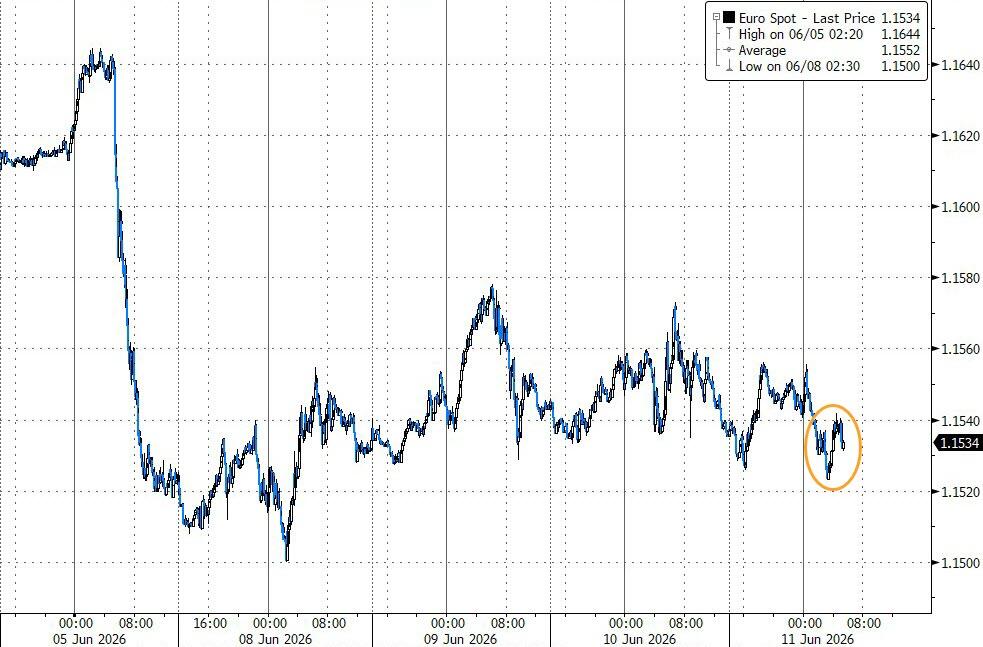
    EUR was flat ahead of the ECB decision and the initial market reaction is muted.

    The rate hike was fully priced in, and traders had already anticipated upward revisions to inflation forecasts for 2026 and 2027.

    As expected, and just like in March, the ECB has also produced new scenarios to account for the uncertainty it continues to face. These will be published together with the new projections after the press conference.

    Watch the ECB press conference live here (due to start at 0845ET):

    Tyler Durden Thu, 06/11/2026 - 08:25

    Pages